Dark matter detection refers to experimental efforts to observe particles or phenomena that constitute dark matter, the invisible mass that makes up about 85% of the universe's matter. Since dark matter does not interact electromagnetically, detectors must look for rare scattering events with ordinary matter, or for signals from exotic processes like axion conversion or black hole evaporation. Modern approaches include cryogenic crystal detectors, quantum sensors, and even networks of atomic clocks.
History
The first direct detection experiments began in the 1980s, with the UK's DAMA and the US's CDMS among the pioneers. No definitive detection has been confirmed as of 2025.
How it works
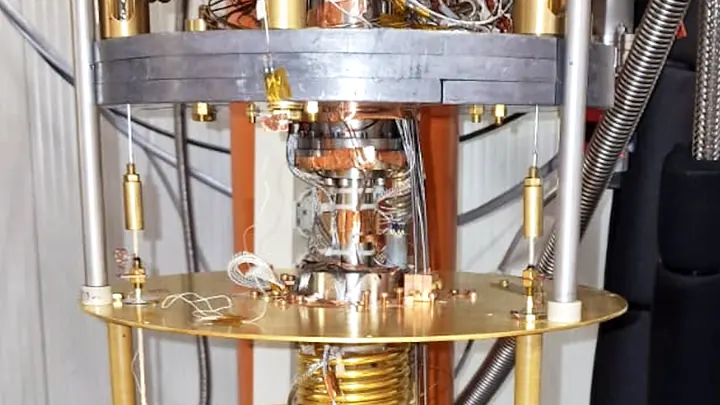
Most detectors rely on measuring the tiny energy deposition when a dark matter particle (like a WIMP) scatters off a nucleus or electron. This requires extremely low backgrounds, achieved by deep underground labs and ultra-clean materials. Alternative methods: axion detectors use strong magnetic fields to convert axions into photons; quantum sensors (e.g., superconducting qubits) can detect single phonons or photons from dark matter interactions; and some proposals use the timing of pulsars or gravitational wave detectors to sense the gravitational effects of dark matter.
In practice
Primarily used in fundamental physics research, but the technology developed (ultra-low-noise sensors, cryogenics) has spin-offs in quantum computing and precision metrology.
Fun fact
Some dark matter detectors are so sensitive that they must be shielded from cosmic rays, and even the decay of trace radioactive isotopes in the detector material itself can mimic a dark matter signal.
No one has ever seen dark matter, but it should pass through detectors like wind through leaves. Sometimes, very rarely, a dark matter particle bumps into an atomic nucleus, and then the detector must catch that jolt. The trouble is that light dark matter particles can hardly move heavy nuclei: it's like trying to knock down a bowling pin by throwing a feather at it.
A hunter sets snares in the woods. They know the animal's habits but not whether it will ever show up. In much the same way, physicists set up detectors in hopes of catching particles of dark matter — the invisible substance thought to make up most of the Universe's mass.
A new study offers hunters an unusual tool: not a trap, but a measuring tape.
Buried in Antarctic ice, there's a detector the size of a cubic kilometer. It doesn't catch light but ghostly particles — neutrinos. Yet sometimes, a different beast might flash through: a pair of muons born together and flying apart in a wide fan. No known particle of ordinary matter can paint that pattern.
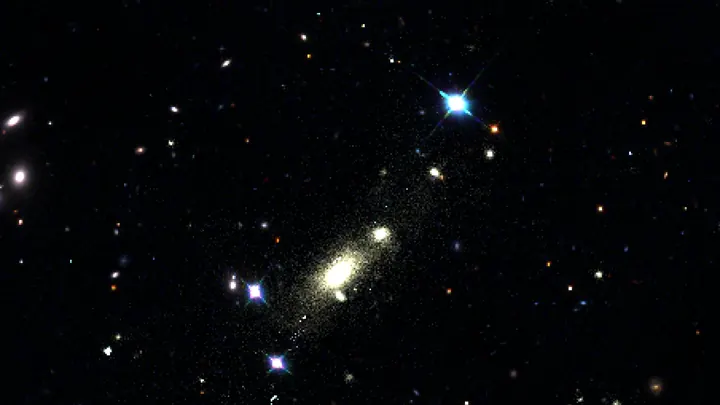
In the galaxy NGC 1052 DF2, stars move at only 8 kilometers per second, as if there were no invisible mass around. For comparison: in our Milky Way, outlying stars accelerate to 200 kilometers per second, held by a massive dark matter halo.
The universe sounds with silence. The lion's share of matter — about 85%—remains invisible, manifesting only through gravity. Back when Vera Rubin Vera Rubin showed that galaxies spin as if wrapped in unseen mass.
Dark matter leaves no trace in ordinary detectors: it passes through them like wind through gauze. To spot it, you need instruments that can feel a mosquito's punch in a storm. Quantum sensors with a threshold of a fraction of an electronvolt (a thousand times less than the energy of visible light) are just that.
In the pitch darkness of a vacuum chamber, a tiny magnet floats. It touches no walls and loses almost no energy — an ideal sentinel, ready to catch the faintest nudge. Such a sentinel is exactly what you need for axion hunting. These particles are prime suspects in the case of the Universe's hidden mass, which we call dark matter.
The universe is like a vast warehouse where a strict inventory was taken long ago. The cosmic microwave background is an ancient record of everything in stock 380,000 years after the big bang. According to it, the fraction of matter in the cosmic 'budget' (the parameter Omega_m) is known with high precision.
An ocean permeates all of space, yet remains invisible to us. This ocean is dark matter, and the waves on its surface are particles called axions. They are so light and elusive that they pass through Earth without noticing it. But if these waves crash against a shore made of a special material, they might leave a trace — a tiny electric current.
Every second, about a hundred invisible particles, muons, pass through your body. They are born high in the sky when cosmic rays collide with air atoms, raining down on Earth. These particles are so penetrating that they can pass through a multi-story building, but they slightly change direction when they encounter dense material, such as lead or uranium.
An old photograph taken at the moment of the universe's birth has been carrying its light to us for nearly 14 billion years. This snapshot is the cosmic microwave background, the cooled echo of the Big Bang. It captures the tiny inhomogeneities from which galaxies later grew.
The story began almost a century ago, when Edwin Hubble showed that galaxies are receding, and Fritz Zwicky and Vera Rubin later realized: to explain their motions, invisible mass is needed — dark matter.
In the very beginning, moments after the Big Bang, the universe was ridiculously symmetric: particles and antiparticles in equal measure. But a tiny imbalance occurred, like one extra grain of sugar in a kilogram, and the entire familiar world, stars, planets, people, arose from that surplus. How nature created this imbalance remains a mystery.
Dark matter has eluded direct observation so far, even though its gravity holds galaxies together. One hypothesis: it’s made of axions — ultra-light particles predicted by theory.
A flat crystal of charged atoms suspended in an electromagnetic trap behaves like a perfectly calm pond. The slightest breeze, and ripples spread across its surface. This 'pond' catches the splashes from dark matter particles and the ripples of spacetime — high-frequency gravitational waves.
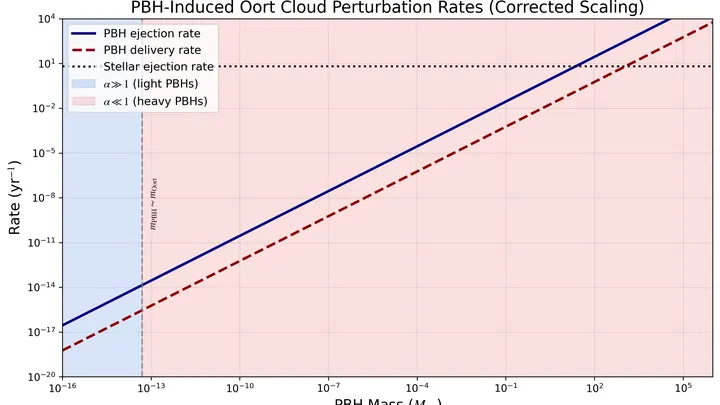
The Oort Cloud is a spherical swarm of trillions of icy bodies at the very edge of the Solar System, about a light-year from the Sun. These objects are almost motionless relative to one another until some gravitational disturbance breaks their calm.
Conventional dark matter detectors are like a soccer goalkeeper waiting for a powerful shot while the ball barely rolls. The invisible particles filling our galaxy often move too slowly to be noticed by sensitive sensors.
At the edge of the solar system, far beyond Neptune's orbit, something is knocking icy chunks off their paths. Their orbits are stretched and tilted in the same way, as if an invisible hand arranged them in a pattern.
Dark matter is an invisible mass holding galaxies together. Its nature remains unknown, but one likely candidate is the axion — an ultra-light particle that barely interacts with matter. To catch it, physicists built a hybrid trap.
At the Large Hadron Collider, protons collide at nearly the speed of light. Sometimes they don't smash apart but exchange photons — particles of light. These photons can produce a pair: one particle the detector sees, and another that flies off unnoticed.
Images of distant galaxies are riddled with curved arcs and smears — light warped on its way to us. This effect, predicted by Albert Einstein, acts like a giant funhouse mirror: a massive galaxy cluster distorts the images of background sources.
A bullet that doesn't just pierce one target but leaves marks in several layers of armor. That's roughly how superheavy dark matter behaves, and it's what the DarkSide-50 detector was built to catch for the first time. The usual suspects for dark matter (weakly interacting massive particles, or WIMPs) pass through matter almost unnoticed, occasionally bumping into a nucleus.
Ancient lead that lay on the seafloor for two thousand years has become the heart of a detector searching for the most elusive substance in the universe. From it, researchers grew a transparent lead tungstate crystal weighing 13 grams and cooled it to near absolute zero.
Since Vera Rubin first convincingly showed that galaxies are surrounded by invisible matter, the quest to understand the nature of dark matter has remained one of physics' greatest challenges.
Dark matter is the invisible glue that keeps galaxies from falling apart. Back in the 1930s, Fritz Zwicky suspected its existence, and in the 1970s Vera Rubin proved that without it, stars would fly apart.
The LCLS-II X-ray laser in California fires short, powerful flashes, like a strobe light at a disco. Between flashes, there are dark pauses lasting 26.9 nanoseconds (billionths of a second).
The merger of two neutron stars is like a strike on a gong: a ripple in space, a gravitational wave, spreads through the universe. Detectors on Earth catch this ripple and, from its strength, calculate the distance to the source.
Dark matter is an invisible substance, five times more abundant in the universe than ordinary matter. Its particles barely touch atoms, but occasionally they can nudge an electron, like a string brushed by the wind.
The enigma of dark matter was already studied by Fritz Zwicky and Vera Rubin. For decades, it was depicted as a cold, listless skeleton that only draws galaxies together.
Inside a giant spectrometer in Karlsruhe, shaped like a huge metal barrel, scientists are catching particles that are nearly impossible to catch. Neutrinos are the ghosts of the microcosm: every second, trillions of these particles fly through your body, and you don't even notice. But they do have mass, and scientists want to measure it.
In the 1930s, Fritz Zwicky, observing the Coma cluster, noticed anomalously high galaxy velocities: their motion pointed to a huge hidden mass gravitationally binding the system.
Deep inside a cryostat, beneath layers of superconducting coils, lies a stack of hundreds of semiconductor layers. Each layer is just a few nanometers thick: gallium arsenide, then aluminum gallium arsenide. The electrons within these layers are confined to a plane, like ants on a sheet of paper.
A silicon sphere 166 nanometers in diameter floats in a beam of infrared laser light. The pressure is below 10⁻⁸ mbar, and the motional temperature is about 10 millikelvin. That is colder than the cosmic microwave background.