Decay rate describes how quickly the amplitude of a wave or oscillation diminishes over time. In physics, this concept applies to everything from a swinging pendulum losing energy to friction, to the exponential decay of radioactive particles, to the damping of electromagnetic waves in a medium. It quantifies how a system returns to equilibrium after being disturbed.
History
The mathematical formalism of exponential decay was established in the 17th century, but its application to wavedamping and particle physics developed through the 19th and 20th centuries, notably with Rutherford's work on radioactivity.
How it works
The decay rate is typically expressed as a constant that appears in an exponential function, such as A(t) = A₀ e^(-λt), where λ is the decay rate. A higher λ means faster decay. The mechanism behind it varies: for mechanical oscillations, it's often friction or air resistance; for particles, it's quantum mechanical processes like spontaneous emission or nuclear instability.
In practice
Decay rates are used in medical imaging (e.g., PET scans), in dating archaeological artifacts via carbon-14, and in designing shock absorbers and damping systems for buildings and vehicles.
Fun fact
The decay rate of a pendulum in a vacuum is so small that it can swing for hours, but in air, it loses energy much faster due to air resistance.
Units by system: SI: per second · CGS: per second · Planck: per planck time · natural: per second
A stone falls into a pond. Ripples spread, weaken, and soon vanish. But if the pond were infinite and the water perfect, the disturbance would last forever, gradually fading. In physics, such decaying remnants are called "tails"—they live long after the main wave has passed.
A pendulum weighing a few grains of sand swings on a hair-thin glass fiber. Its motions are so faint that the thermal jostling of air molecules seems like a hurricane. Yet such a pendulum is the key to witnessing quantum wonders in the world of large objects.
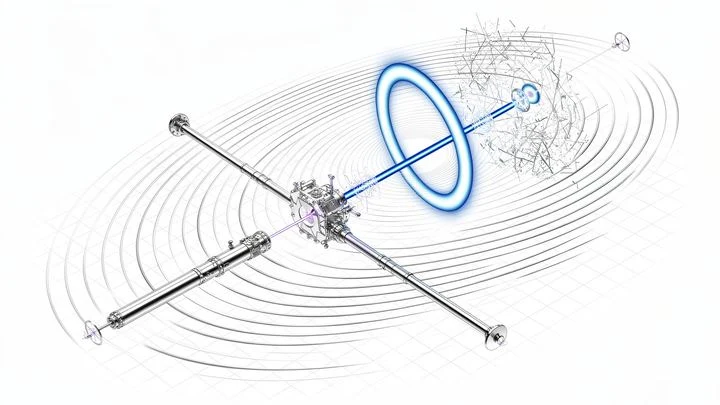
Immediately after the Big Bang, in the seething cauldron of the cooling Universe, much like in unevenly hardening glass, stresses appeared — hairline cracks in reality, cosmic strings. Picture a tightrope walker balancing on an invisible cable stretched across the abyss of warped spacetime.
Immediately after the Big Bang, space may have vibrated like a string from quantum effects. As these oscillations faded, they would have left a mark on the expansion of galaxies — a memory effect. The search for this echo in telescope data turned up nothing.
Atomic clocks are pendulums that tick at the frequency of light. Inside a trap, an aluminum ion hangs, and a laser probes it like a tuning fork. If the laser's frequency matches the atom's natural frequency, the atom responds. The clock's rate is checked against this response.
When a particle decays, it doesn't just vanish: it transforms into a whole set of other particles, and each transformation has its own script. Physicists from the BESIII collaboration have, for the first time, broken down the rare decay of the D0 meson step by step: it turns into two kaons and two pions.
The J/psi particle lives for an instant and then decays into lighter particles, much like a snapped string scattering into pieces. Physicists from the BESIII collaboration caught over ten billion such decays to figure out exactly what 'pieces' are produced.
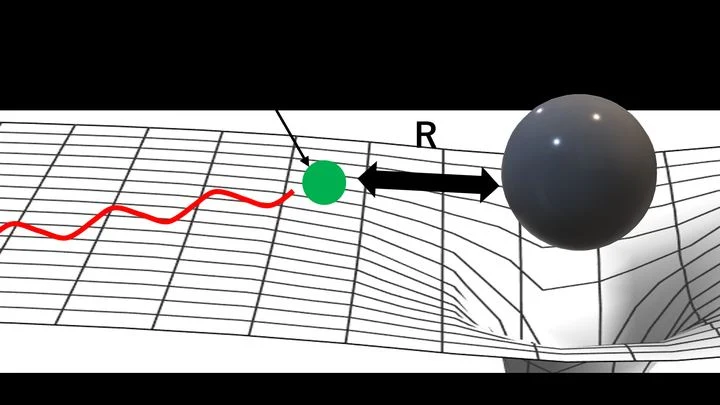
An atom excited by light gives its energy back in an instant — it emits a photon. This process is like a tired runner dropping a heavy load. But if the runner is on a mountain slope, it's harder to pick up speed. Gravity acts on the atom similarly: near a massive body, time flows slower, and the atom emits differently.
In the stream of charged particles that constantly blows from the Sun, radio bursts sometimes occur — short, powerful signals at frequencies you can pick up on an ordinary radio. Until now, it was unclear how exactly these signals are born in that stream.