A Protein Caught in a Beam of Light express
A protein in a cell is not a frozen sculpture but a restless mechanism. Its parts are constantly vibrating, and these movements determine how it grabs molecules, transmits signals, or builds the cellular scaffold. But filming the life of a single protein was hampered by two nuisances at once. First, the movements last millionths of a second — ordinary cameras simply cannot catch them. Second, the protein itself trembles in water due to thermal jolts, smearing the image.
Engineers from Switzerland and the Netherlands built a sensor that solves both problems at once. At the heart of the device is a silicon waveguide on an optical fiber, where light is confined in a channel thinner than the wavelength. Such a trap holds the molecule in the beam and simultaneously suppresses its Brownian wandering by a factor of 60. It is as if the ripples on the water suddenly froze, leaving the object beneath perfectly clear. The sensor records continuously for minutes, with each frame lasting less than a microsecond.
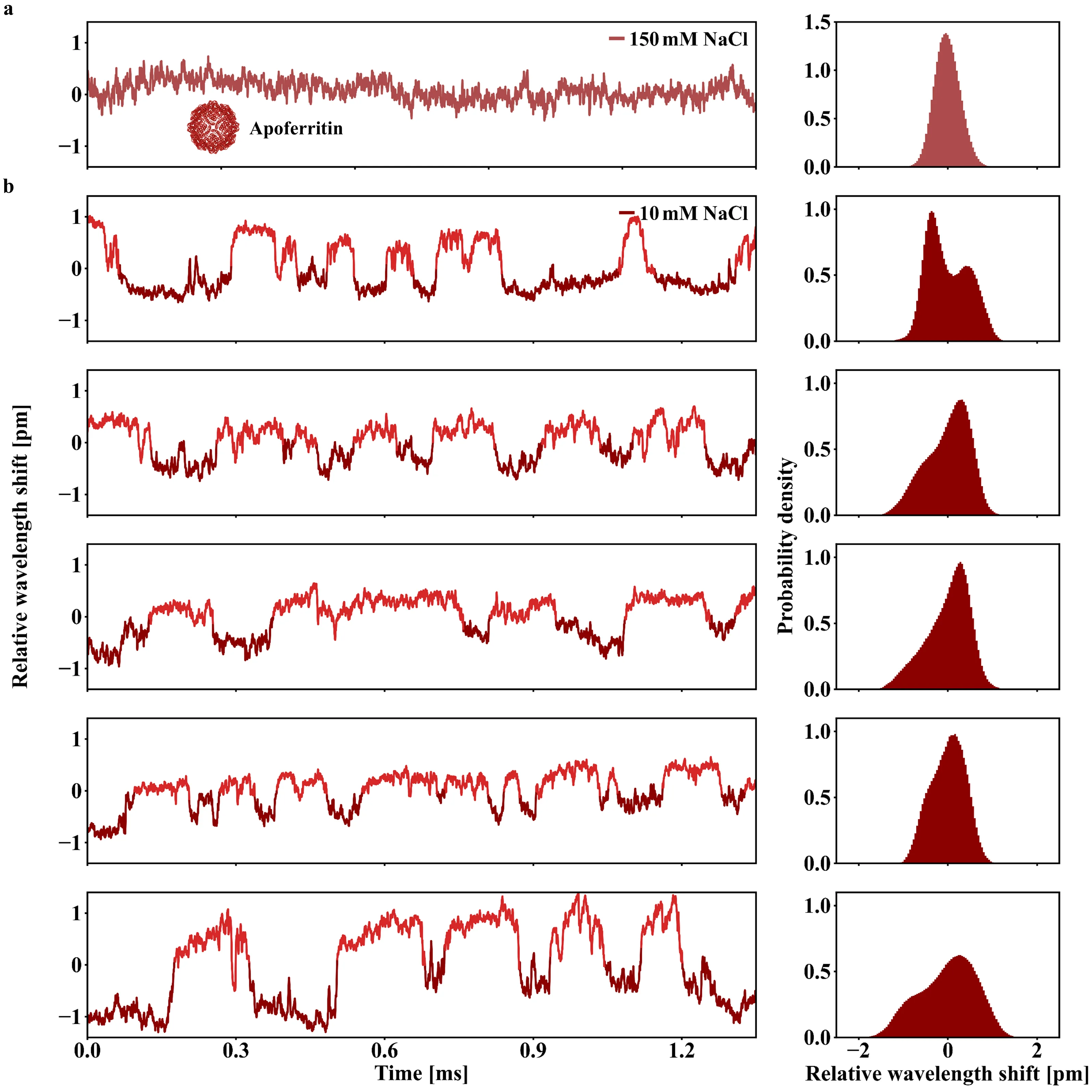
They tested the device on ferritin — a protein shell that stores iron inside cells. In the continuous recording, tens of thousands of transitions between shell shapes appeared, with the fastest jumps fitting into 400 nanoseconds. Previously, such details were lost in the averaged signal from many molecules. Now it is visible that some shells switch frequently, others freeze for a long time, and some remember their previous state. Long-term observation of a single molecule revealed memory and heterogeneity that are hidden in a crowd.
Thus, the sensor turns thermal ripples from an enemy into an ally: by suppressing them, the light beam becomes a window into the mechanics of the protein machine. And this window is now open for minutes, showing not an averaged portrait but a living movie of molecular gears.
Original abstract
as written by the authors arXiv:2607.15925
Microsecond conformational changes underlie many protein functions, but ensemble averaging has been needed to observe them without labels. Single-shot measurements on individual proteins have had insufficient speed, while protein Brownian-motion has obscured signals. Here, we report a fibre-integrated silicon-photonic sensor that overcomes these barriers, resolving protein dynamics at sub-microsecond speeds in continuous single-shot measurements that can extend over minutes. This is achieved by combining far-sub-wavelength optical field confinement with high optical field uniformity that suppresses protein Brownian-motion by a factor of sixty. In single-shot measurements on ferritin molecules, we observe tens of thousands of transitions consistent with conformational fluctuations of the ferritin shell, resolving them over timescales as short as 400 ns. The ability to continuously monitor transitions over long times reveals switching kinetics, memory effects and molecular heterogeneity hidden in ensemble averages. This opens a new path to improved mechanistic understanding of protein function.
Brownian motion was first noticed not in molecules but in pollen grains in water — botanist Robert Brown in 1827 observed particles dancing without any visible cause.
In the novel "Minority Report," criminals are caught by precognition — the new sensor also catches hints of a protein's future states through its memory.