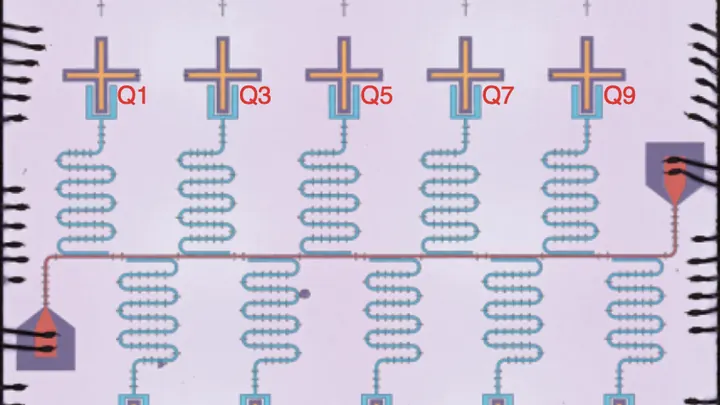
Quantum noise suppression refers to techniques that protect fragile quantum states, such as qubits, from decoherence caused by environmental interactions. In quantum computing, noise is the primary obstacle to building large-scale, fault-tolerant machines. Suppression methods range from passive approaches like isolating qubits in low-temperature, shielded environments, to active error correction codes that detect and fix errors. Interestingly, some recent research shows that under certain conditions, noise can even be harnessed as a catalyst to enhance quantum operations, challenging the assumption that noise is always harmful.
History
The problem of decoherence was identified in the 1980s, and the first quantum error correction codes were proposed by Peter Shor and Andrew Steane in 1995. Dynamical decoupling was introduced in the late 1990s. The idea of noise-assisted suppression is a recent development from the 2020s.
How it works
The main idea is to either reduce the coupling between the qubit and its environment, or to correct errors faster than they accumulate. Passive suppression uses materials and geometries that minimize noise sources, such as magnetic shielding or phonon engineering. Active suppression includes dynamical decoupling (applying rapid pulses to average out noise) and quantum error correction (encoding one logical qubit into many physical qubits with redundancy). A novel approach uses stochastic fluctuations themselves to suppress unwanted quantum tunneling, effectively using noise to cancel noise.
Quantum bits (qubits) are like delicate music in a noisy factory. Ambient magnetic fields constantly 'drown out' their quantum state, turning a coherent signal into cacophony. Usually, this destructive process is slowed by retuning the qubits themselves to different frequencies, but that doesn't always work.
A radio picks up a broadcast through crackle and hiss. That's roughly how modern quantum computers work: the useful signal drowns in noise. The longer the computation runs, the more the interference distorts the result.
Two musicians play a duet. In a perfect hall, they hear each other perfectly and gradually fall into resonance. But try playing in a room where someone keeps slamming the door. You'd think the rhythm would be thrown off. But no: sometimes that very random slam makes both of them sync up instantly.
Four musicians play in harmony only if they hold hands. In the quantum world, such a chain is formed by four electrons in four neighboring quantum dots — tiny traps for charge. This is the basis of the SAGE qubit (from "singlet-based always-on exchange").
Qubits in a superconducting quantum computer are like tightly stretched strings. When a particle from space or from a radioactive decay flies by, it strikes these strings and they start to vibrate. This vibration disrupts the fragile quantum states, and computations go awry.
Quantum computers promise to describe molecules with perfect accuracy, but their main nemesis is noise. Every extra qubit and every extra operation add errors. Chemists and physicists have now devised a way to compute molecules with half the qubits: the HSQD method.
The calm вода of a lake: the slightest ripple blurs the depth. In quantum sensors, noise — random jitters — generates энтропию (disorder) and kills precision. Physicists found a solution: scramble the order of events.
The void is deceptive. William Unruh showed that an accelerating observer perceives the vacuum as hot. The effect resembles the particle birth near black holes, predicted by Stephen Hawking, but instead of spacetime curvature, acceleration is at work.