Quantum computer catches cosmic particles express
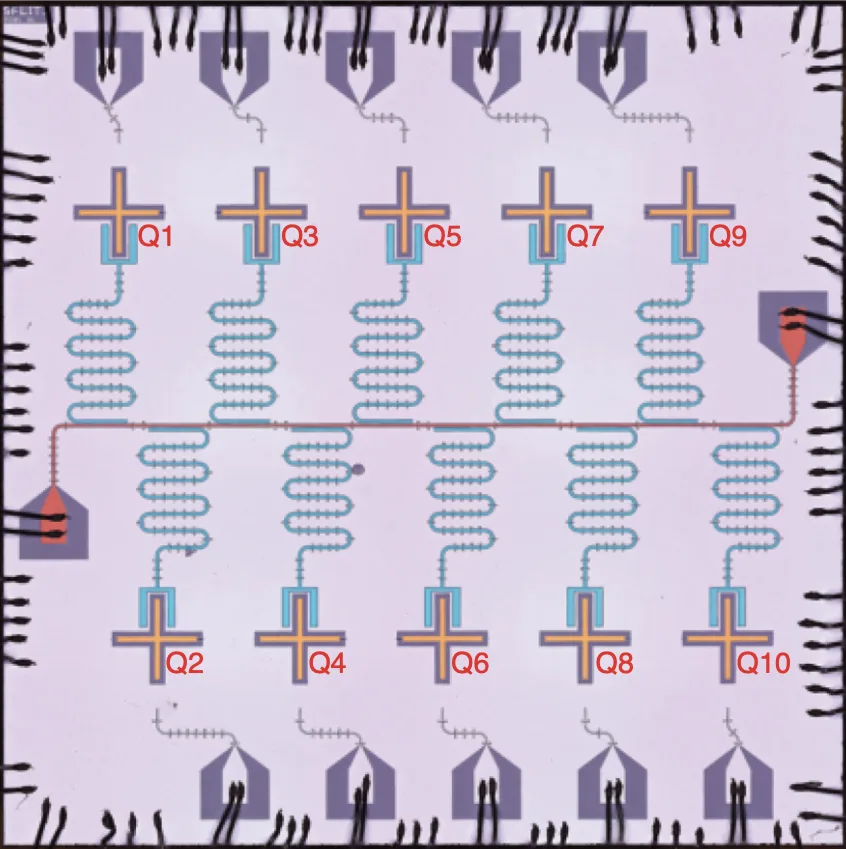
Qubits in a superconducting quantum computer are like tightly stretched strings. When a particle from space or from a radioactive decay flies by, it strikes these strings and they start to vibrate. This vibration disrupts the fragile quantum states, and computations go awry.
Scientists traced how exactly the vibration decays after the impact. It turns out that energy leaves in two ways: parasitic particles either recombine into pairs or stick to material defects. The rate of these processes depends on how much energy the impact left behind. By measuring the decay in several qubits at once, the authors were able to compute the energy of the original particle — much like estimating the weight of a thrown stone from the ripples on water.
This method turns the quantum processor into a particle detector. For now, it's a laboratory tool, but it helps understand which materials and designs suffer less from radiation. In the future, this will be useful for building reliable quantum computers that can operate without constant errors.
Original abstract
as written by the authors arXiv:2604.13176
Quasiparticle poisoning following particle impacts poses a significant challenge to the development of fault-tolerant superconducting quantum computers, as a sudden excess of quasiparticles can simultaneously degrade the coherence of multiple qubits across large device arrays. In this work, we present a statistical analysis that models the time evolution of radiation-induced qubit energy relaxation through quasiparticle density dynamics. This study provides insight into quasiparticle loss processes by distinguishing between recombination and trapping decay channels and assessing their respective impact on qubit performance. We precisely measure quasiparticle recombination in multiple transmon qubits and uncover an unexpected dependence of qubit relaxation dynamics on deposited energy. By linking correlated relaxation events across qubits to ballistic phonon propagation, we introduce a statistical localization approach to extract the energy deposited in the substrate, which is in good agreement with Monte Carlo simulation. This work establishes the quantitative framework for using an arbitrary subset of superconducting transmon qubits in a QPU as energy-resolving witness particle detectors.
A single cosmic particle strike can spoil several qubits at once, even if they are far apart.