math.DG math.DG

9 articles

articles

General Relativity2026-04-242 minarXiv:2604.22424express
The Hidden Geometry of Spinning Black Holes
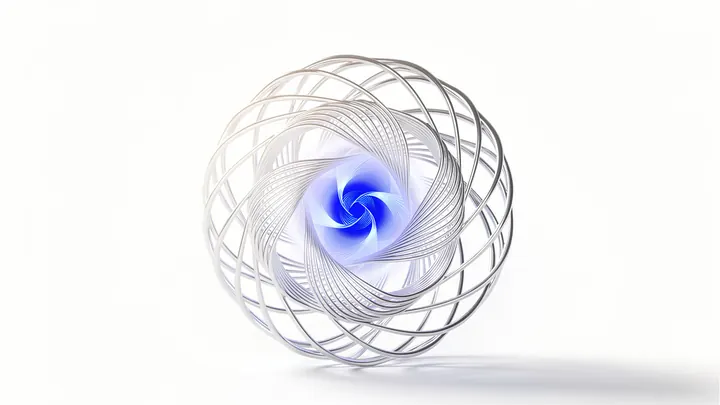
A black hole is like a giant whirlpool in a river — space and time swirl around it and get pulled inward. Mathematically, this whirlpool is described by the Kerr solution, but it has remained a mystery why perturbations on such a background split into independent parts.
General Relativity2026-06-051 minarXiv:2606.07781express
How to Weigh a Black Hole from the Inside
A black hole is like a bottomless well. You can measure how much water has flowed into it by watching the level from outside. But how do you find the mass of the water itself if you're standing inside the well? That's roughly the problem the authors of a new paper tackle.
HEP Theory2026-06-152 minarXiv:2606.16857express
How 11 dimensions become 10
A long pipe with a wave rolling along it. From far away, the pipe looks like just a line — one dimension has vanished. That's roughly how physicists get from an 11-dimensional theory of gravity (which describes everything: particles and forces alike) down to 10 dimensions. They take one dimension and close it into a tiny ring, invisible at large scales.
math.DG2026-07-013 minarXiv:2607.00949
The Veronese Fingerprint
A geometer runs a finger along an invisible surface, and by how the geodesics bend, lifts its fingerprint. That fingerprint can be the maximum normal curvature κ(F): the largest curvature among all geodesics passing through a point of the immersed manifold.
cs.CG2026-07-014 minarXiv:2607.01046
Monodromy in Vineyards: Blame It on One Singularity
Two passengers step into an empty car on a ring subway line and take their seats. After one full loop, they are surprised to find themselves in each other’s seats — even though nobody moved. That’s pretty much how monodromy plays out in vineyards — families of persistence diagrams, a method rooted in the work of Henri Poincaré.
HEP Theory2026-07-072 minarXiv:2607.06236express
How to Catch a Ball from the Awkward Side
In cricket, there's a special delivery — the googly. The ball spins in a way that deceives the batsman. Physics had its own googly: for nearly half a century, mathematicians couldn't make twistor theory work with real gravity. It described 'nice' fields perfectly, where everything twists in one direction. But as soon as an 'awkward' component appeared, the machinery broke down.
General Relativity2026-07-252 minarXiv:2607.23282express
How a Black Hole Turns into a Wormhole
A black hole is not an eternal vacuum cleaner. Surround it with a non-ideal fluid (matter with internal friction), and the geometry starts to lead a life of its own. The authors of the paper showed that a special geometric flow, the almost η-Ricci–Yamabe soliton, acts like an invisible sculptor.
math.DG2026-08-052 minarXiv:2608.04718express
How to Complete the Edge of Spacetime
The universe isn't just a place; it's a schedule of events: what happened earlier and what happened later. In Einstein's geometry of spacetime, this schedule sometimes breaks off. For instance, inside a black hole, particle paths run into a singularity — an edge beyond which the equations stop.
q-bio.BM2026-08-182 minarXiv:2608.17759express
A Protein Thread Woven from Noise
Under an electron microscope, a protein looks like a series of blurry shadows — hundreds of thousands of images of the same molecule, but from different angles and with heavy noise. Previously, from these shadows, one first assembled a volumetric 'haze'—a map of how electric charge is distributed inside the protein.