Einstein's equations are instructions on how mass and energy curve spacetime, like a heavy ball on a stretched rubber sheet. Planets and light follow the curves of this 'fabric'.
History
Albert Einstein developed general relativity from 1907 to 1915, attempting to reconcile special relativity with Newtonian gravity. In the crucial stage, he collaborated with mathematician Marcel Grossmann. In the autumn of 1915, Einstein presented the final form of the equations at the Prussian Academy of Sciences. David Hilbert almost simultaneously derived them from a variational principle. The first exact solution was found by Karl Schwarzschild in 1916. Later, Georges Lemaître used the equations for a cosmological model of an expanding universe, and in 1998, the discovery of accelerated expansion confirmed the importance of the cosmological constant Λ.
How it works
It applies in all cases where gravity is strong or high precision is required: calculating orbits in strong fields (perihelion of Mercury), black hole dynamics, gravitational lensing, evolution of the universe (cosmology), prediction of gravitational waves (detected by LIGO in 2015). The equations apply from the scale of astrophysical objects to the entire universe. In the classical limit of weak fields, it reduces to Newton's law of universal gravitation. Limitations: they do not account for quantum effects, which requires a theory of quantum gravity.
Fun fact
If the Sun were to suddenly disappear, the Earth would 'feel' it not instantly, but only after 8 minutes — that's how long it takes for the gravitational disturbance to reach us at the speed of light.
As planets orbit the Sun, they don't just follow their paths: they give each other a slight tug. It's like a dance where each partner feels the movements of the others. Scientists set out to determine how strongly this mutual attraction alters the planets' trajectories.
It turns out there are small corrections that were previously overlooked.
A light ray passing by a massive body slightly changes its direction, like a stream of water bending around a rock in a creek. In the solar system, there are many such "rocks": planets, their moons, asteroids. And each one, with its own gravity, bends the path of light coming from distant stars.
Stare long enough into the night sky, and sooner or later your gaze hits a blackness beyond which nothing is visible. This is not just a distant fence: it is the edge of the universe accessible to us, the cosmic horizon. Light from more distant stars simply hasn't had time to reach us.
A spotlight beam fades into the darkness, but if you trace it backward, you hit the lamp. The history of the universe might be the same: tracing its expansion backward, we run into a beginning.
Physicists took the simplest model — a universe that stretches equally in all directions, like a cube with all sides growing.
A black hole is not just a dark spot in space. It has a temperature, and it radiates. It has entropy — a measure of hidden information encoded on its horizon's surface, like a pattern on a soap bubble.
Space is expanding, and that expansion is accelerating. But what if, in the first instants after the Big Bang, gravity behaved differently? The authors of a new study added an invisible field to Einstein's equations that siphons energy from ordinary matter and radiation.
Quantum field theory is the language physicists use to describe elementary particles and their interactions. The authors of the work decided to slightly "tweak" this language: they introduced deformations, that is, small changes to the rules of the game.
Quantum field theory is the language physicists use to describe elementary particles and their interactions. The authors of the work decided to slightly "tweak" this language: they introduced deformations, that is, small changes to the rules of the game.
Newton gave us a world where bodies move in a void and clocks tick the same for everyone. For three centuries, this picture worked flawlessly. But it relies on many invisible props: absolute position, the 'up-down' direction, and a single rhythm of time for the entire universe. We have never measured these directly — only through the relations between objects.
An invisible scaffold holds galaxies together, keeping them from flying apart. This is dark matter — matter that doesn't shine and barely interacts with ordinary stuff. Astrophysicists have long debated what it's made of.
A scale that weighs not a body, but the very space around it. That's how Einstein's equations work in general relativity: they link the curvature of spacetime to what resides within it.
The quantum world is like a kitchen where particles suddenly appear out of "nothing." But you need a chef — a classical field acting as an external source. Glauber's theorem, long known in optics, has now been generalized: it shows exactly how the field "cooks up" particles, be they photons or gravitons.
A scale that weighs not a body, but the very space around it. That's how Einstein's equations work in general relativity: they link the curvature of spacetime to what resides within it.
A rotating black hole is no calm whirlpool. Space around it shudders and rings at the slightest disturbance, like a guitar string after a pluck. These oscillations are described by the Teukolsky equation — a complex mathematical construct that physicists have studied for half a century.
Recently, a strange symmetry was noticed in this equation.
Two stars circle each other, gradually drawing closer. Their dance loses energy, and that energy escapes into space — in the form of gravitational waves, and sometimes other fields.
In 2017, detectors picked up a gravitational wave from the collision of two neutron stars. Just 1.7 seconds later, telescopes saw a flash of gamma-ray burst from the same spot. That tiny delay became a treasure for physicists.
A pendulum in a noisy room is constantly jostled by people passing by. Its motion is a mix of regular swings and random jerks. Something similar happens with weak gravitational waves against the backdrop of an expanding universe. In Einstein's general relativity, these waves are tiny ripples in spacetime.
In the quiet of the quantum world, there is no emptiness. Particles are intertwined by invisible threads — entanglement. The authors of the work proposed that the very fabric of spacetime is woven from these threads. This is not just a metaphor: they built a mathematical framework where the distance between points is determined by how much shared information they hold.
At the very heart of the Milky Way, stars whirl around an invisible supermassive black hole. One of them, S301, completes an orbit in just 8.7 years. Its path is a highly squashed ellipse: sometimes it grazes the black hole, sometimes it shoots far away. At closest approach, the distance to the black hole is tiny by cosmic standards.
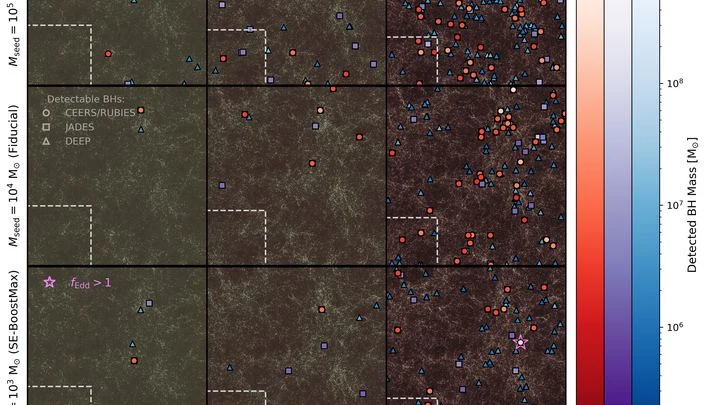
A marathon lasting 13 billion years started with different weights. A hundred solar masses — lighter than some gas clouds. A hundred thousand — gravitational dominance, comparable to an elephant among kittens. That's what black hole seeds looked like, ones that by our time should have turned into supermassive giants.
At the center of attention is a monopole, a special clump of a non-Abelian field (a field where the order of operations changes the result), resembling a magnetic charge without a pair. In this work, it is placed in curved spacetime described by Einstein's equations with a Gauss-Bonnet addition (a correction important at small distances).
An engineering blueprint of a skyscraper always includes a number: the maximum load on the foundation — say, 500 kilopascals. Einstein's field equations in curved spacetime impose a similar limit on the 'force load' inside stars, planets, and any other clumps of matter.
An engineering blueprint of a skyscraper always includes a number: the maximum load on the foundation — say, 500 kilopascals. Einstein's field equations in curved spacetime impose a similar limit on the 'force load' inside stars, planets, and any other clumps of matter.
Some 123 parsecs from Earth, in the constellation Corona Australis, drifts the neutron star RX J1856.5-3754. Its diameter is about 12 kilometers, smaller than Moscow's Ring Road, but its surface temperature reaches 460 000 kelvin. The star emits a slow, almost inaudible exhalation.
0.965—a number that split cosmologists into 'before' and 'after'. That's the value of the spectral index ns measured by the ACT telescope as it stared into the cosmic microwave background — the cooled light of the Big Bang.
Two balls dropped from different heights fall to the ground with different accelerations. In space, things are more complicated: even emptiness makes bodies move differently.
Spring scales in a shop show weight simply: the load presses on a spring, it compresses, and the needle moves along the scale. The relation between force and compression is direct, like Hooke's law. Now imagine a scale with a tricky platform: the force is transmitted through levers, and the reading depends not only on the weight but also on how the platform itself bends.
380 thousand years after the Big Bang, the universe cooled enough for light to decouple from plasma. That cosmic microwave background still pervades space, like the first chord of a symphony, the echo of a fiery beginning.
Cosmic ripples begin with tiny clumps. 380,000 years after the Big Bang, the universe was nearly homogeneous — density fluctuations were only one part in 100,000. But gravity turned these weak ripples into galaxies, clusters, and giant voids.
Gravity in our world is curved spacetime. That's how Einstein's general theory of relativity describes it. But what happens to gravity at the level of atoms and particles, where quantum mechanics rules? This question has remained unanswered for nearly a century.
A huge bowl of water. Drop a stone into it — ripples spread across the surface. The fabric of spacetime works much the same way: when two massive stars merge, they create ripples — gravitational waves. These waves travel to Earth and are picked up by giant detectors like LIGO and Virgo.
A pair of black holes circles in a dance, gradually drawing closer. They lose energy and spin — a process known as angular momentum radiation. In standard Einstein theory, only gravitational waves carry away angular momentum.
In the first moments after the Big Bang, cosmic symmetry breaking divided the hot plasma into regions with different vacuums — the lowest energy states of a field.
Two tiny weights, each about the mass of a grain of sand, hang in the dark at a temperature colder than deep space. They don't touch, but an invisible thread connects them — gravity. The experiment physicists are now building aims to catch the moment when that thread tugs one weight due to the motion of the other.
Gravity is the invisible glue that holds stars and planets together. But what if this glue has a tiny mass? In massive gravity, the carrier particles (called gravitons) weigh a minuscule but nonzero amount. This changes the rules near black holes.
The authors of the new study built on a mathematical tool — eigenvalue decomposition.
A taut trampoline sheet dips under a heavy ball. If the ball spins quickly, the sheet begins to twist around it. Spacetime near a rotating black hole behaves similarly: it is not just curved, but also dragged along by the rotation, like water swirling around a whirlpool.
For thirteen billion years, light battled through cosmic emptiness. It bent around massive galaxy clusters that, as Einstein predicted, acted as giant lenses — amplifying and distorting the distant glow. In 2023, the NIRSpec instrument on the James Webb Space Telescope captured this light and spread it into spectra.
Gravity isn't just the force that keeps us on the floor. On cosmic scales, it conducts galaxies, bends light rays, and decides the fate of everything. A century ago, Einstein described it as the curvature of space and time.
13.8 billion years ago, the universe swirled in a waltz. The right turn was forbidden. Today, the echoes of that cosmic ball reach us as a barely perceptible ripple in spacetime — gravitational waves. Their existence was predicted by Albert Einstein.
In 2019, the world saw the first image of a black hole's shadow — an orange doughnut on a black background, becoming a symbol of scientific progress. But this image wasn't captured by a camera: it was born from mathematical alchemy, where data from eight radio telescopes, which gathered only crumbs of signal, merged into a single picture.