Imagine a train traveling almost at the speed of light. A passenger on the train and a person on the platform measure the length of the same carriage and the time on the clocks — and get different results! The Lorentz transformations show how these measurements are related so that the speed of light remains the same for both observers. It is as if space and time compress and stretch, adjusting to the motion.
History
In 1892–1904, Hendrik Lorentz developed these equations, independently starting from the FitzGerald length contraction hypothesis, to explain the null result of the Michelson-Morley experiment. In 1905, Henri Poincaré was the first to give the complete mathematical form and showed that they form a group, naming them 'Lorentz transformations'. In the same year, Albert Einstein derived them from two postulates — the constancy of the speed of light and the equivalence of inertial frames.
How it works
They are used in all problems of special relativity to recalculate physical quantities between frames of reference. They allow for the correct description of electrodynamics of moving media, relativistic kinematics, time dilation and length contraction effects. Limits of applicability: only for inertial frames; in the presence of gravity, they are replaced by the more general transformations of general relativity.
Fun fact
GPS satellites move at high speed, and their clocks tick slightly slower than those on Earth. Without taking the Lorentz transformations into account, the navigator would accumulate an error of several kilometers every day!
In the heart of an old city stands a clock tower whose hands have never been adjusted since it was built. By how far it runs slow, you can calculate how much time has stretched since then. In space, the role of such towers is played by relic galaxies — dense stellar systems that formed in the first few billion years and have since neither merged with neighbors nor given birth to new stars.
The quantum world does not forgive forgetfulness. Throw a stone into a pond — the ripples spread and vanish, the information about the impact dissipates without a trace. In quantum mechanics, everything is different: the evolution of a system is reversible, and the past is never completely erased.
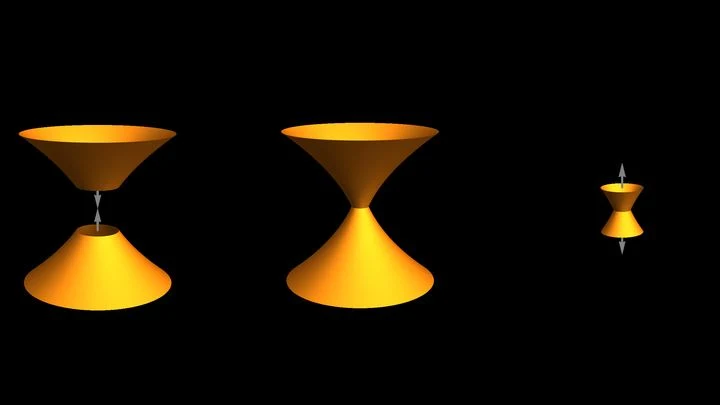
The universe isn't just a place; it's a schedule of events: what happened earlier and what happened later. In Einstein's geometry of spacetime, this schedule sometimes breaks off. For instance, inside a black hole, particle paths run into a singularity — an edge beyond which the equations stop.
In a pot of boiling water, steam bubbles appear and disappear — a similar struggle takes place in two-dimensional materials. Here, electrons both create magnetism and try to extinguish it.
At the very heart of the Milky Way, stars whirl around an invisible supermassive black hole. One of them, S301, completes an orbit in just 8.7 years. Its path is a highly squashed ellipse: sometimes it grazes the black hole, sometimes it shoots far away. At closest approach, the distance to the black hole is tiny by cosmic standards.
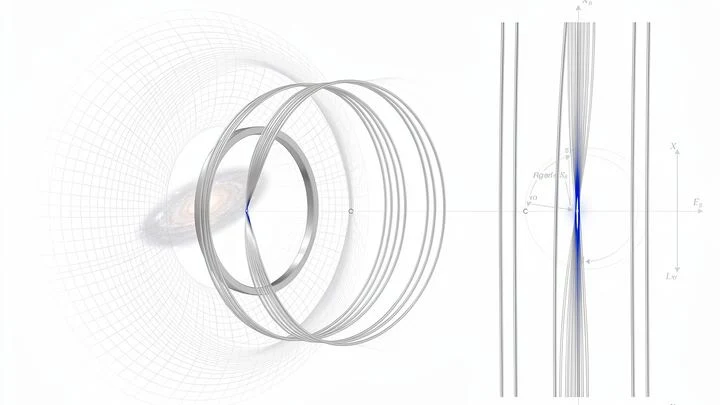
A light ray passing by a massive body gets deflected: this is the effect of gravitational lensing, familiar from images of distant galaxies. The astrophysicists started with a rotating black hole (Kerr spacetime) and added a tiny correction to how light itself propagates.
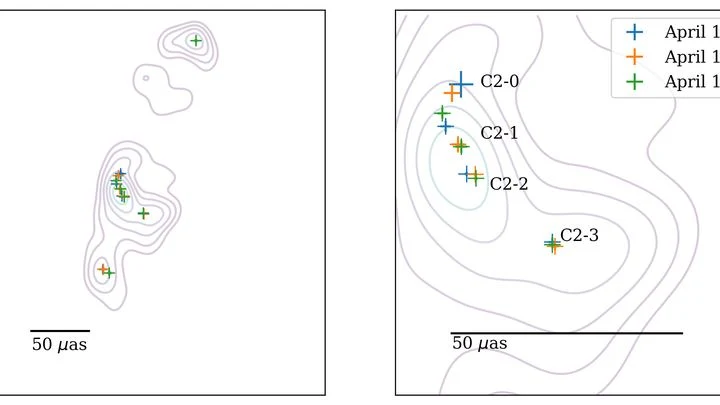
In April 2021, the antennas of the Event Horizon Telescope (EHT)—a global network of millimeter-wave radio telescopes — zeroed in on a tiny spot in the constellation Virgo.
In 2021, the LHAASO observatory registered gamma quanta with energies above a petaelectronvolt from sources like the Crab Nebula — a supernova remnant with a pulsating neutron star at its heart.
Two synchronized swimmers dive into the sea. One hits calm water, the other a whirlpool. Their movements, perfectly coordinated at the start, diverge. Something similar happens to two quantum particles when one moves in flat space and the other in curved space.
Almost a century after Фриц Цвикки suspected something was amiss in the motion of galaxies in the Coma cluster, and Вера Рубин measured stellar velocities in spiral arms, the nature of тёмной материи remains one of the most vexing mysteries.
A quantum spin chain is like a string of beads, where each bead is a microscopic magnet pointing up or down. In the XXZ model, these little magnets interact differently along the three axes, and at special parameter values, roots of unity, the system awakens with a hidden memory.
The Schwarzschild black hole is the simplest model in general relativity. But when you switch to teleparallel gravity (TEGR), where torsion replaces curvature, the horizon develops a problem. Some quantities built from torsion tend to infinity.
Usually, a wormhole is imagined as a tunnel in space, whose walls are held open by something unusual — matter with negative energy. Like the supports in a mine that keep the ceiling from collapsing. But in this work, the physicists did without supports.
Tea in a cup cools quietly on the table. But if you zoom past at near-light speed, the thermometer will read higher — even though no one heated the tea. Calculations confirm: the needle will creep up.
A century ago, physicists split into three camps.
Two pebbles drop into water, and the ripples on the surface intersect, blending their patterns. Neutrinos behave much the same way: light particles that pierce us by the billions every second. They can transform from one type to another, like an actor changing masks. Physicists call this dance oscillations.
A stone falls into a well, and the splash reaches your ears with a delay. Something similar happens to light as it leaves Earth: its oscillations become less frequent, the beam seems to 'tire.' This is gravitational redshift — a phenomenon Einstein spoke of a century ago.
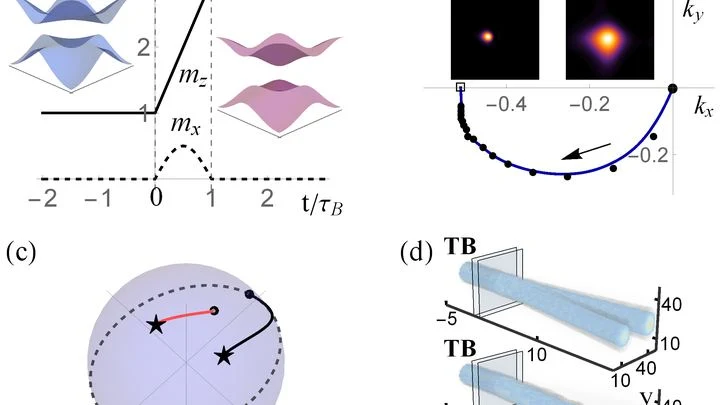
A stone falls into a pond, and ripples spread across the water. They reflect off the shore, overlap, and die out. All this motion unfolds in space. But what if the pond itself changed its depth or density for an instant — not at one point, but everywhere at once? A temporal boundary is exactly such a jump in properties over time, not space.
A palm hovering over a hot stove feels the heat even when the surrounding air seems cool. Something similar happens to electrons in the Aharonov–Bohm effect: the particle senses an electric voltage even though it enters a region where the field has already been switched off.
No one has ever seen dark matter, but every galaxy feels its pull. Usually, it's pictured as a sea of identical, silent particles. The new work paints a livelier picture: two kinds of particles, heavy and light, constantly exchanging between them.
Light travels across a room, bouncing off mirrors and walls. The emptiness in between seems perfectly neutral: it doesn't hinder the beam or curve its path. But what if, at the deepest foundations of the world, emptiness is more complex? Physicists have long suspected that the symmetry of space might break at tiny scales, and then light would behave differently.
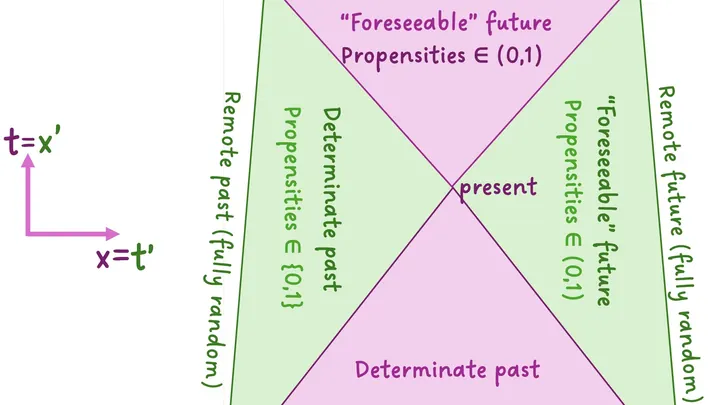
According to the laws of physics, nothing can outrun light, otherwise for some observers the effect would occur before the cause. Artur Ekert and Andrzej Dragan showed that this situation creates an uncertainty resembling quantum indeterminacy.
Imagine a city drawn on a sheet of paper. The streets are the same, the intersections are in place, but the distances between blocks have suddenly changed.