Ojos rojos: una lente cósmica muestra un par de agujeros negros exprés
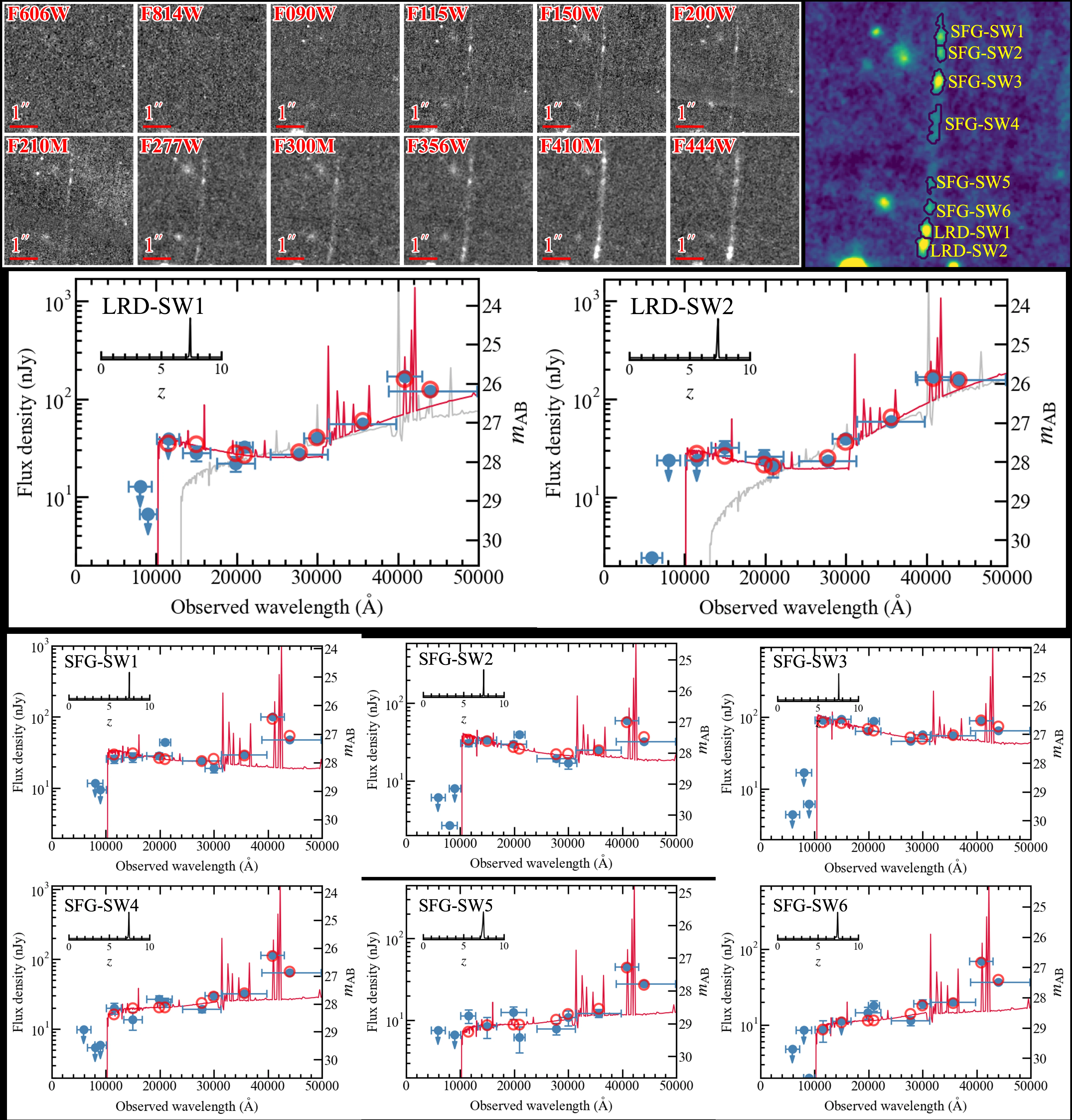
Gracias a la lente gravitacional —un efecto predicho por Fritz Zwicky, donde un cúmulo de galaxias actúa como una lupa—, el telescopio James Webb detectó dos puntos rojos en una galaxia de 800 millones de años después del Big Bang. Estos objetos, llamados Ojos Rojos, resultaron estar no en el centro, como se esperaría, sino en las mismísimas afueras — como un par de pupilas brillantes escrutando el vacío.
Cada ojo es un agujero negro de masa intermedia, rodeado de gas incandescente. Están separados por apenas 70 pársecs — en términos cósmicos, más cerca que la distancia de nosotros al centro de la Vía Láctea. El hallazgo trastoca la idea del crecimiento de los agujeros negros: quizás los monstruos supermasivos en los núcleos galácticos se formaron a partir de muchos de estos "pupilas" errantes, que se fusionaron y devoraron materia en las periferias. En otras palabras, cada gigante comenzó como un par de ojos rojos.
Resumen original
tal como lo escribieron los autores, en inglés arXiv:2601.06015v1
We report the identification of a pair of faint little red dots (LRDs), dubbed Red Eyes, in a strongly-lensed galaxy at $$z\sim7$$ behind the PLCKG004.5-10.5 cluster, identified from the JWST Treasury program VENUS. Red Eyes are spatially resolved on the image plane with distinct colors, while the critical curve lies far north of Red Eyes, clearly requiring two different LRDs rather than a single LRD. Red Eyes is an extremely close pair of LRDs separated by $$\sim70\,\mathrm{pc}$$ in the source plane with a magnification of $$\mu\sim20$$, which consistently explains another counter-image detected to the north-west. Red Eyes is hosted in a typical star-forming galaxy with $$M_{\mathrm{UV,int}}\sim -19$$, but its own UV emission is very faint ($$M_{\mathrm{UV,int}} \gtrsim -16$$). Moreover, Red Eyes does not reside at the galaxy center but lies at an offset position of approximately one effective radius $$R_{\mathrm{e}}$$ away from the galaxy center. If observed without lensing, Red Eyes would appear as a typical star-forming galaxy at $$z\sim 7$$ with $$M_{\mathrm{UV}}\sim -19$$, showing no apparent LRD signatures in either morphology or SED. These results suggest that multiple off-center LRDs, similar to Red Eyes, may be commonly hidden in a typical high-$$z$$ star-forming galaxy. In this case, various plausible scenarios may emerge, one of which is that intermediate-mass black holes (IMBHs) with $$M_\mathrm{BH}\sim10^{4\text{--}6}\,M_\odot$$ may form in star clusters on a stellar disk and contribute to the growth of the central supermassive black hole via mergers, with some IMBHs detectable as luminous LRDs in a sufficiently active and massive phase.
El par de Ojos Rojos está separado por 70 pársecs, casi 30 veces menos que la distancia de nosotros al centro de la Galaxia. Para agujeros negros, es una vecindad extremadamente estrecha.