Network Warns of El Niño a Year in Advance
Context
El Niño is a warm tongue of water in the eastern equatorial Pacific that occurs roughly once every four years. It affects weather worldwide, from droughts in Australia to floods in Peru. Alongside this work in the archive are studies that also try to peer into the future of the climate system: some use neural networks for early drought warning, others build gravitational maps of galaxies with machine learning. The common thread is the search for hidden patterns in large datasets. This article follows the same vein but focuses on a specific problem: extending the prediction horizon of El Niño beyond six months, where classical models and ensembles lose skill.
Methods
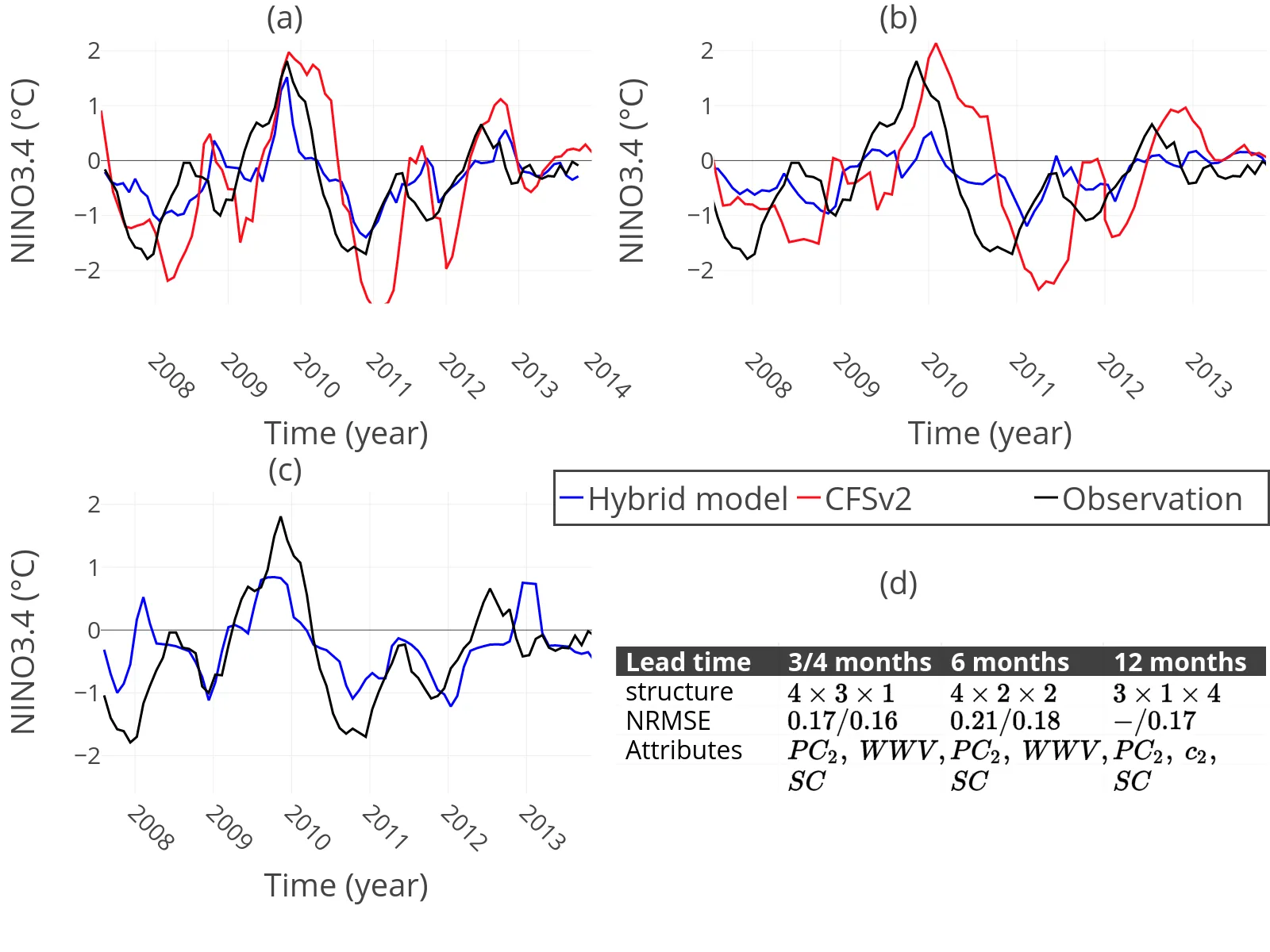
The hybrid model decomposes the time series of the NINO3.4 index (the average sea surface temperature anomaly in the central Pacific) into linear and nonlinear parts. The linear part is predicted by a classical ARIMA(12,1,0) or ARIMA(12,1,1) model, which captures inertia and seasonality. The residual, that is, the nonlinear deviations, is predicted by a feedforward neural network with one or two hidden layers. The network receives not only the index itself but also three additional attributes: the volume of warm water (WWV) in the equatorial band, the second principal component of residual wind stress (PC2), associated with westerly wind bursts, and a sinusoid with a one-year period to account for the seasonal cycle. For 12-month forecasts, WWV is replaced by the network metric c2, computed from correlations of sea level anomalies. The network is built at a correlation threshold of 0.9 with a sliding window of one year. Training is done on 80% of the time series, and testing on the remaining 20%. Additionally, cross-validation is performed with 200 random starting points for the test period.
Results
The hybrid model showed better skill than the average of the CFSv2 ensemble forecast at lead times of 3–6 months. For example, in January 2010, all members of the CFSv2 ensemble overestimated the NINO3.4 index, whereas the hybrid model gave a more accurate forecast. The normalized root mean square error (NRMSE) of the hybrid model was lower than that of CFSv2 for the 4-month forecast (0.016 versus 0.021 on average over the test period). At the 6-month lead time, the hybrid model still outperformed the ensemble, although it underestimated the 2010 El Niño. Most importantly, the 12-month forecast using the network metric c2 proved to be no worse, and sometimes better, than the 6-month forecast. The average NRMSE for the 12-month forecast was about 0.018, comparable to 0.017 for the 6-month forecast. This is the first time a statistical model has achieved such a horizon without losing skill. Cross-validation confirmed robustness: for different splits into training and test sets, the peaks of the NRMSE distributions coincided, although the spread increased with the forecast horizon.
Implications
The work shows that network metrics reflecting global correlations in the climate system can serve as early indicators of El Niño. Unlike neighboring studies that predict droughts or plasma instabilities, here physically motivated attributes are combined for the first time with climate network topology within a hybrid model. This is not just another neural network: the choice of attributes is based on the Zebiak–Cane model, which provides interpretability. The result challenges the notion of an insurmountable spring predictability barrier; perhaps the barrier is not due to chaos but to a lack of information in the variables used.
Future development
The method can be improved by replacing the linear ARIMA part with a dynamical model that accounts for ocean wave dynamics. It is also promising to use nonlinear measures of association, such as lagged mutual information or transfer entropy, for attribute selection. Extending the network beyond the Pacific, for example including the Indian Ocean, could provide even earlier signals. Finally, the loss function could be modified so that the model better predicts extreme events rather than just average error.
Impact
The results will affect operational El Niño forecasting at meteorological centers, allowing warnings of droughts and floods a year in advance. The method is also applicable to other climate modes, such as the Indian Ocean Dipole.
Next steps
Test the model on independent data after 2014 and on other indices, such as NINO1+2. Investigate which specific correlations in the network provide predictive power, to link c2 to concrete physical processes.
Key open problems
In climate science, the nature of the spring predictability barrier remains an open question: is it a consequence of chaotic dynamics or of insufficient observational data? This work shows that adding network variables that capture global correlations can weaken the barrier, but it does not explain its mechanism. It is also unclear how universal the network metric c2 is for different types of El Niño (eastern and central).
The network metric c2 is simply the fraction of nodes that form pairs. In the climate network, it increases when local correlations strengthen before El Niño and decreases afterward. In essence, the ocean starts 'whispering' in pairs before it screams.
Key numbers
- forecast horizon: 12 months
- NRMSE for 12-month forecast: 0.018
- NRMSE for 6-month forecast: 0.017
- correlation threshold for network: 0.9
- sliding window length: 1 year