Monsoon 18 Months Ahead: Where Predictability Hides
In 1884, British meteorologist Henry Blanford built the first model for forecasting the Indian monsoon. Nearly a century and a half later, seasonal forecast skill has barely improved. From 1989 to 2012, official forecasts by the India Meteorological Department showed negative correlation, meaning they were worse than random guessing. The monsoon, which brings rains from June to September, determines harvests for hundreds of millions of people, and a forecast error translates into malnutrition or floods.
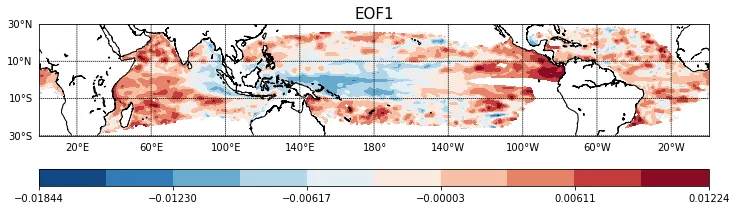
The authors of the new study abandoned the search for a single index, such as Pacific sea surface temperature. Instead, they took the global field of anomalies in the depth of the 20-degree isotherm across the tropical belt from 30°S to 30°N. This water layer lies below surface agitation and is therefore less subject to random atmospheric forcing. Its slow variations accumulate memory of past ocean states. By projecting these anomalies onto a map of correlations with monsoon rainfall over all 24 months of lag, the scientists obtained a predictor that sums contributions from three oceans at once: the Pacific, Indian, and Atlantic.
The result surprised them: the correlation between December anomalies of depth two years before the monsoon and rainfall reached 0.86 over the entire period from 1871 to 2008. That is higher than most one-season forecasts. The paradox is that the longer the lead time, the higher the skill. A forecast at 5 months gave a correlation of 0.81, while at 1 month it was only 0.66. The reason is that December conditions two years ahead fall into the phase of slow error growth in the ocean's heat accumulation and release cycle, whereas May conditions fall into the phase of rapid growth. By then, the oceanic pendulum has already passed the point of no return, making its further motion harder to predict.
This failure indicates that the high potential rests on small-scale nonlinear anomalies in thermocline depth. They vary from event to event, and linear schemes cannot capture them. Before this work, it was unclear whether monsoon predictability beyond one season even existed. Now it is shown that the potential is there, but it is hidden in the nonlinear nature of ocean waves. This shifts the focus from searching for a "better index" to developing nonlinear methods that can capture the event-to-event variability of El Niño.
Practical application remains limited: today's linear models cannot use this signal, and nonlinear ones have yet to be built. But the result provides a benchmark for testing dynamical systems: if a model does not reproduce the slow evolution of the 20°C isotherm depth in the tropics, its long-term monsoon forecast is doomed. The slow oceanic pendulum continues to swing, and now it is clear that its rhythm can be read if we abandon the usual rulers.
A correlation of 0.86 at 18 months ahead is higher than most one-season forecasts. For comparison, the best dynamical systems achieve about 0.6 at 1–2 months.
The idea of peering years into the climate via slow ocean waves recalls Kim Stanley Robinson's Mars trilogy, where colonists use long-term climate cycles to plan terraforming.