Seasonal Predictability of Lightning over Global Hotspots
Context
Lightning claims thousands of lives each year, especially in the tropics, where thunderstorms are most intense. In India, the share of lightning deaths among all victims of natural disasters is rising, despite an overall decline in fatalities from cyclones and floods. Seasonal forecasting of precipitation is already well developed, but lightning was considered too chaotic and local a phenomenon to predict months ahead. This work stands alongside studies on seasonal predictability of precipitation and climate indices, but shifts the focus to lightning as a hazard in its own right.
Methods
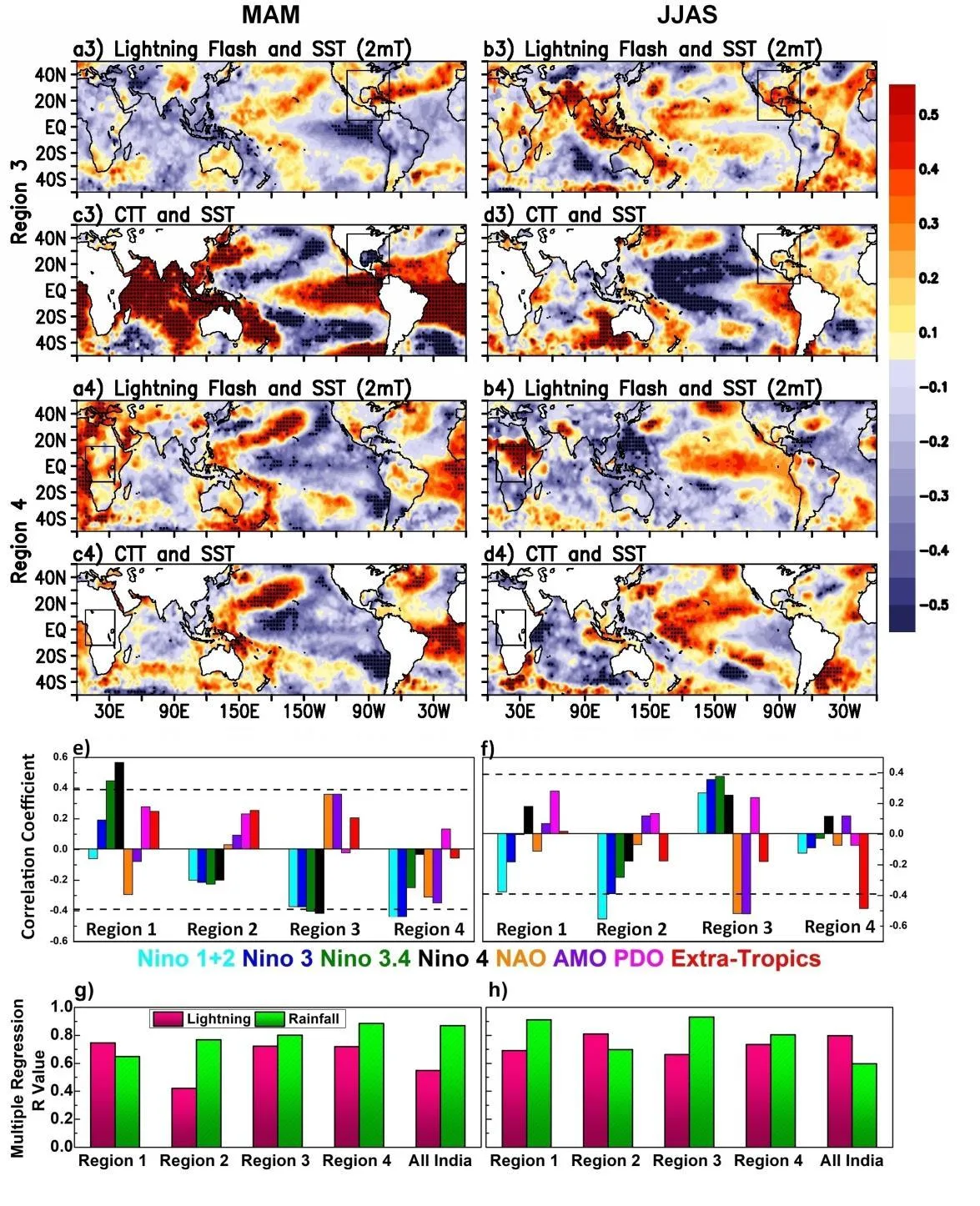
Satellite data on lightning flash density from the LIS and OTD instruments aboard the TRMM satellite for 1997–2013, with a resolution of 2.5 degrees, were used. Four hotspots were selected: eastern and northwestern India, North America, and Africa. For each region, seasonal means (March–May and June–September) were computed and correlated with global indices: Niño1+2, Niño3, Niño3.4, Niño4, NAO, AMO, PDO, and extratropical sea surface temperature. Additionally, multiple linear regression was applied to combinations of indices. Synoptic variability (periods shorter than 10 days) was also compared with ocean temperature.
Results
Correlations between lightning density and global indices were significant in all regions. For eastern India in the pre-monsoon season, the multiple correlation reached 0.74, and for all of India during the monsoon, 0.79. For North America and Africa, values were around 0.72. The relationship with sea surface temperature in the Niño4 region was strongest in the pre-monsoon, while during the monsoon a negative correlation with Niño1+2 was significant. The difference between El Niño and La Niña years showed that in the pre-monsoon, more lightning occurs over eastern India during El Niño, and in the monsoon, over northwestern India during La Niña. Lightning predictability proved comparable to that of precipitation, and in some places even higher.
Implications
This work differs from neighboring studies in that it treats lightning not as a byproduct of precipitation but as an independent target for seasonal forecasting. Neighboring studies on seasonal predictability focus on precipitation, temperature, or circulation, whereas here it is shown that lightning can also be predicted with similar accuracy. This is the first systematic test of lightning predictability over several global hotspots using multiple regression.
Future development
The topic could evolve toward dynamic models with lightning parameterizations that directly link thunderstorm activity to large-scale circulation. It may be possible to create operational seasonal lightning forecasting systems analogous to precipitation forecasting systems. Also promising is the study of the role of soil moisture and other local factors in combination with global predictors.
Impact
The results could be used by meteorological services for early warnings of thunderstorm hazards, which is especially important for agriculture, aviation, and energy.
Next steps
The next step will be to test lightning predictability using dynamic climate models that include cloud electrification parameterizations, and to assess forecast quality on independent data.
Key open problems
In meteorology, the question of the limits of predictability of convective phenomena on seasonal timescales remains open. This work shows that even such fast processes as lightning can be partially predictable due to their connection with slow oceanic modes. This links the problem to the broader issue of predictability of tropical convection and its response to global warming.
In India, lightning kills more people than cyclones and floods combined, and this share is growing every year.
In Ray Bradbury's story 'A Sound of Thunder', a change in the distant past leads to unpredictable consequences in the present. Here it is the opposite: distant slow processes in the ocean help predict local thunderstorms.
Key numbers
- correlation for eastern India in the pre-monsoon: 0.74
- correlation for all India during the monsoon: 0.79
- data period: 17 years
- spatial resolution: 2.5 degrees
- share of lightning deaths among all natural disasters in India: growing