Echoes of Distant Oceans: How Seasonal Lightning Can Be Predicted from Slow Currents
Every year, lightning kills thousands of people, especially in the tropics, where thunderstorms are most intense. In India, the share of lightning deaths among all victims of natural disasters is rising, despite an overall decline in fatalities from cyclones and floods. One might think that lightning is too fast and too local to predict months ahead. But new research shows that if you look not at individual strikes but at seasonal totals, a slow echo of distant oceans emerges.
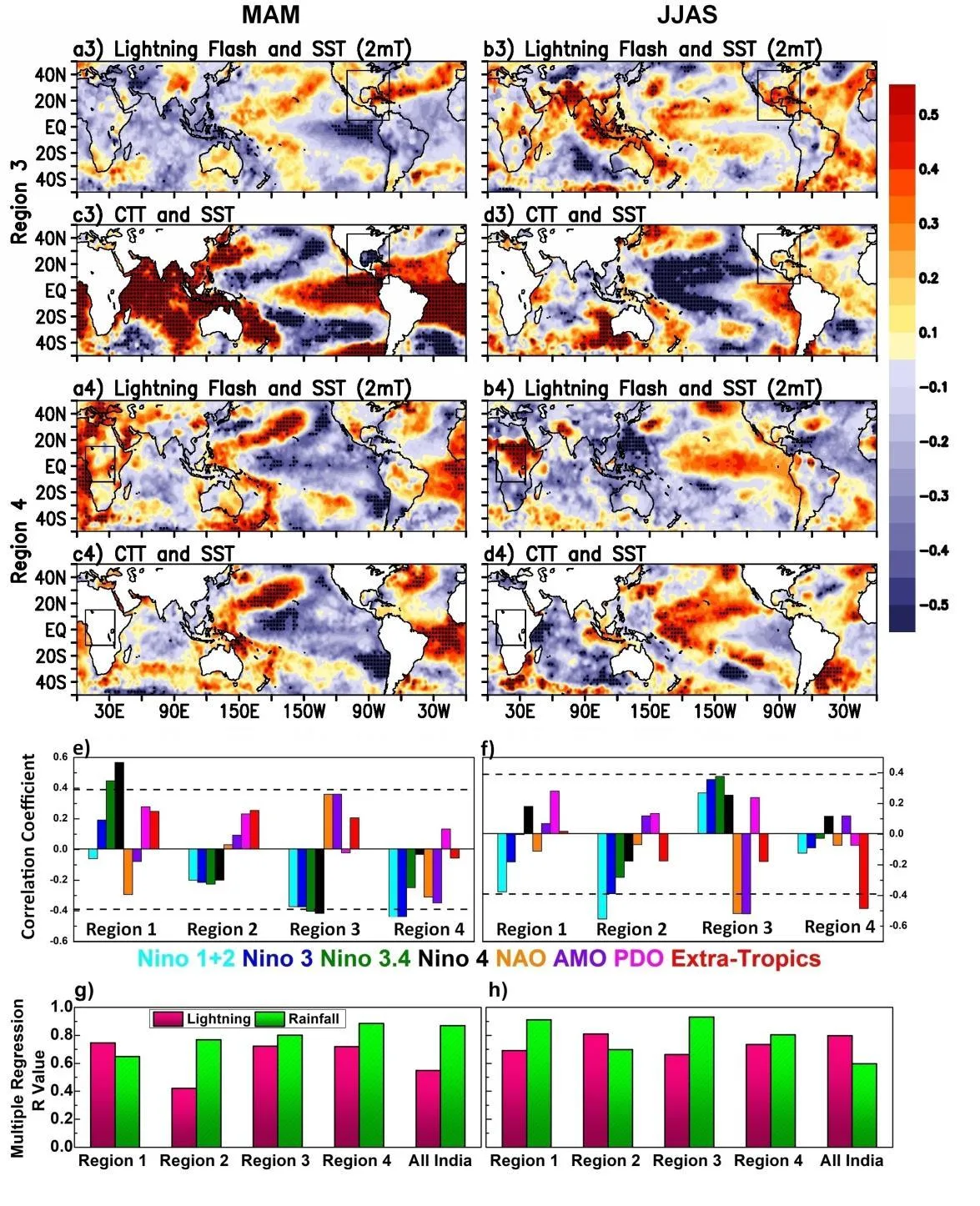
The researchers used satellite lightning density data from the LIS and OTD instruments on the TRMM satellite for 1997–2013. They selected four hotspots: eastern and northwestern India, North America, and Africa. For each region, they computed seasonal averages (March–May and June–September) and compared them with global indices: El Niño, the North Atlantic Oscillation, the Atlantic Multidecadal Oscillation, and others. The connection proved significant everywhere.
The ocean acts like a slow flywheel: it accumulates heat over months, then releases it to the atmosphere, altering wind and moisture patterns. El Niño, a warm current in the Pacific, and La Niña, its cold counterpart, set the rhythm for thunderstorms on the other side of the planet. In the pre-monsoon, there are more lightning strikes over eastern India during El Niño, while in the monsoon, more over northwestern India during La Niña. These are not random coincidences but a robust relationship that can be exploited.
Previously, it was thought that lightning was too chaotic and local to predict a season ahead. Now it is clear that when strikes are averaged over a season and a region, they follow the same slow oceanic modes as rainfall. Weather services could issue seasonal thunderstorm warnings, just as they already do for rain. This would save lives in agriculture, aviation, and energy.
Lightning remains an instantaneous discharge, but its seasonal echo travels from distant oceans. And if we learn to listen to that echo, we can hear the thunder long before the first clap.
In India, lightning kills more people than cyclones and floods combined, and this share is growing every year.
In Ray Bradbury's story 'A Sound of Thunder', a change in the distant past leads to unpredictable consequences in the present. Here it is the opposite: distant slow processes in the ocean help predict local thunderstorms.