Seasonal Hurricane Forecasts: How Models See the El Niño–Cyclone Link
Context
Seasonal tropical cyclone forecasts are critical for planning the protection of people and infrastructure in countries bordering the Atlantic, the Caribbean Sea, and the Gulf of Mexico. It is known that El Niño (the warm phase of the Pacific sea surface temperature oscillation) suppresses hurricane formation in the Atlantic, while La Niña (the cold phase) enhances it. This work sits alongside studies that have already shown that models can predict the total number of cyclones in a season, but none have checked how well they reproduce the physical link between El Niño and cyclones themselves. Unlike neighboring studies that focus on overall predictability or specific regions, this one is the first to systematically evaluate the El Niño–cyclone teleconnection across six operational models.
Methods
The authors used data from six European seasonal forecast models within the Copernicus system: UKMO, DWD, CMCC, ECMWF, MF5, and MF6. For each model, they analyzed forecasts initialized in early June over the period 1993–2014 (22 hurricane seasons). Tropical cyclones were identified using a unified vortex tracking algorithm based on wind vorticity at 850 and 200 hPa. ERA5 reanalysis and the IBTrACS observational archive served as references. The relationship between the El Niño index (sea surface temperature in the Niño 3.4 region) and cyclone counts was assessed using correlation and regression coefficients, as well as composite maps of track density for El Niño and La Niña years. Additionally, correlations with vertical wind shear and specific humidity at 500 hPa were analyzed. Uncertainty was estimated via bootstrap resampling (1000 samples).
Results
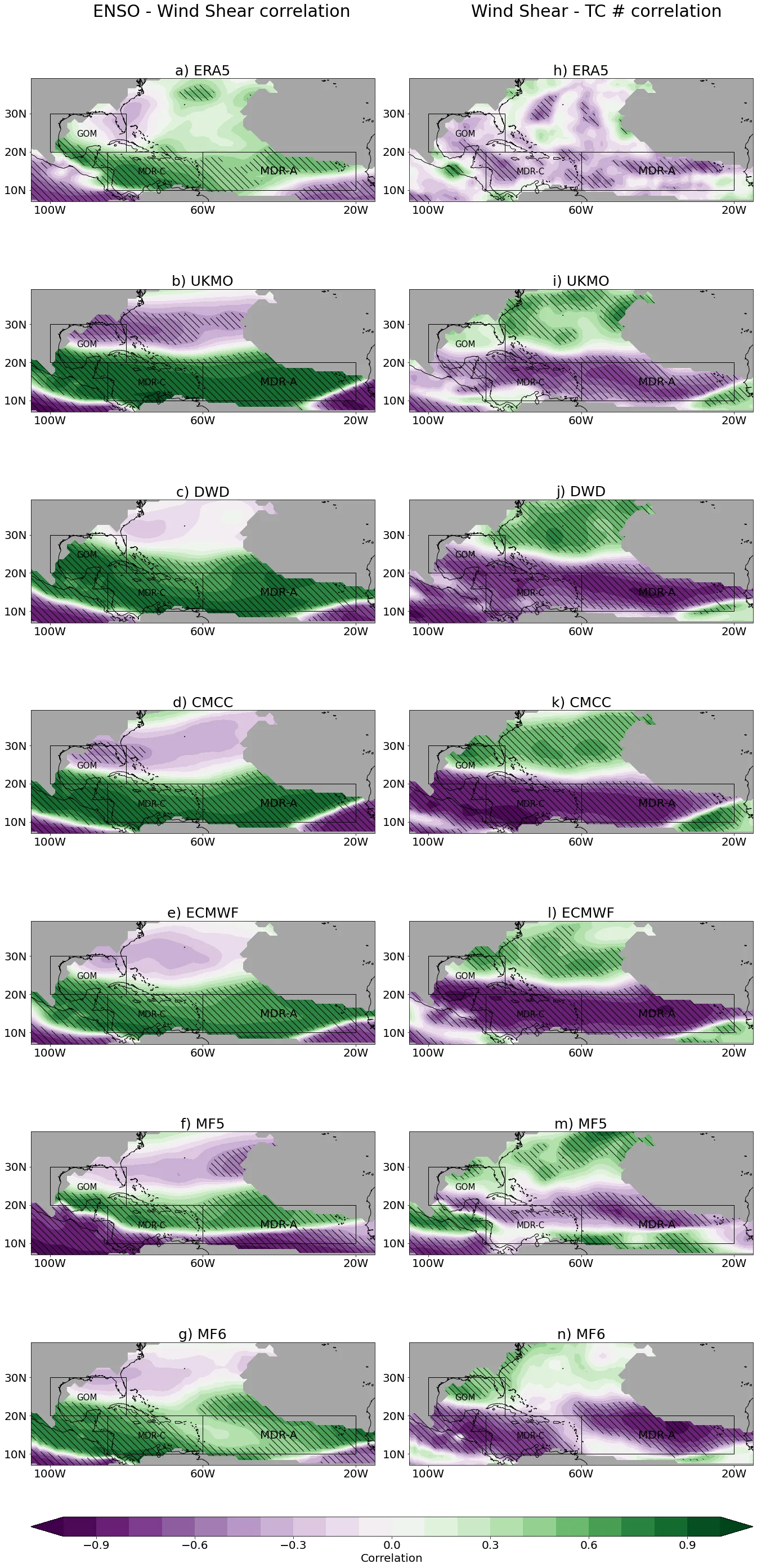
All six models reproduce the negative relationship between the El Niño index and total cyclone counts in the basin: warm years have fewer cyclones, cold years have more. However, the strength of the relationship is overestimated in models compared to reanalysis: correlation coefficients in models are larger in magnitude than in ERA5 and IBTrACS, although regression coefficients are smaller due to underestimated interannual variability in cyclone numbers. Spatial analysis revealed serious errors: in the eastern Caribbean, models predict a significant negative correlation that is absent in ERA5, and north of 25°N models show a sharp sign change in correlation that is not observed in reality. Composite maps for El Niño and La Niña years also show that models capture the overall reduction in activity but fail to reproduce the fine structure of anomalies, especially in the Caribbean basin and near Florida. Wind shear analysis showed that models overestimate its connection to El Niño in the main cyclone development region, while the relationship between shear and cyclone numbers in the subtropics has the wrong sign. Humidity, in contrast, is modeled reasonably well and does not explain the errors.
Implications
This work shows that, unlike neighboring studies that focused on overall predictability of cyclone numbers, here for the first time a systematic error is identified in reproducing the spatial structure of the El Niño–cyclone teleconnection. This means that even with a good forecast of total hurricane numbers, regional forecasts for the Caribbean basin and subtropics may be unreliable. The error likely stems from models' inability to correctly shift the Hadley cell boundary in response to El Niño, leading to incorrect wind shear distribution. This calls into question the use of such models for detailed regional hurricane activity forecasts and highlights the need to improve the physics of atmospheric circulation.
Future development
The topic could develop toward longer hindcast records, which would reduce uncertainty from the small sample (only 22 seasons). It is also promising to investigate how models reproduce the Hadley cell response to different types of El Niño (eastern Pacific and central Pacific), as these may affect wind shear differently. Improving the parameterization of wind shear and its interaction with the Hadley cell in models could enhance the accuracy of regional forecasts. Furthermore, a similar analysis could be applied to other basins, such as the western Pacific, where the relationship with El Niño is opposite.
Impact
The results will affect operational seasonal forecasting centers that use these models to issue hurricane activity forecasts. They are also important for climate modelers striving to improve the representation of large-scale circulation.
Next steps
The next step could be to analyze longer hindcast periods (e.g., from 1981) to increase statistical reliability. It would also be worthwhile to conduct sensitivity experiments with models regarding wind shear parameterization and the Hadley cell boundary.
Key open problems
This work directly addresses an unresolved problem in seasonal tropical cyclone forecasting: why models predict total cyclone numbers well but their spatial distribution poorly. This points to fundamental limitations in reproducing atmospheric circulation, especially the Hadley cell response to El Niño, which remains an open question in climate modeling.
In 2020, during La Niña, a record 30 tropical cyclones were recorded in the Atlantic, surpassing even the previous record from 2005.
Key numbers
- analysis period: 1993–2014 (22 seasons)
- number of models: 6 European seasonal forecasts
- model resolution: from 32 to 110 km
- mean cyclone count in ERA5: 14.5 ± 4.4 per season
- mean cyclone count in DWD: 2.9 ± 0.6 per season