Ventilation Potential: A New Index for Tropical Cyclone Genesis ✛
Context
Genesis potential indices (GPIs) are widely used to estimate where and how often tropical cyclones may form. They combine several environmental parameters: rotation (vorticity), thermal energy (potential intensity), wind shear, and humidity. However, different ways of accounting for humidity yield opposite projections for the future: some suggest an increase in cyclone numbers, others a decrease. This work sits at the intersection of meteorology and climatology: studies exist on El Niño influences, seasonal forecasts, and paleoclimate, but a unified theory of cyclone genesis is lacking. The authors propose simplifying the index by replacing three thermodynamic parameters with one: ventilation potential intensity, which follows directly from theory.
Methods
The authors took data on real tropical cyclones from the IBTrACS archive and environmental parameters from the ERA5 reanalysis for 1981–2020. They calculated ventilation potential intensity (vPI) using formulas from ventilation theory, based on temperature, humidity, and wind shear. They then constructed the new index GPIv as the product of vPI and the 'capped' absolute vorticity at 850 hPa, raised to a power. The exponent was tuned by least squares so that the global mean number of cyclones matched observations (84.6 per year). For validation, they compared GPIv with four existing indices and applied it to CMIP6 climate models to assess future changes.
Results
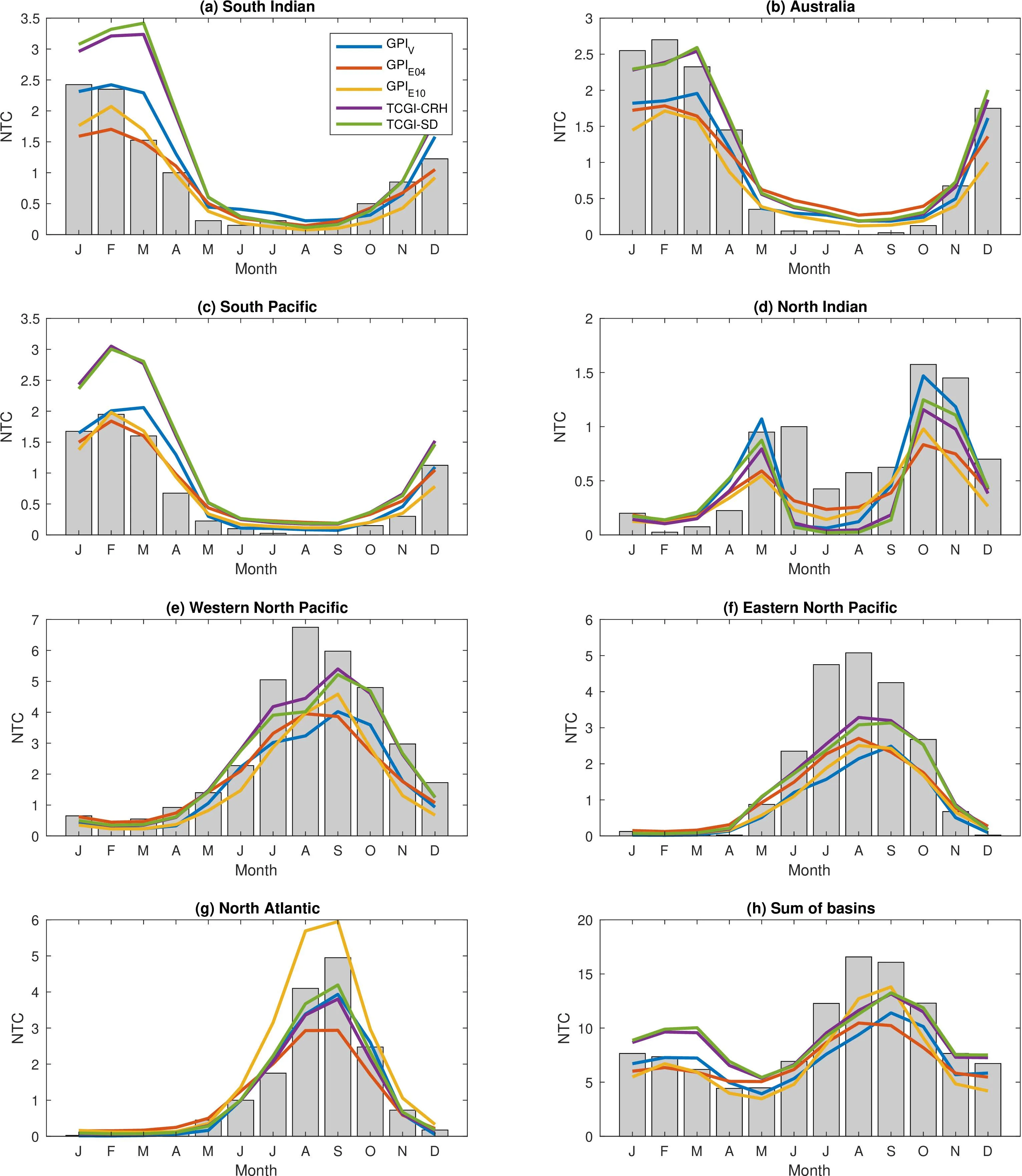
The new index GPIv reproduces the spatial distribution of cyclone genesis as well as more complex indices do, but it uses only one fitted parameter. It correctly captures the seasonal cycle and the response to El Niño. In CMIP6 future projections, GPIv shows a gradual increase in the favorability of conditions for cyclones as warming progresses, especially in the subtropics and high latitudes. For example, by the end of the century under the ssp585 scenario, the increase in the Atlantic reaches 61.6%, and in the eastern Pacific, 60.4%. Meanwhile, changes in the tropics are small, and a significant signal appears only under strong warming.
Implications
This work differs from neighboring studies in that it applies ventilation potential intensity to Earth for the first time (previously it was used only for exoplanets). This allows combining three thermodynamic parameters into one, removing ambiguity in how humidity is accounted for. This approach confirms that as warming proceeds, conditions for cyclones become more favorable, consistent with indices based on entropy deficit. It is a step toward a more physically grounded theory of cyclone genesis.
Future development
In the future, the index could incorporate a parameter describing cyclone 'seeds': localized updrafts that are currently not accounted for. This might improve forecasts on short time scales. It would also be worthwhile to test GPIv on higher-resolution data and across different climate states, such as in the paleoclimate.
Impact
The results will affect climate modeling and risk assessment for tropical cyclones under global warming.
Next steps
The next step is to include a measure of cyclone 'seed' activity in the index and test it on seasonal forecasts.
Key open problems
A key unresolved problem is the lack of a complete theory of tropical cyclone genesis. GPIs remain semi-empirical, and their future projections carry large uncertainty due to the neglect of small-scale processes such as convective seeds.
The knowledge machine's view
This section is addressed to the author of the paper and their colleagues. Neighbouring works were found by meaning-based search across our archive, not by word overlap. We do not review: we show the field around the work.
What the work does
The paper introduces a new tropical cyclone genesis potential index, GPIv, based on the ventilated potential intensity (vPI) and absolute vorticity. The authors use IBTrACS and ERA5 data from 1981 to 2020, fit a single exponent so that the global cyclone count matches observations, and compare with existing indices. They then apply the index to CMIP6 models and find an increase in favorable conditions in the future, especially at high latitudes.
Where its strength is
The index combines three thermodynamic parameters into one that has a clear physical interpretation from ventilation theory, which removes ambiguity in how moisture is accounted for and simplifies the model without losing accuracy.
Where it could go next
- One could compare the distribution of GPIv with the energy of existing cyclones: there is a paper in the archive on a power law for hurricane energy that might suggest how to link genesis potential to subsequent intensity.based on: Hurricane Energy Follows a Power Law arXiv:0910.0054
- It would be interesting to see how GPIv responds to different El Niño phases compared to model estimates: there is a nearby study on why models overestimate the El Niño–hurricane link, which could help refine the index's predictive power.based on: The Overzealous Translator: Why Models Overestimate the El Niño–Hurricane Link arXiv:2212.11422
- Since GPIv depends on ventilated potential, which is sensitive to wind shear and moisture, one could study its behavior under a changing climate alongside work on the intensification of tropical cyclones in different basins.based on: Are Tropical Cyclones Intensifying? It's Not Just the Atlantic arXiv:2606.22518
Worth trying
- Try using GPIv for seasonal forecasts in individual basins, comparing with indices that account for the accumulated effect of El Niño.
- Check whether GPIv provides a better match with observed cyclone energy if the exponent is applied not to vorticity alone but to its combination with vPI.
- Apply GPIv to paleoclimate reconstructions to assess cyclone genesis conditions in the past.
Why this may matter
Such an index could serve as a basis for more accurate seasonal and climate forecasts, as well as for understanding the link between environmental conditions and actual cyclone activity.
Nearby works in our archive
- Hurricane Energy Follows a Power Lawsimilarity 0.55
- El Niño: Predicting Strength and Onset a Year in Advancesimilarity 0.52
- A Ceiling of Randomnesssimilarity 0.49
- The Overzealous Translator: Why Models Overestimate the El Niño–Hurricane Linksimilarity 0.48
- How to Make Your Model Pay for Its Mistakessimilarity 0.48
- Are Tropical Cyclones Intensifying? It's Not Just the Atlanticsimilarity 0.47
The archive is sparse around this work: the closest review is only 0.55, against a usual 0.64. It looks like few have drilled nearby.
Ventilation potential intensity drops to zero when the ventilation index exceeds a threshold of 0.145, creating a sharp boundary between regions favorable and unfavorable for cyclones, something previous indices lacked.
Key numbers
- exponent in the GPIv formula: 4.90
- ventilation index threshold: 0.145
- increase in GPIv in the Atlantic by 2100 (ssp585): 61.6%
- increase in GPIv in the eastern Pacific by 2100 (ssp585): 60.4%
- global mean number of cyclones per year: 84.625