In 1834, Émile Clapeyron combined the experimental laws of Boyle, Charles, and Gay-Lussac into the single equation pV = nRT. This elegant formula describes the equilibrium state of an ideal gas — a model where molecules are considered point-like and non-interacting. It works as a 'switch' between the volume, pressure, and temperature of a gas, allowing prediction of the behavior of real gases under ordinary conditions.
History
The experiments of Robert Boyle (1662) and Edme Mariotte showed the inverse proportionality of pressure and volume (pV=const at constant T). Jacques Charles (1787) and Joseph Gay-Lussac (1802) established the dependence of volume on temperature. Amedeo Avogadro in 1811 hypothesized that equal volumes of gases contain equal numbers of molecules under the same conditions. Émile Clapeyron in 1834 combined these laws into a single equation, later generalized by Dmitri Mendeleev with the inclusion of the universal gas constant.
How it works
Widely applied from internal combustion engine calculations to atmospheric modeling. Limits of applicability: the equation is not applicable at high densities and low temperatures, when intermolecular interactions and the finite size of molecules become significant — there, Van der Waals equations with corrections are used.
In practice
From inflating tires to weather forecasting: the relationship between pressure, volume, and temperature governs engines, balloons, and breathing.
Fun fact
If you leave a ball in the sun, it inflates itself — not magic, but the temperature increase raises the pressure with almost constant volume.
In the dark chamber of the trap, thousands of charged particles dance under electric fields. At first they move freely, like a crowd in a square, but cool the cloud and the dance slows: ions begin to sense each other, their steps become constrained.
264 kilometres per second — that's how fast the Solar System hurtles through the cloud of dark matter. Its existence was given away by galaxies: they spun too fast to be held by visible mass, and Vera Rubin was first to suspect a hidden scaffolding.
For decades, global atmospheric models resembled artists forced to paint planetary storms with coarse brushstrokes: a resolution of 25–100 km forced them to 'guess' convection through approximate schemes, introducing systematic errors in rainfall and climate forecasts.
At temperatures billionths of a degree above absolute zero, a Bose–Einstein condensate emerges — a state where thousands of atoms march in a single quantum key.
A pot of water always boils the same way: hit 100 degrees and bubbles start. Quantum fluids are different. When a cloud of atoms is cooled to near absolute zero, it can turn into a single matter wave — a Bose–Einstein condensate. But the transition itself, it turns out, can happen in three different ways.
Tea in a cup cools quietly on the table. But if you zoom past at near-light speed, the thermometer will read higher — even though no one heated the tea. Calculations confirm: the needle will creep up.
A century ago, physicists split into three camps.
A drop of honey spreads slowly across a table, while water spreads quickly. The resistance to flow, viscosity, differs from one fluid to another. But what if the viscosity changes on the fly, as the substance compresses or expands?
If you pour sand into a glass, it settles in a flat layer. But instead of sand, take the tiniest particles of gas: in a gravitational field they don't just fall: each particle races along its own trajectory, collides with neighbors, and all this commotion creates pressure.
A tiny glass bead hangs in a laser beam like a speck of dust in sunlight. Around it is a rarefied gas: atoms of krypton, xenon, and heavy molecules of sulfur hexafluoride. They collide with the bead, and each hit transfers a tiny impulse, like a pea thrown at a taut sheet makes it tremble.
Impulse is a measure of motion: mass times velocity.
Plasma is a gas in which electrons are stripped from atoms, behaving like a soup of charged particles. To predict how such a soup flows and heats up, you need to know how particles collide and exchange energy.
Atoms in a gas behave like billiard balls: they fly, collide, and scatter in different directions. But instead of solid balls, they have a soft "coat" of attractive and repulsive forces. At close range, atoms repel sharply; at longer range, they attract slightly. Scientists need to calculate these collisions precisely to model gas flows around airplanes or inside microchips.
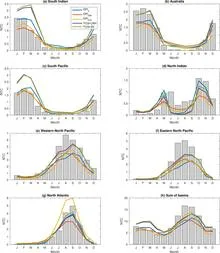
Over warm ocean waters, air rises, spins, and turns into a giant vortex that carries winds faster than a race car. For such a vortex to form, several conditions must align: rotation, heat, moisture, and calm winds aloft. Previously, meteorologists combined these conditions into complex indices, like a kitchen recipe with a dozen ingredients.