The energy hidden in stationary objects is called potential by physicists. It comes in different forms: gravitational (associated with height in a gravitational field), elastic (compression or stretching of materials), electrical (charges in a field). All these types share a principle: the work that a system can perform is determined by its configuration. When a stone falls down, its potential melts away, turning into speed. On cosmic scales, gravitational potential energy is the main source of starlight: as a gas-dust cloud contracts, it heats up and ignites a thermonuclear furnace.
History
The term 'potentialenergy' was introduced in 1853 by the Scottish engineer and physicist William Rankine. However, the roots of the idea go back to Galileo and Leibniz, who spoke of 'living force' (vis viva) and 'dead force'. Lagrange and Hamilton embedded potential into analytical mechanics, making it the foundation of describing motion. In 1915, Emmy Noether proved that the law of conservation of energy (and hence the rigorous definition of potential function) follows from the homogeneity of time. Today, potential energy remains a key concept from quantum mechanics to cosmology.
How it works
In mechanics, the change in potentialenergy dU is related to the work dA done by a conservative force: dU = -dA = -F·dr. The potential is defined up to an arbitrary constant; only potential differences have physical meaning. In the Earth's gravitational field, U = mgh, where h is measured from a chosen reference level. In general, the gravitational potential of a point mass M is φ = -GM/r, and the potential energy of a test body of mass m is U = mφ. In electrodynamics, the scalar potential φ and vector potential A form a four-dimensional potential that determines field strengths. Quantum mechanics uses the potential energy operator in the Schrödinger equation. The gravitational potential energy of a uniform sphere (e.g., a star) determines its internal thermal history and stability.
In practice
Hydroelectric power plants convert water's potentialenergy into electricity. Any object at height stores energy ready to do work — from a clock weight to a hanging chandelier.
Fun fact
A tablespoon of neutron star matter, if it fell to Earth, would release as much energy as a powerful atomic bomb — thanks to the enormous gravitational potential energy.
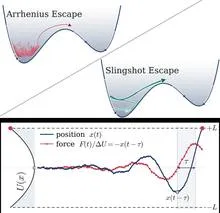
A particle sits in an energy pit like a pea in a dimple. To get out, it needs to go over the barrier, and usually this is rare: the higher the barrier, the longer the wait. The Arrhenius law says the waiting time grows exponentially, meaning doubling the barrier height increases the time by hundreds of times.
A translator who has memorized all the lines in advance responds instantly — no need to listen to the whole conversation again. That's how the new model works: instead of running atoms through a computer for hours, it immediately outputs the crystal's free energy at any temperature and pressure.
In a thin perovskite film, a material for cheap solar cells, light creates pairs of charges: an electron and a "hole." They need to reach the electrodes and produce current, but many vanish along the way. Where exactly they go is the question that determines how efficient the cell will be.
A fusion reactor is like a super-hot furnace where plasma reaches millions of degrees. The walls are made of tungsten, the most refractory metal there is. But even tungsten needs protection: fast particles from the plasma bombard the surface and knock atoms loose. These ejected atoms enter the plasma and cool it down, like a spoonful of cold milk in hot tea.
In a pot of water, microscopic spheres, colloidal particles, are floating. Each sphere is coated with long polymer chains that look like a brush and carries an electric charge. If you get the temperature and solution composition right, the spheres start arranging themselves into ordered patterns — crystals.
When sugar goes into tea, it dissolves. But why doesn't it just fall back out? It's all about chemical potential — a quantity that shows how 'favorable' it is for a substance to be in a given place and state. For a pure substance, it's easy to calculate, but for a mixture of several components, it's a real puzzle.
A protein chain folds into a working tool in a fraction of a second, and almost never makes a mistake. For a long time, it was thought that evolution specifically polishes amino acid sequences so that a protein not only works but also easily finds its unique shape. New work turns this idea on its head.
A neuron transmitting a signal is like a tiny battery that quickly discharges and recharges. For nearly 70 years, it was believed that a special "potassium valve," opening with a delay, was responsible for the recharge phase. New work claims this current is a ghost.
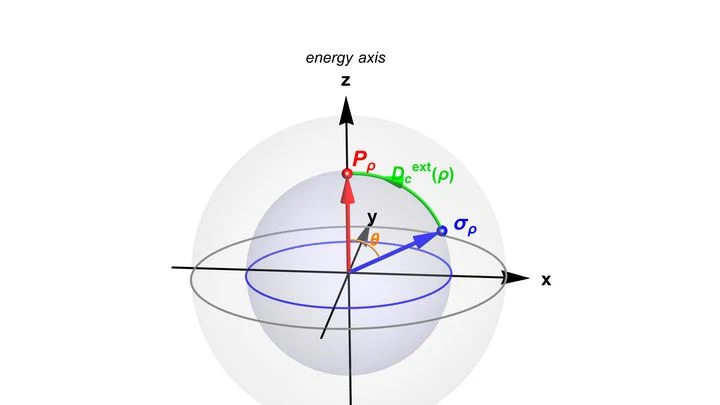
Any battery, from a AA to a quantum one, is simple in principle: there's a store of energy, and there's a way to get it out. In the quantum world, this 'way' looks like a careful switching between particle states, akin to moving a ball from a high shelf to a low one.
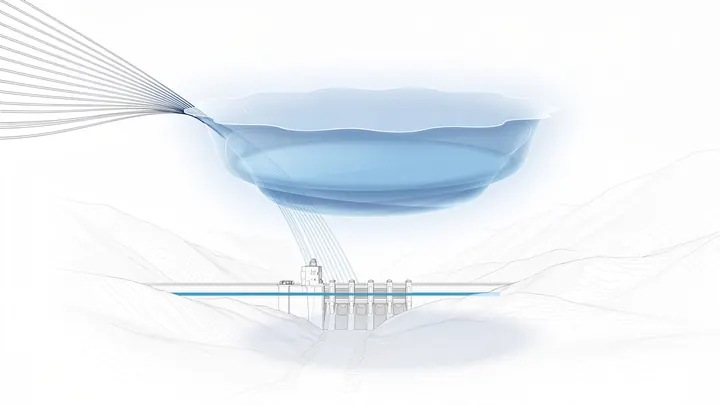
Inside the concrete dam, machines hum, running on empty. Three out of ten turbines are silent. The water level in Southeast Brazil’s largest reservoir has dropped so low that the blades are about to gulp air. The country’s 160 hydropower plants, which supply more than half its electricity, are linked into a single water network where every drop counts.
In the late 1990s, the night sky delivered a surprise: Saul Perlmutter and Adam Riess found that the expansion of the Universe is accelerating. Ever since, the greatest riddle has been dark energy — a substance making up nearly 70% of the cosmos, yet evading laboratory study.
A pendulum swings in thick syrup. In the first fractions of a second, it moves quickly, but the syrup slows it down, and then suddenly the syrup becomes thinner, and the pendulum speeds up again. Something similar might have happened to our universe.
Two grains of salt fall into a glass of water. They dissolve, and sodium and chloride ions spread throughout the volume. The schoolbook truth is simple: like charges repel, opposite charges attract. But recent experiments with tiny spheres in liquids have revealed a picture that breaks this rule.
The Mpemba effect is surprising: hot water sometimes freezes faster than cold. Scientists built a simple model: a bead in a thick, honey-like medium, on a landscape with two dips and a wall at the edge. The bead moves viscously, unable to hop over the central bump.
Water in a glass settles down once you stop stirring it. Oil in an engine dampens vibrations. It seems viscosity is always about damping. But in some flows, it's the opposite: add friction, and waves start to grow as if from nowhere.
Physicists have found a simple explanation.
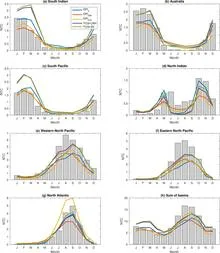
Over warm ocean waters, air rises, spins, and turns into a giant vortex that carries winds faster than a race car. For such a vortex to form, several conditions must align: rotation, heat, moisture, and calm winds aloft. Previously, meteorologists combined these conditions into complex indices, like a kitchen recipe with a dozen ingredients.