Light Bridges for Quantum Computers ✛ ✎ ✦
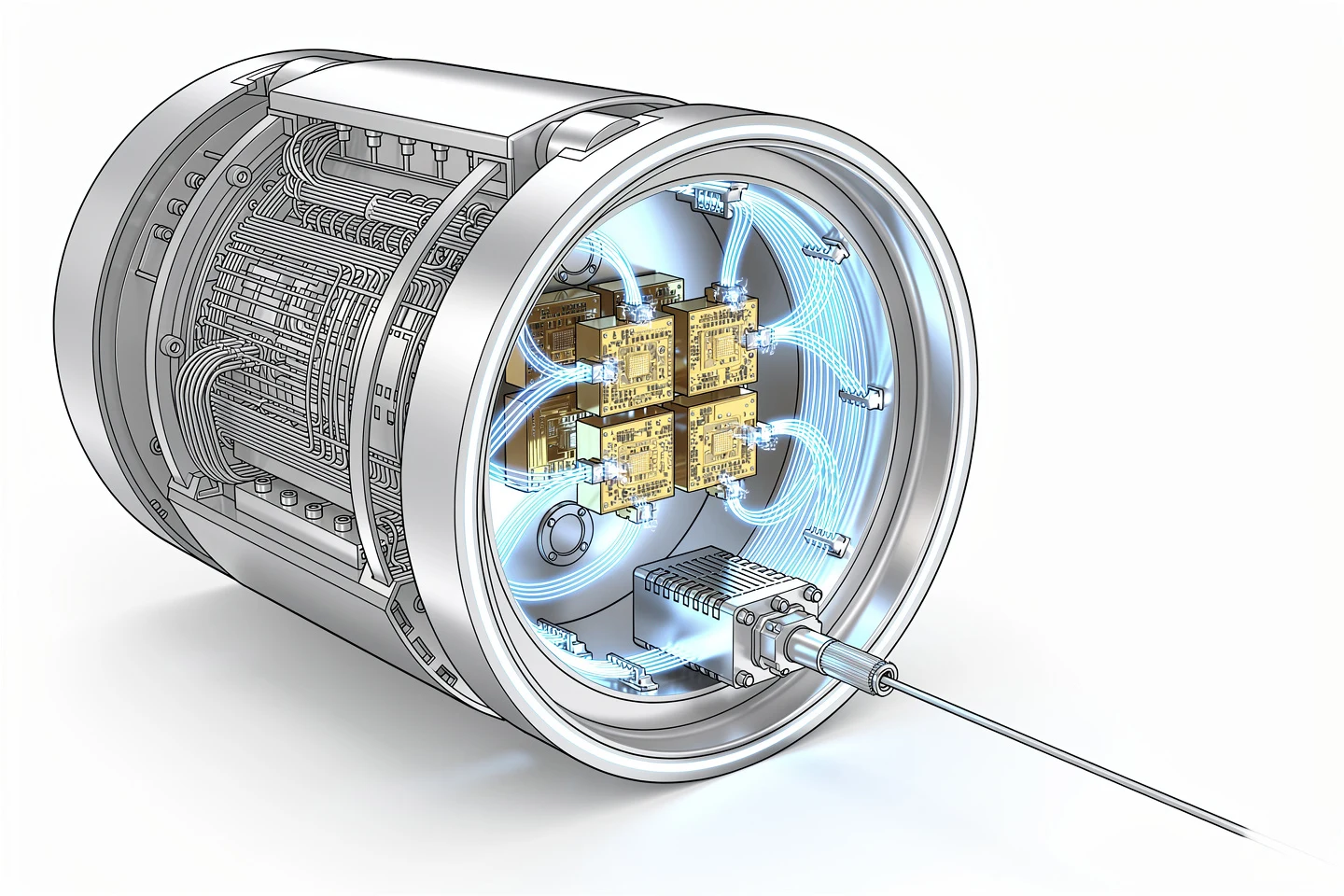
Modern quantum processors based on superconductors live only in bulky refrigerators at ultralow temperatures. Otherwise, thermal noise destroys their quantum nature — scientists call this quantum decoherence. One such fridge holds only a handful of qubits, but serious computing needs millions. The solution is to connect the fridges with light through fiber optics, which can carry quantum information. But inside, qubits talk in microwaves, while fiber optics only understand optical signals. So you need a translator, and current prototypes work like a bumbling moonshiner: they distill the microwave "mash" into photonic "liquor", but the output is a murky noise.
The solution resembles the art of distillation. Physicists devised a protocol where qubits from different modules try to establish quantum entanglement again and again. Each attempt is checked with a quantum measurement. Noisy, failed cycles are simply discarded, and several partially pure ones are repeatedly "distilled" together — just as raw alcohol is distilled into a pure product. After a few iterations, the connection fidelity rises to 99% — above the threshold needed for reliable quantum computing.
The bottom line: there's no need to wait for perfect translators. Right now, we can build distributed quantum systems where dozens of simple fridges combine into a machine with millions of qubits, using existing technology.
Ordinary fiber optic cables can transmit single photons without significant attenuation over hundreds of kilometers — that's what the idea of quantum networks is built on.