The teraelectronvolt (TeV) is a unit of energy equal to one trillion electronvolts (10^12 eV). In particle physics, it is the standard scale for describing the energies of particles in modern accelerators and in high-energy cosmic rays. For comparison, the rest energy of a proton is about 0.001 TeV, so a particle with an energy of 1 TeV carries roughly a thousand times its rest mass in kinetic energy.
History
The term came into common use in the 1970s and 1980s as accelerator energies crossed the GeV (gigaelectronvolt) scale and entered the TeV range, with the Tevatron at Fermilab (1983) being the first accelerator designed to reach 1 TeV per beam.
How it works
One electronvolt is the energy gained by a single electron when accelerated through an electric potential difference of one volt. A teraelectronvolt is simply a billion times larger. In practice, particle accelerators like the Large Hadron Collider (LHC) accelerate protons to energies of several TeV per beam, colliding them to probe the fundamental structure of matter. Cosmic rays can reach energies of millions of TeV, far beyond what any terrestrial accelerator can achieve.
In practice
TeV energies are used in high-energy particle colliders to discover new particles and test fundamental theories, and in gamma-ray astronomy to study the most violent processes in the universe, such as supernova remnants and active galactic nuclei.
Fun fact
A single particle in an ultra-high-energy cosmic ray can carry the kinetic energy of a well-thrown baseball, but concentrated into a single subatomic particle.
Systems:naturalSIOne teraelectronvolt is equal to 1.602176634 × 10^-7 joules, defined as the kinetic energy gained by an electron accelerated through a potential difference of one trillion volts.
In 1054, a star flared up in the constellation Taurus. The light of its death was so bright that it was visible in daylight for nearly a month, and Chinese astronomers recorded it in their chronicles. Today, the Crab Nebula is spreading over that spot, and its claws are clouds of gas still being whipped up by the dead star at its center.
A proton beam aimed at a tumor cuts through soft tissue like a knife through butter, but its range depends on the subtle properties of water, the stuff we're mostly made of. Water is the body's main component, and how quickly protons slow down in it determines exactly where they deposit their energy.
Hot water after a shower, warm air from ventilation, the heated walls of an engine — all this is heat below 100°C. Usually, it dissipates without doing any useful work. Now it can be captured and turned into electricity.
Inside the new device is a wire made of a nickel-titanium alloy. This material remembers its shape: when heated, it contracts; when cooled, it returns to its original shape.
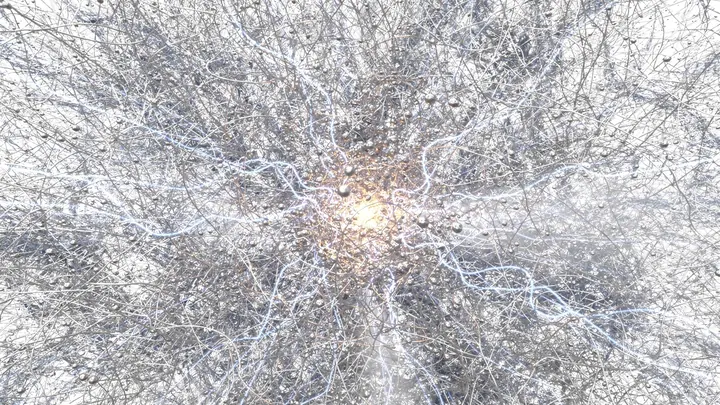
The universe sometimes resembles an old fabric: after rapid cooling, wrinkles could have remained — thin, almost invisible threads of monstrous density. They are called cosmic strings. Usually, at the center of such a string hides a singularity — a point where the laws of physics lose their meaning.
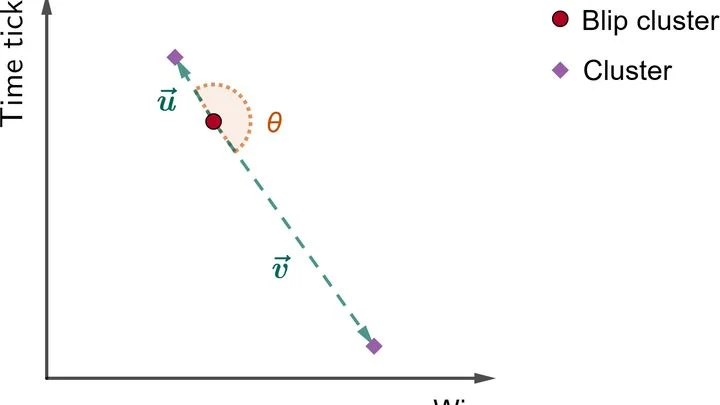
A chamber the size of a small truck is filled with liquid argon at minus 186 degrees Celsius. When a particle flies in, it knocks electrons off argon atoms, and those electrons drift toward the walls, tracing a three-dimensional picture of the event.
In an orchestra, each musician plays their own part, but at a certain moment all instruments pause on a single note. Cosmic rays behave somewhat like this — particles flying toward us from distant stars.
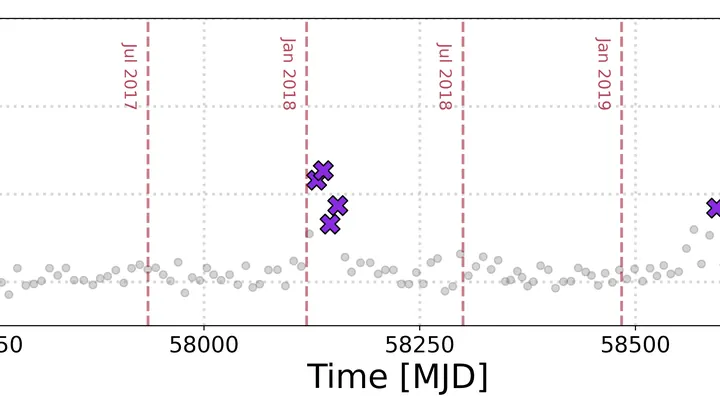
A spotlight shines ever brighter, but at some limit the bulb suddenly burns out, and no more light comes through. Astrophysicists have seen something similar in the distant blazar Markarian 421. This is an active galaxy whose jet of superheated plasma points almost straight at Earth, like the beam of a cosmic lighthouse.
A drop of water stretches in a strong electric field. The deuterium nucleus, a bound pair of a proton and a neutron, behaves the same way, except here the field comes from a passing gamma ray, and instead of just stretching, the nucleus can simply fall apart.
Cosmic rays are particles that arrive from deep space. When such a particle hits the atmosphere, it triggers a whole shower of new particles, like a billiard ball breaking a rack, sending balls scattering in all directions. To predict what such a shower will look like, we need to know how the primary particle interacts with the nuclei of air atoms.
Cosmic rays are not light but charged particles bombarding Earth from all directions. Most of them are protons (hydrogen nuclei), but heavier nuclei also show up: helium, nitrogen, iron.
Light hits a silicon wafer, and a single electron is born inside it. An ordinary instrument wouldn't notice — the signal is too faint. The new detector not only hears it but also determines its energy with an accuracy of 589 millielectronvolts. That's like distinguishing the footsteps of an ant at arm's length.
Inside the detector, a particle knocks an electron out of a silicon atom. This takes 0.
Cosmic rays are like a downpour pelting from all sides. But when the wind blows, the droplets change direction. In the same way, a solar storm, a cloud of magnetized gas from the Sun, bends the paths of these particles that normally rain down on Earth evenly. Cosmic rays are invisible messengers from distant galaxies.
At night over the Siberian taiga, a faint blue light sometimes flickers. It's not the aurora borealis but a cosmic-ray shower: a single particle from deep space slams into the atmosphere and shatters into millions of secondary particles. They race toward the ground in a broad front, like a ripple from a stone dropped into water, and make the air glow.
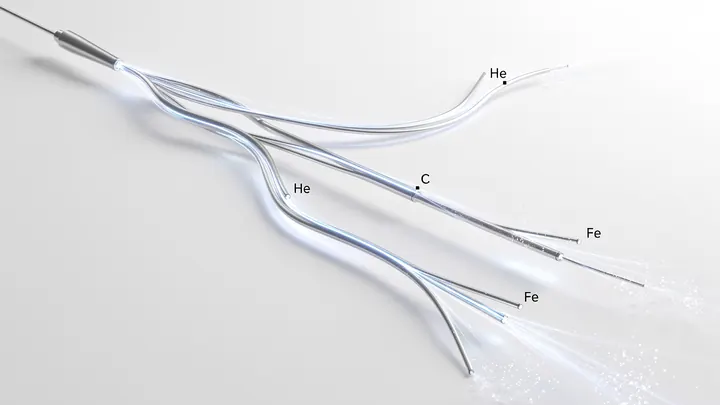
Like long-distance runners, atomic nuclei, from light helium to heavy iron, race toward us across the Galaxy. At the finish line, in a detector on a high-altitude balloon, we see that heavy nuclei arrive a bit more exhausted than light ones. The difference is small, but it repeats from flight to flight.
In the quiet harbor of the Local Bubble, a rarefied cavity of hot gas around the Sun, an explosion recently thundered. A supernova went off tens of parsecs away, and its echo still lingers in the neighborhood, reshaping the cosmic-ray landscape.
High above Antarctica, a balloon carried an instrument that caught electrons from space. These particles come from distant stellar explosions and other powerful events. The instrument measured their energy, like the force of an impact. And in one energy range, there were more impacts than calculations predicted.
In the stream of cosmic rays, particles flying toward us from the depths of the Galaxy, titanium is rare. Its nuclei are almost indistinguishable from iron: both are heavy, and both leave similar tracks in detectors.