Ten Thousand New Three-Dimensional Orbits in the Three-Body Problem ✛
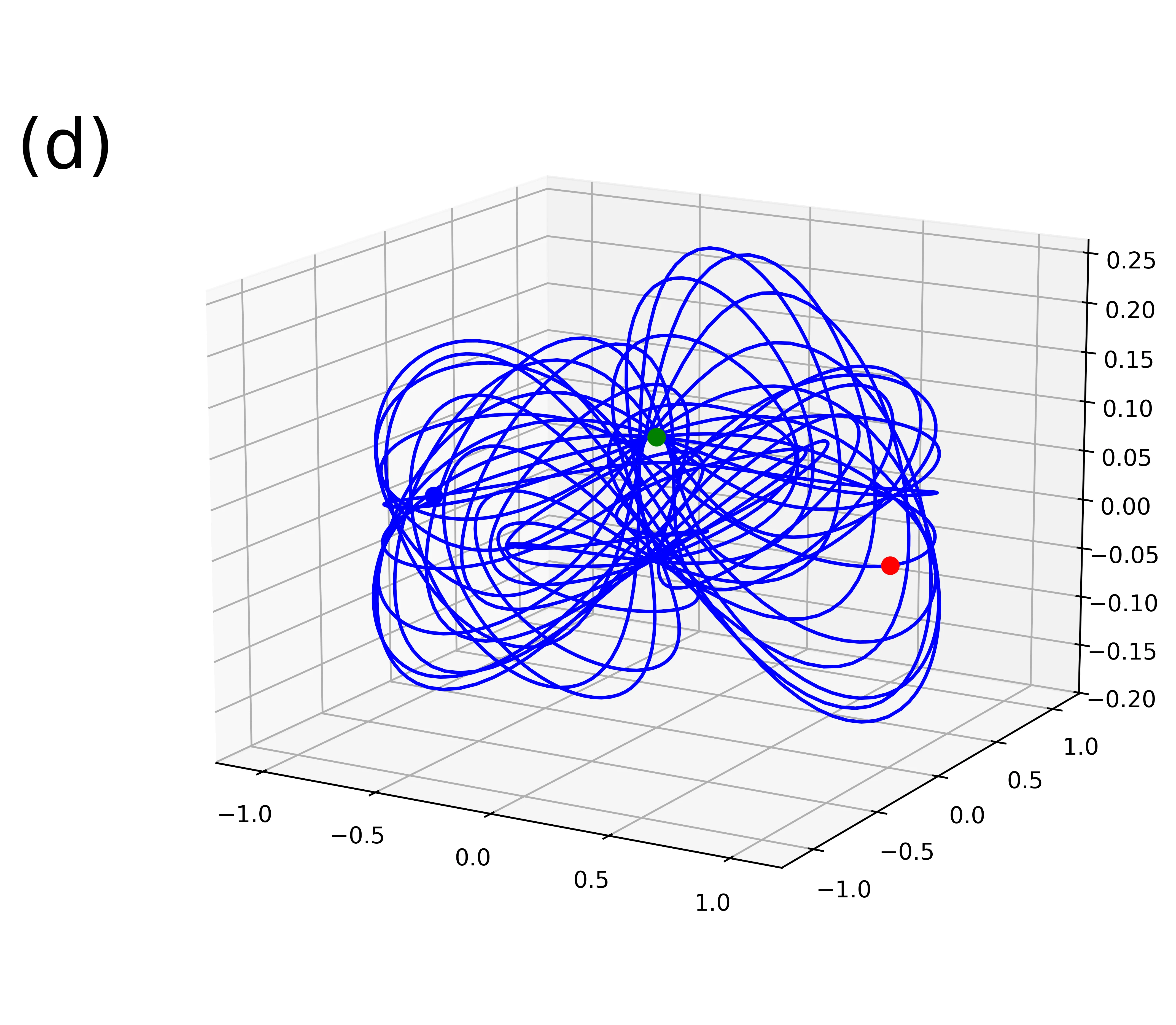
Three bodies attracting each other by universal gravitation: a problem that has stumped mathematics for three centuries. After Poincaré, it became clear that no general solution exists and trajectories are chaotic. But within this chaos there are islands of order: periodic orbits where motion repeats. For a long time, only planar orbits lying in a single plane, like ripples on water, were found. Three-dimensional ones, where bodies trace figures in space, remained almost unstudied: too complex for computation.
Chinese researchers decided to sift through a billion initial conditions to fish periodic trajectories out of the chaos. They set positions and velocities on a grid and checked whether the system returns to its initial state after time T. To suppress numerical noise, they applied the "clean numerical simulation" method, which reduces errors to a level that allows converging chaotic trajectories. This way they found 10,059 three-dimensional orbits for masses m1=m2=1 and m3=0.1n, where n ranges from 1 to 20. About 20% of them turned out to be linearly stable: small perturbations do not destroy the orbit.
These orbits are not just a mathematical curiosity. Periodic orbits serve as the "skeleton" of chaos: phase space organizes around them, and by studying them one can understand the structure of chaotic dynamics. Until now, there was no large-scale set of three-dimensional orbits with finite masses, and theorists could not test hypotheses. Now a catalog of 10,059 trajectories opens the way to systematic analysis. The authors plan to generate orbits for arbitrary masses and develop methods for topological classification, an analogue of braid groups for planar orbits in the three-dimensional case.
For now, this is pure knowledge: no practical applications are in sight. But the history of the three-body problem knows examples where abstract orbits suddenly proved useful for space missions. Perhaps these three-dimensional dances will one day serve future navigators.
Among the found orbits there is a "piano trio": two bodies with equal masses move along one closed curve, like two violins, while the third body with a different mass moves along its own, like a piano.
The three-body problem and its chaotic orbits are the central theme of Liu Cixin's novel "The Three-Body Problem," where the instability of a planet's orbits in a system with three suns determines the fate of a civilization.