Ten Thousand New Three-Dimensional Orbits in the Three-Body Problem ✛
Context
The three-body problem is one of the oldest unsolved questions in celestial mechanics, dating back to Newton. After Poincaré, it became clear that no general analytical solution exists and that trajectories are chaotic. For a long time, only planar periodic orbits were known, found by Euler, Lagrange, and others. Three-dimensional orbits, where bodies move in space rather than in a plane, remained largely unexplored due to computational complexity. This work stands apart: the nearest neighbors in the archive deal with either planetary migrations or quantum effects, but not with three-dimensional three-body orbits.
Methods
The authors employed a numerical strategy based on a grid search, the Newton–Raphson method, and "clean numerical simulation" (CNS), which suppresses numerical noise to a level that allows converging chaotic trajectories to be obtained. The initial configuration was defined by four parameters: the coordinate z0 of the third body and the velocity components vx, vy, vz. For each mass m3, $10^9$ initial conditions were scanned on a 1000×1000×1000 grid. Candidates were selected by the smallness of the return function (δ(T)<$10^{-1}$), then refined to δ(T)<$10^{-10}$. Stability was assessed via Floquet theory using the monodromy matrix.
Results
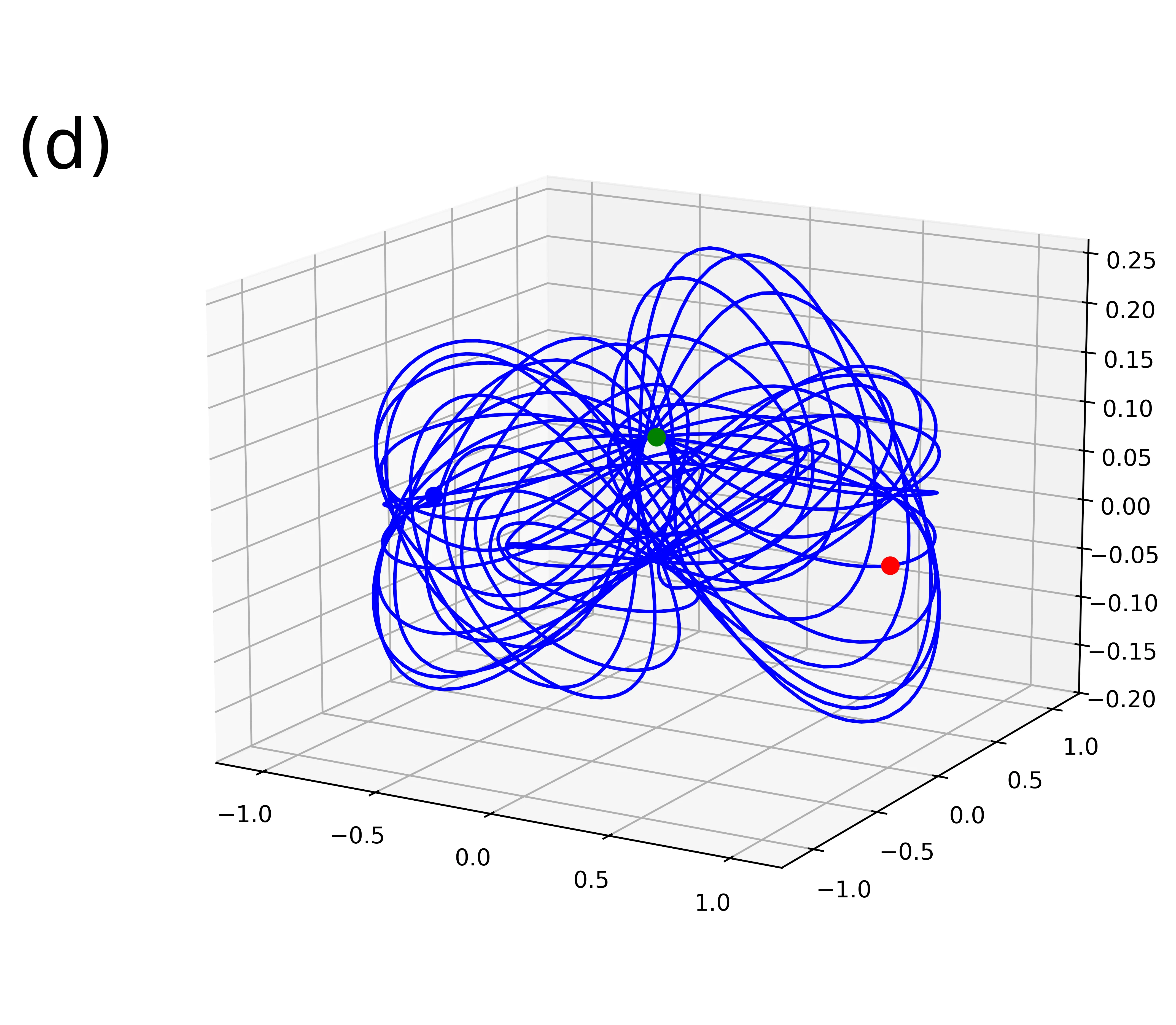
A total of 10,059 three-dimensional periodic orbits were found for masses m1=m2=1 and m3=0.1n (n=1..20). Of these, 1,996 (about 20%) are linearly stable. In the case of three equal masses, 21 choreographic orbits were found, where all three bodies move along a single closed curve. With two equal masses, 273 "piano trio" orbits were identified: two bodies with mass 1 follow one closed trajectory, and the third with a different mass follows another. All orbits are new and have not been published before. For orbit O3(1.0), an accuracy of 70 significant digits was achieved, which is physically equivalent to an exact solution.
Implications
This work dramatically expands the catalog of three-dimensional periodic orbits of the general three-body problem. Unlike neighboring studies focused on planar orbits or the restricted problem, here spatial orbits with finite masses have been obtained en masse for the first time. This provides a new tool for studying chaotic dynamics: periodic orbits serve as the "skeleton" of chaos, around which the phase space is organized. The discovery of choreographic and "piano trio" orbits points to a richness of three-dimensional dynamics that was previously inaccessible.
Future development
The method is applicable to arbitrary mass m3, allowing arbitrarily many orbits to be generated. Using the found orbits as starting points, continuation in mass can yield orbits with three unequal masses. The question of topological classification of three-dimensional orbits remains open: for planar orbits, braid groups or the shape sphere are used, but for the 3D analog, no such tool exists yet.
Impact
The results will affect celestial mechanics, chaos theory, and possibly the dynamics of stellar systems and the design of space missions in three-body systems.
Next steps
The plan is to continue the search for arbitrary masses m3 and to update the publicly available dataset. Also, methods for topological classification of three-dimensional orbits need to be developed.
Key open problems
In the field of celestial mechanics and dynamical systems, the problem of a complete classification of periodic orbits of the three-body problem and understanding their role in chaotic dynamics remains unsolved. This work provides a massive dataset for testing theoretical hypotheses and searching for patterns.
The knowledge machine's view
This section is addressed to the author of the paper and their colleagues. Neighbouring works were found by meaning-based search across our archive, not by word overlap. We do not review: we show the field around the work.
What the work does
The authors used a numerical strategy based on grid search, the Newton–Raphson method, and purely numerical simulation to suppress noise. They found 10,059 three-dimensional periodic orbits of the general three-body problem with finite masses, including 21 choreographic orbits and 273 'piano trio' orbits, assessing stability via Floquet theory.
Where its strength is
This work is the first to mass-produce spatial periodic orbits with finite masses, creating an extensive catalog that can serve as a 'skeleton' for studying chaotic dynamics.
Where it could go next
- It might be interesting to see how the orbit classification methods used for cyclers apply to the new three-dimensional orbits, especially for identifying families with common properties.based on: How Planets Switch Stars: The Discovery of Stable Cyclers arXiv:2606.29189
- Related work on fast visitors analyzes the observability of objects; one could consider which of the new orbits might be detected in real systems given observational constraints.based on: Speed Filter of the Skies: How Swift Visitors Elude Telescopes arXiv:2606.05344v1
Worth trying
- Test classification by symmetry types or topology of closed curves, similar to distinguishing cyclers.
- Check whether any of the found orbits pass close to massive bodies and could be interesting for observations.
- Use the catalog as a set of initial conditions to study the transition to chaos near stable orbits.
Why this may matter
Such a catalog could become the basis for a systematic study of the phase-space structure of the three-body problem and for finding new dynamical phenomena, as well as for comparison with real celestial systems.
Nearby works in our archive
- How Planets Switch Stars: The Discovery of Stable Cyclerssimilarity 0.50
- Planet X: The Dance of Twelve Stonessimilarity 0.49
- Silent Beacons in Spacesimilarity 0.49
- The Unheard Hum of Neutron Starssimilarity 0.48
- Speed Filter of the Skies: How Swift Visitors Elude Telescopessimilarity 0.46
The archive is sparse around this work: the closest review is only 0.54, against a usual 0.64. It looks like few have drilled nearby.
Among the found orbits, there is a "piano trio": two bodies with equal masses move along one closed curve, like two violins, while the third body with a different mass moves along its own, like a piano.
The three-body problem and its chaotic orbits are the central theme of Liu Cixin's novel "The Three-Body Problem," where the instability of a planet's orbit in a system with three suns determines the fate of a civilization.
Key numbers
- number of new orbits: 10,059
- percentage of stable orbits: about 20%
- choreographic orbits: 21
- "piano trio" orbits: 273
- accuracy of orbit O3(1.0): 70 significant digits