Newton's third law, also called the law of action and reaction, states: the forces of interaction between two bodies are equal in magnitude and opposite in direction. It is important to understand that they are applied to different bodies, so they do not balance each other. Isaac Newton in the 'Principia' (1687) gave this principle a strict mathematical form, but empirically people always faced opposition: when rowing, the oar pushes the water backward, and the water pushes the boat forward.
History
The principle of opposition was discussed even by ancient mechanics, but it was systematically studied by Isaac Newton based on experiments and observations. He verified the law in collisions of pendulums (with Christiaan Huygens) and in planetary motion. Newton realized that the Sun and planets mutually attract: if the Sun attracts the Earth, then the Earth pulls the Sun with the same force, but due to the huge mass the reaction is unnoticeable. Later the law was confirmed in all conceivable interactions.
How it works
It is applied in jet engines, walking, swimming, in calculating impacts and contact stresses. In rocketry, the third law explains thrust: the ejection of mass at high speed produces an equal force impulse, pushing the rocket forward. The limits of applicability are classical: in electrodynamics with retarded potentials, the third law in the simple form for instantaneous forces is violated; accounting for field momentum is required.
In practice
The reactive jet of gases in a rocket engine bursts downward — and the rocket rises upward; without this law, spaceflight would be impossible.
Fun fact
If the third law suddenly turned off, you couldn't walk: your foot pushes off the ground, and the ground pushes you forward.
The robot juggler catches and throws balls in precise rhythm with a human, like two пульсара sending pulses in unison. Juggling three balls is a classic cascade, governed by a steady beat, like the uniform rotation of a cosmic lighthouse. Break the rhythm and the pattern crumbles.
Right after the Big Bang, space was a hot plasma — a mix of charged particles and light. In such a medium, electric currents couldn't flow on their own: a 'potential difference' was needed to push electrons relative to photons.
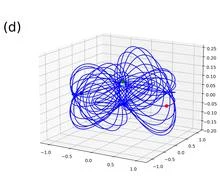
Three bodies attracting each other by universal gravitation: a problem that has stumped mathematics for three centuries. After Poincaré, it became clear that no general solution exists and trajectories are chaotic. But within this chaos there are islands of order: periodic orbits where motion repeats.