The SETI Blind Spot: How Technological Progress Makes Alien Civilizations Invisible ✛ ✦
Context
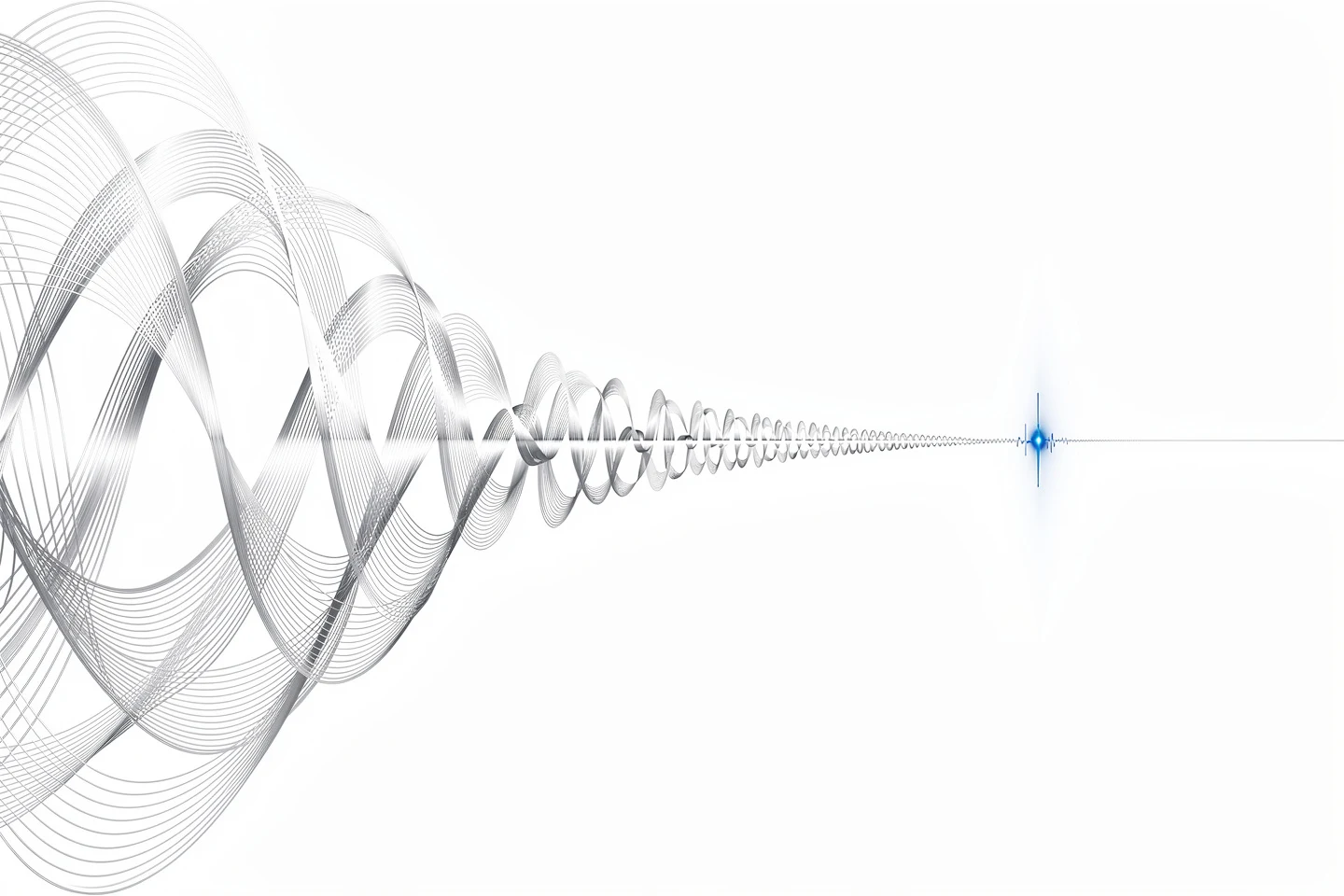
For decades, SETI has relied on radio astronomy, listening to the sky for narrowband signals from distant exoplanets in our Galaxy. But modern understanding of technological evolution casts doubt on this strategy: if our own civilization is rapidly shifting from powerful analog transmitters to low-power digital systems, other intelligences likely undergo similar transitions. The problem is compounded by signals fading in the interstellar medium, making them even harder to notice. The SETI blind spot is the fleeting nature of the era when a civilization’s technology aligns with our detection capabilities.
Methods
To quantify this effect, an analytical model describes a civilization’s technological level K(t) as exponential growth: K(t)=K0 $e^{αt}$, where α is the acceleration rate. This model encompasses historical trends—from slow pre-exponential development to the explosive growth of the AI era. The detection window $τ_d$ is defined as the period when K falls within the range accessible to our instruments [$K_{min}$, $K_{max}$]: below, signals are too weak; above, they rely on physics unknown to us. Then $τ_d$ = (1/α) ln($K_{max}$/$K_{min}$), derived from the exponential formula. The model doesn’t require detailing specific technologies and applies to any technosignatures.
Results
The main result: the detection window’s duration is inversely proportional to the acceleration rate. For slow growth (α≈0.007 year⁻¹), the window is ~2,000 years; for moderate (α≈0.03 year⁻¹), ~500 years; for rapid AI-driven growth (α≈0.14 year⁻¹), only ~100 years. For post-biological civilizations with α≥1 year⁻¹, the window shrinks to under 20 years. These estimates depend weakly on the choice of dynamic range $K_{max}$/$K_{min}$: even changing it by orders of magnitude, $τ_d$ varies little. Key takeaway: the faster a civilization evolves, the harder it is to catch it in a phase accessible to us. This offers an elegant explanation for the Great Silence: we don’t see our cosmic siblings not because they’re absent, but because they zip past our observational window.
Implications
For SETI science, this demands a radical strategy overhaul. Narrowband radio searches, targeting signals like our 1960s TV broadcasts, catch only a fleeting moment of technological youth. Future searches must embrace machine learning, go wideband, and leverage spectroscopy and photometry to spot anomalies—from excess heat of megastructures to inexplicable dips in stellar light curves. The focus shifts from detecting familiar signals to hunting any disruption of natural order.
Future development
Future development promises integration of AI into major sky surveys like the SKA project and the Vera Rubin Observatory. Algorithms are already being built to automatically separate natural phenomena from artificial anomalies in multidimensional data, covering spectra and photometry simultaneously. Within the next decade, we expect to conduct the first systematic wideband radio survey of the entire sky, capable of capturing even brief technosignatures.
Impact
The model will influence planning for future missions and observatories, including radio astronomy projects SKA and ngVLA, as well as ground-based optical surveys. It justifies the shift from one-off searches to continuous real-time sky scanning.
Next steps
Next steps include a pilot wideband radio survey using the 64-meter Sardinia telescope and subsequent data analysis with neural networks. In parallel, we’ll need theoretical criteria to distinguish a technological anomaly from an unknown astrophysical phenomenon.
Key open problems
The work directly tackles fundamental problems: exoplanet research, the Fermi paradox, and the nature of the Great Silence. It offers a quantitative explanation for why advanced civilizations might be invisible, linking the SETI problem to the broader question of technological singularity.
The knowledge machine's view
This section is addressed to the author of the paper and their colleagues. Neighbouring works were found by meaning-based search across our archive, not by word overlap. We do not review: we show the field around the work.
What the work does
The paper proposes an analytical model linking the rate of technological acceleration of a civilization to the duration of the detection window for its signals. It shows that with rapid development, this window shrinks to decades, which may explain the absence of observed extraterrestrial civilizations. The author concludes that it is necessary to shift from searching for narrowband radio signals to a broadband search for anomalies across all ranges.
Where its strength is
The model elegantly translates qualitative reasoning about technological evolution into a quantitative assessment of observability, without requiring details of specific technologies. This allows a rethink of SETI strategy toward an agnostic search for anomalies.
Where it could go next
- Searching for laser pulses from extraterrestrial civilizations could be a natural extension of the proposed approach: paper 2607.12106 discusses methods for detecting short optical signals, which may also be subject to the narrow window effect.based on: Space Fireflies: Hunting for the Laser Pulse of Extraterrestrial Civilizations arXiv:2607.12106
- The idea of shifting from searching for familiar signals to searching for any violations of the natural order resonates with the concept of 'gardens' in paper 2607.07592, which proposes looking for traces of engineering activity rather than communication signals.based on: From Smoke to Fire: What We’re Really Looking For in the Universe arXiv:2607.07592
- For fast artificial objects such as interstellar probes, the velocity filter effect discussed in 2606.05344v1 may be analogous to the narrow window effect: fast-moving objects are easily missed in standard observations.based on: Speed Filter of the Skies: How Swift Visitors Elude Telescopes arXiv:2606.05344v1
Worth trying
- Apply the detection window model to laser signals, estimating how the pace of laser technology development affects the duration of their observability.
- Develop machine learning algorithms for anomaly detection in broadband data, similar to those used for finding 'gardens'.
- Estimate the probability of missing fast interstellar objects in existing sky surveys, taking into account their velocity filter.
Nearby works in our archive
- Earth's Shadow Hunts for Alien Probessimilarity 0.71
- Search for alien radio signals along the planetary planesimilarity 0.68
- Hunting Ancient Civilizations Through Cosmic Dustsimilarity 0.68
- The Last Cry of an Alien Civilizationsimilarity 0.66
- Alien Radio Hum: How to Eavesdrop on Distant Civilizationssimilarity 0.66
- Space Fireflies: Hunting for the Laser Pulse of Extraterrestrial Civilizationssimilarity 0.64
- From Smoke to Fire: What We’re Really Looking For in the Universesimilarity 0.64
- Speed Filter of the Skies: How Swift Visitors Elude Telescopessimilarity 0.63
The archive is crowded around this work: 5 reviews nearby, closest at 0.71. This ground is well walked — and there is plenty to compare against.
Original abstract
as written by the authors arXiv:2607.07413
The search for extraterrestrial intelligence (SETI) has traditionally framed the detection challenge with a focus on the parameter $$L$$ in the Drake equation - the communicative lifetime of a civilisation. I argue that the more pertinent quantity is $$\tau_d$$, the duration during which a civilisation produces technosignatures that are \emph{actually detectable by us, now}. Modelling technological progress as an exponential process, we show that $$\tau_d = \alpha^{-1}\ln(K_{\rm max}/K_{\rm min})$$, where $$\alpha$$ is the rate of technological acceleration and $$[K_{\rm min},K_{\rm max}]$$ brackets the technology levels accessible to our instruments. As $$\alpha$$ increases, $$\tau_d$$ can shrink to mere decades, dramatically narrowing the window in which civilisations overlap technically. This ``technology mismatch'' has implications for future search strategies, emphasising broadband and technology-agnostic approaches, as well as anomaly detection across multi-wavelength/messenger survey data.
Earth’s own radio broadcasts have been wideband and low-power since the 1990s — today our phones emit more scattered signal than the analog TV transmitters of the past.
The concept of a fleeting detection window echoes Arthur C. Clarke’s story ‘The Sentinel,’ where an alien artifact waits millions of years for someone to activate it, but the active phase is brief.
Key numbers
- Acceleration rate α (fast): 0.14 year⁻¹
- Detection window τ_d (fast): ~100 years
- Dynamic range K_max/K_min: 10⁶
- Technology doubling time T_2 (fast): 5 years
- Window for post-biological civilizations: ≤20 years