Imaginary Heat Capacity as a Witness of Temporal Entanglement ✛
Context
Quantum mechanics treats space and time differently: position is an operator, while time is an external parameter. Because there is no tensor product structure for temporal slices, the usual notion of entanglement does not apply; however, nonclassical temporal correlations exist and can be tested via temporal Bell or Leggett-Garg inequalities. Testing such inequalities for macroscopic bodies is extremely difficult due to the inaccessibility of individual subsystems. Previously, in quantum thermodynamics, witnesses of spatial entanglement based on heat capacity and magnetic susceptibility were proposed. This work extends these ideas to the temporal domain by linking the imaginary part of complex heat capacity to temporal nonclassicality. Related works on the arXiv concern quantum entanglement in collisions, quantum clocks for the early universe, and quantum batteries, but none uses heat capacity as a witness of temporal correlations.
Methods
The authors consider a macroscopic system in thermal equilibrium, to which a weak periodic temperature modulation is applied. In the linear regime, the response of the Hamiltonian is described via the fluctuation-dissipation theorem and the Kubo formula, leading to the definition of complex heat capacity as the Fourier transform of the response function. The imaginary part of the heat capacity is expressed through the commutator of Hamiltonians at different times. For a specific model, a qubit interacting with a thermal reservoir and described by the Lindblad equation, an analytical expression for the imaginary heat capacity is derived. Then, a pseudodensity matrix for two instants of time is constructed, whose elements are related to correlation functions of Hamiltonian components, which in turn are related to complex heat capacity. Based on the pseudodensity matrix, the maximum value of the Bell parameter for the temporal CHSH inequality is computed and its time dependence is analyzed.
Results
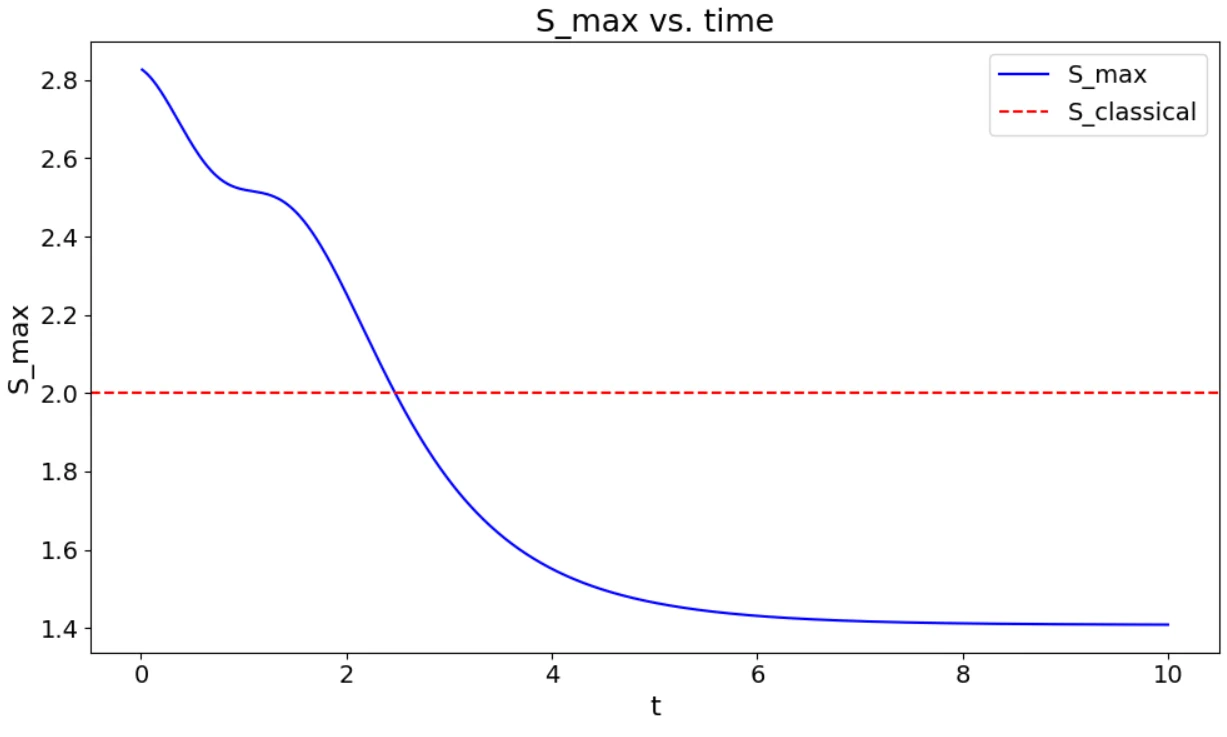
For a qubit in contact with a thermal reservoir, a pseudodensity matrix is obtained whose eigenvalues exhibit negativity in a certain time window, indicating temporal nonclassicality. The maximum Bell parameter Smax violates the classical bound of 2 at early times, reaching values up to the quantum Tsirelson bound, and then decays below the classical threshold as decoherence sets in. It is shown that negativity of the pseudodensity matrix and violation of the temporal CHSH inequality are sensitive to different aspects of temporal correlations: the former is a sufficient but not necessary condition, and the latter is also sufficient but not necessary. For a full characterization of temporal nonclassicality, both criteria must be considered together. Bounds on the imaginary part of the heat capacity are established that guarantee temporal entanglement: only a certain range of C''(ω) values leads to violation of the classical limit.
Implications
This work proposes a new experimentally accessible witness of temporal entanglement based on the standard technique of temperature-modulated calorimetry. Unlike previous approaches that require precise control over the quantum state and sequential measurements in additional bases, here it suffices to measure the imaginary part of the heat capacity. This opens the possibility of testing temporal quantum correlations in macroscopic condensed matter systems where direct tomography is impossible. Compared to related works using photonic or NMR systems to simulate pseudodensity matrices, this method does not require noninvasive measurements and is robust against decoherence.
Future development
In the future, the proposed formalism could be extended to systems with many qubits and to other thermodynamic observables such as magnetic susceptibility. It would be interesting to investigate the dependence of pseudodensity matrix negativity on the initial state of the qubit, including pure and maximally mixed states. Generalization to two spatially separated qubits measured at different times is also possible, which would connect the results to known works on heat capacity as a witness of spatial entanglement.
Impact
The results may stimulate experimental studies of temporal quantum correlations in solid-state systems and the development of quantum thermodynamics as a tool for probing fundamental aspects of quantum mechanics.
Next steps
An experimental verification of the predictions is planned in a follow-up work, as well as theoretical generalization to many-body systems and other initial states.
Key open problems
This work is directly related to the fundamental problem of the quantum-classical transition and the role of decoherence in suppressing nonclassical correlations on a macroscopic scale. It also contributes to the long-standing debate about whether quantum effects can manifest in thermodynamic quantities of large systems.
The knowledge machine's view
This section is addressed to the author of the paper and their colleagues. Neighbouring works were found by meaning-based search across our archive, not by word overlap. We do not review: we show the field around the work.
What the work does
The study establishes a link between the imaginary part of complex heat capacity and temporal nonclassicality through the pseudo-density matrix. Using a qubit interacting with a thermal reservoir as an example, it is shown analytically that the negativity of the pseudo-density matrix and the violation of the temporal CHSH inequality indicate temporal entanglement.
Where its strength is
The strength of the work lies in providing an experimentally accessible macroscopic criterion for temporal nonclassicality based on heat capacity measurements, without the need for manipulations of individual subsystems.
Where it could go next
- It might be interesting to compare the proposed criterion with the hierarchy of temporal correlations discussed in the work on quantum echo, to see how imaginary heat capacity fits into the broader picture of temporal quantum effects.based on: Death and Rebirth of Quantum Echo: A Hierarchy of Temporal Correlations in a Qubit arXiv:2505.01379v1
- Closely related is the work on the quantum coherence microscope, where the phase of atoms in a lattice is measured directly; perhaps similar experimental techniques could test predictions for temporal entanglement in condensed matter systems.based on: Quantum Coherence Microscope: Seeing the Phase of Atoms in a Lattice arXiv:2608.09924v1
Worth trying
- Test whether the connection between imaginary heat capacity and temporal nonclassicality holds for systems with more complex spectra, such as a harmonic oscillator in a thermal reservoir.
- Investigate whether imaginary heat capacity can serve as a witness of temporal entanglement in nonequilibrium protocols, such as quantum batteries.
Why this may matter
If the criterion can be confirmed experimentally, it would open the way to studying temporal quantum correlations in macroscopic systems, which could have applications in quantum thermodynamics and quantum technologies.
Nearby works in our archive
- Time Gets Entangled Like Threadssimilarity 0.58
- Death and Rebirth of Quantum Echo: A Hierarchy of Temporal Correlations in a Qubitsimilarity 0.57
- Quantum Clocks for the Infant Universesimilarity 0.57
- A Quantum Dot That Entangles Lightsimilarity 0.56
- Quantum Coherence Microscope: Seeing the Phase of Atoms in a Latticesimilarity 0.55
- Three Fates of Quantum Echosimilarity 0.55
The archive is sparse around this work: the closest review is only 0.58, against a usual 0.64. It looks like few have drilled nearby.
The imaginary part of heat capacity, long regarded merely as a measure of entropy production rate, turns out to be linked to a purely quantum phenomenon, temporal entanglement, giving it a new physical meaning.
Key numbers
- Classical bound of the temporal CHSH inequality: 2
- Tsirelson quantum bound: 2√2 ≈ 2.828
- Onset time of pseudodensity matrix negativity: t = π/4 (in natural units)
- Time when CHSH violation disappears: t ≈ 2.5 (in natural units)
- Time when negativity disappears: t ≈ 5.2 (in natural units)