Imaginary Heat Capacity: An Echo of Quantum Time ✛
A thermometer dipped into a sample usually tells you only the temperature. But if the temperature oscillates slightly and the sample responds with a delay, that response hides more: the imaginary part of the heat capacity, which turns out to be able to hear the quantum echo of time.
Quantum mechanics treats space and time differently: position is an operator, while time is an external parameter. Therefore, the usual notion of entanglement, which requires describing two subsystems simultaneously, does not work for different moments in time. Instead, physicists use the pseudo-density matrix, a generalization of the density matrix to multiple times. Its negative eigenvalues, or negativity, indicate nonclassical temporal correlations. But how can one measure such a matrix for a macroscopic object, where individual particles are inaccessible? The answer came from thermodynamics.
The authors considered a qubit coupled to a thermal reservoir and applied a weak periodic temperature modulation. In the linear response, the imaginary part of the heat capacity is expressed through the commutator of Hamiltonians at different times. This allowed them to relate it to the elements of the pseudo-density matrix and derive criteria for temporal nonclassicality. For a specific model, they obtained analytical expressions and found bounds: only a certain range of imaginary heat capacity values guarantees violation of the classical limit.
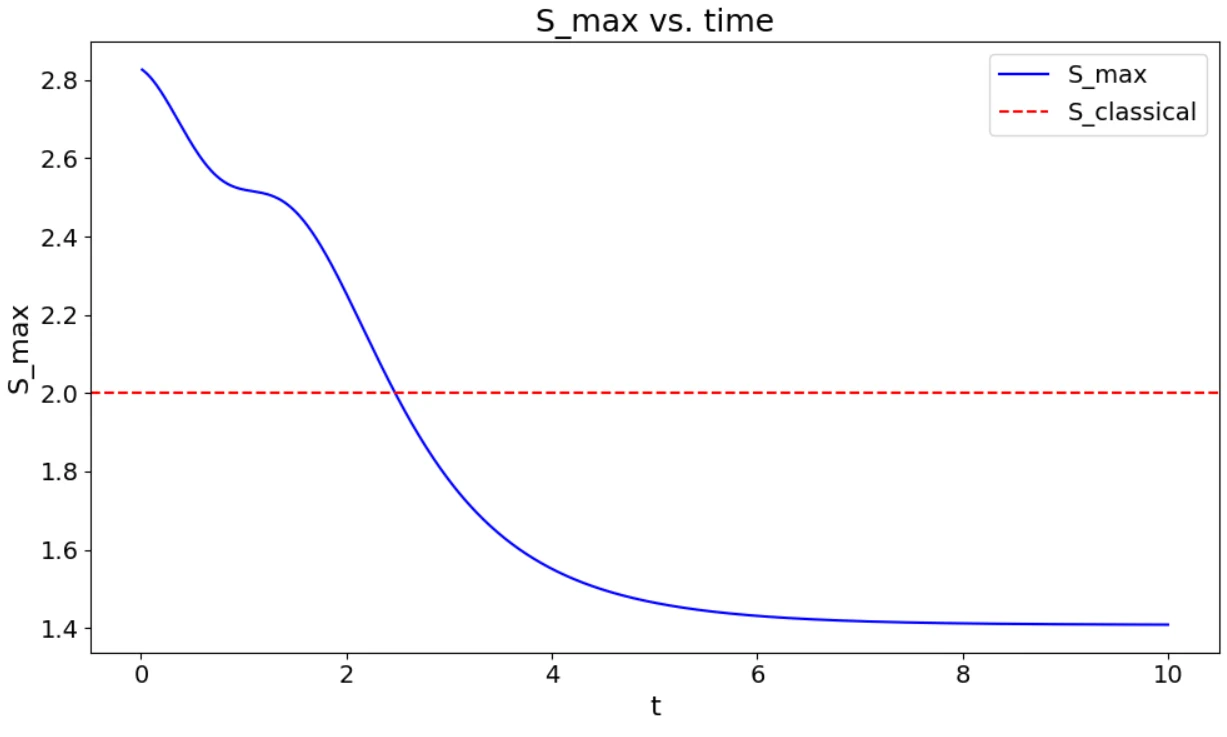
The numbers speak for themselves: the classical bound for the temporal CHSH inequality is 2, while the quantum Tsirelson bound reaches 2√2 ≈ 2.828. At early times, the maximum Bell parameter Smax exceeds 2, confirming temporal nonclassicality, but as decoherence sets in (the loss of quantum coherence due to the environment), it drops below the classical threshold. The negativity of the pseudo-density matrix disappears even later: at t ≈ 5.2 in natural units, whereas the CHSH violation vanishes already at t ≈ 2.5. This means that both criteria are sensitive to different aspects of temporal correlations, and a complete picture requires both.
Previously, testing temporal entanglement required precise control over the quantum state and sequential measurements in additional bases. Now, it suffices to measure the imaginary part of the heat capacity, using the standard technique of temperature-modulated calorimetry. This opens the way to studying temporal quantum effects in condensed matter today. In the future, the formalism can be extended to many-body systems and other thermodynamic observables, such as magnetic susceptibility. A thermometer that hears the quantum echo of time might soon become a common tool in laboratories.
The imaginary part of the heat capacity, long thought to be merely a measure of entropy production rate, turns out to be linked to a purely quantum phenomenon: temporal entanglement, giving it a new physical meaning.