Galactic Contrail: A Dark Object Carved a Path Through NGC 3627 ✛
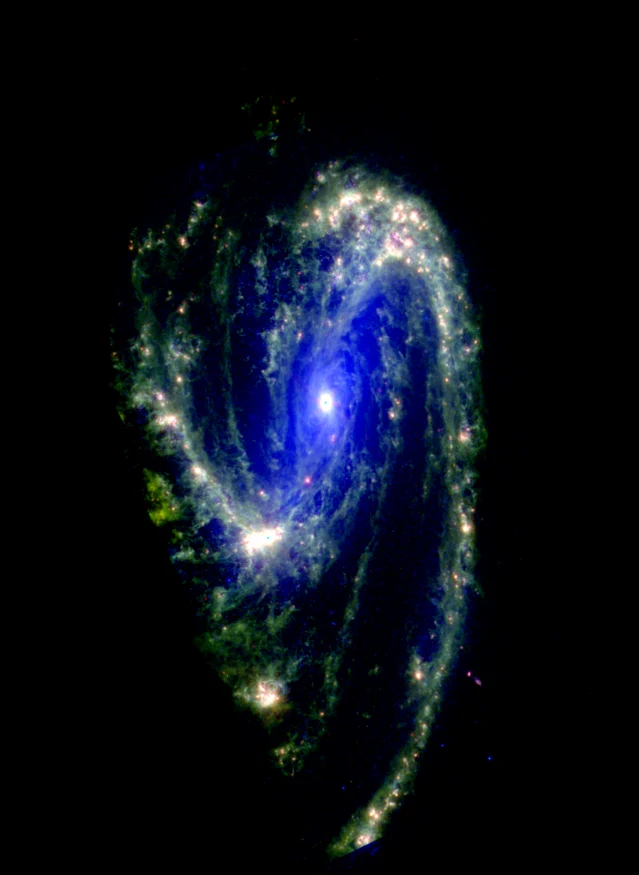
NGC 3627, a spiral beauty in the constellation Leo, harbors a trail that fits no standard scenario. A narrow band of cold gas, a molecular trail, stretches more than 8 kiloparsecs (thousands of parsecs, each about 3260 light-years) with a width of about 200 parsecs. That is like a thread as long as a football field and as thick as a pencil. Such structures have only been seen before in the Milky Way, and they were no larger than a few parsecs. Here, though, we have a true galactic contrail, left by something massive that plowed through the disk.
The gas inside the trail moves chaotically, with speeds around 10 km/s, which is supersonic turbulence, because the local sound speed in the warm neutral medium is only 7.5 km/s. Meanwhile, the velocity along the trail changes smoothly: just 10 km/s per kiloparsec, whereas in the neighboring spiral arm it is 30 km/s per kiloparsec. This pattern is characteristic of gravitational focusing: the passing object's gravity drew the gas into a narrow band, like a finger drawn across a fogged window gathers droplets into a line.
To leave such a trail, the object must have been extremely massive. Calculations based on gravitational wake theory give a mass on the order of 10 million solar masses. This could be a massive black hole or the core of a dwarf galaxy. The crossing time is only about 20 million years, a blink of an eye by galactic standards. That means the event happened very recently, and the trail has not yet had time to dissipate.
Previously, it was unknown whether such kiloparsec-scale molecular trails exist in external galaxies and whether they could indicate the passage of massive dark objects. Now we know: they do. And this opens a new way to search for hidden populations of black holes and dwarf galaxies that are difficult to detect directly. Instead of looking for the object itself, you look for its trail, as in a detective story where the culprit is betrayed by footprints at the scene.
Future surveys, such as Rubin LSST, could search for stellar components along the trail's axis, and higher-resolution ALMA observations could reveal kinematic signatures of the perturbing object. Perhaps similar trails will be found in other galaxies, and then we can estimate how often massive objects pierce galactic disks. The galactic contrail in NGC 3627 is the first, but likely not the last.
The trail in NGC 3627 is 40 times longer than it is wide, like a thread as long as a football field and as thick as a pencil. If such a trail existed in the Milky Way, it would stretch across a quarter of the galaxy's diameter.
In Arthur C. Clarke's novel "Rendezvous with Rama," a mysterious object hurtles through the Solar System, leaving only a gravitational disturbance in its wake. The galactic trail in NGC 3627 is a real analog of such a disturbance, recorded in gas and dust.