A Galactic Wake: How a Dark Object Carved Through NGC 3627 ✛
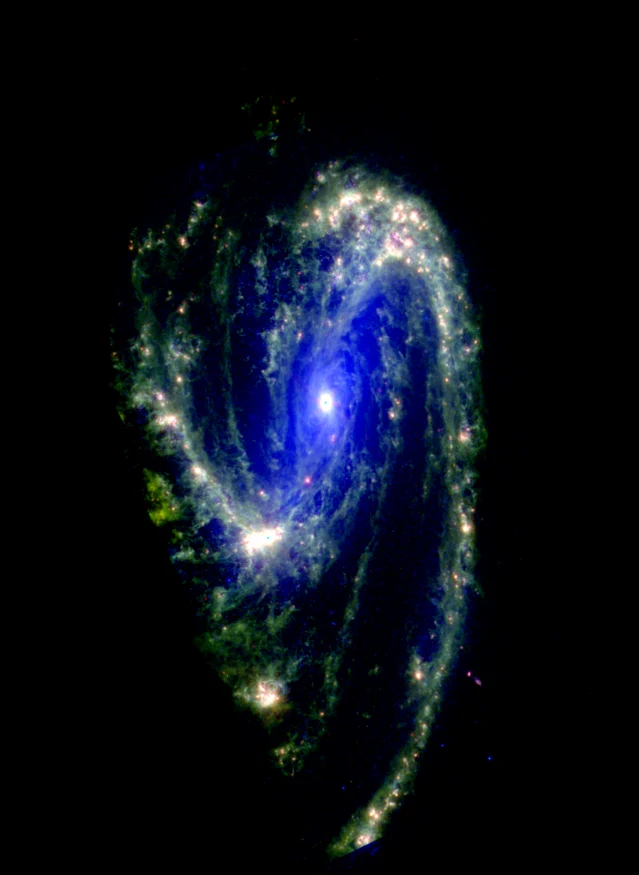
Context
In galaxy disks, gas is organized into spiral arms, but occasionally narrow linear structures appear: molecular wakes that do not fit standard star formation or turbulence scenarios. Previously, such wakes were observed in the Milky Way, but their sizes did not exceed a few parsecs. Nearby in the archive are studies of dark matter, dark halos, and galaxy interactions, but none of them dealt with kiloparsec-scale molecular wakes in external galaxies. This paper stands apart: it is the first to report a wake of this scale outside our Galaxy and proposes an explanation via the flyby of a compact object.
Methods
The study used data from the PHANGS-ALMA survey of CO(2-1) emission to map the gas, and the PHANGS-JWST survey in infrared filters F770W, F2100W, and F335M for dust and star-forming regions. Magnetic field orientation was derived from synchrotron polarization at the VLA. Signal-to-noise and surface density maps were constructed, as well as position-velocity diagrams along the wake. To estimate the mass of the flyby object, the gravitational wake theory was applied, relating mass to velocity dispersion, flyby speed, and interaction radius.
Results
The detected structure extends over 8 kpc with a width of about 200 pc, giving a length-to-width ratio of more than 40. Inside the wake, the velocity dispersion is about 10 km/s, which exceeds the sound speed in the warm neutral medium (≈7.5 km/s) and indicates supersonic turbulence. The velocity gradient along the main part of the wake is only 10 km/s per kpc, whereas in the adjacent spiral arm it is 30 km/s per kpc. The crossing time of the wake, estimated from the width and velocity dispersion, is about 20 million years, consistent with a recent flyby. The mass of the object, calculated from the gravitational wake theory, is on the order of $10^7$ solar masses, consistent with a massive black hole or the core of a dwarf galaxy.
Implications
This work shows for the first time that kiloparsec-scale molecular wakes can exist in external galaxies and serve as indicators of massive dark object flybys. Unlike neighboring studies on dark matter and halo dynamics, here a direct observable signature of a compact object interacting with the interstellar medium is proposed. This opens a new way to search for hidden populations of black holes and dwarf galaxies that are difficult to detect directly.
Future development
Future deep surveys, such as Rubin LSST, could search for stellar components along the wake axis, while higher-resolution ALMA observations could reveal kinematic signatures of the perturbing object. Similar wakes may be found in other galaxies, allowing estimates of the frequency of massive object flybys through disks.
Impact
The results will affect studies of massive black hole and dwarf galaxy populations, as well as understanding of gas dynamics in galactic disks.
Next steps
Conduct deep optical and infrared observations along the wake to search for a stellar component, and search for similar structures in other galaxies from the PHANGS surveys.
Key open problems
This work addresses the problem of a hidden population of massive compact objects in galaxies, which remains unsolved in astrophysics. The detection of the wake provides an indirect method to estimate their abundance and distribution, which is important for understanding the formation of supermassive black holes and the evolution of dwarf galaxies.
The knowledge machine's view
This section is addressed to the author of the paper and their colleagues. Neighbouring works were found by meaning-based search across our archive, not by word overlap. We do not review: we show the field around the work.
What the work does
Using PHANGS-ALMA and PHANGS-JWST data, the authors detected a narrow molecular trail in galaxy NGC 3627, stretching over 8 kpc in length and about 200 pc in width. They constructed CO and dust maps, position–velocity diagrams, and estimated velocity dispersion, crossing time, and the mass of the passing object based on the gravitational wake theory.
Where its strength is
This work is the first to demonstrate a kiloparsec-scale molecular trail in an external galaxy and proposes a specific formation mechanism via gravitational focusing by a compact object, making the trail a potential indicator of dark massive bodies.
Where it could go next
- It might be interesting to compare the detected trail with dynamical perturbations in the stellar disk left by passing massive objects; the archive contains an analysis of a work on the impact wakes of an invisible object in Milky Way stars.based on: An Invisible Stone in the Stellar Pond arXiv:2508.19643
- A possible follow-up is to search for similar trails in other galaxies using archival interferometer data to estimate the frequency of such events; the archive also features a quick review of a study where the gravity of a massive object acts as a magnifying glass, which could help detect faint structures.based on: Invisible Object Weighing a Million Suns: Gravity Acts as a Magnifying Glass arXiv:2510.07382
Worth trying
- Check whether the appearance of the trail correlates with an excess of stellar velocities or disk asymmetry, as suggested in the analysis of the stellar wake.
- Use gravitational lensing methods to search for trail candidates in deep surveys.
- Compare the velocity dispersion along the trail with turbulence models to refine the parameters of the flyby.
Why this may matter
If such trails indeed arise from the passage of massive dark objects, they could become a new tool for mapping the hidden population of black holes and dwarf galaxy nuclei, which is important for understanding dark matter and galaxy evolution.
Nearby works in our archive
- An Invisible Stone in the Stellar Pondsimilarity 0.54
- A Cosmic Lighthouse with a Delaysimilarity 0.53
- Invisible Object Weighing a Million Suns: Gravity Acts as a Magnifying Glasssimilarity 0.53
- Molecules at the Black Hole: Who Sped Them Upsimilarity 0.53
- Galactic Wind: How Stars Blow Gas Out of a Galaxysimilarity 0.52
- Traces of Invisible Jets in the Cloudssimilarity 0.51
The archive is sparse around this work: the closest review is only 0.54, against a usual 0.64. It looks like few have drilled nearby.
The wake in NGC 3627 is 40 times longer than it is wide: like a thread as long as a football field and as thick as a pencil. If such a wake existed in the Milky Way, it would stretch across a quarter of the galaxy's diameter.
In Arthur C. Clarke's novel "Rendezvous with Rama," a mysterious object hurtles through the Solar System, leaving only a gravitational disturbance in its wake. The galactic wake in NGC 3627 is a real analog of such a disturbance, recorded in gas and dust.
Key numbers
- wake length: >8 kpc
- wake width: ≈200 pc
- velocity dispersion: ≈10 km/s
- crossing time: ≈20 million years
- object mass: ≳2×10⁶ M⊙ (estimate ~107 M⊙)