Simple

A Giant Black Hole's Wake in a Spiral Galaxy ⚡ экспресс

Original: "Galactic Contrail in NGC 3627 caused by Dwarf Galaxy Candidate or Massive Black Hole Flyby"
· Mengke Zhao, Guang-Xing Li
arXiv:2509.20832 · 2025-09-25 · CC BY-SA 4.0 · ⏱ 1 min · Galaxies Cosmology
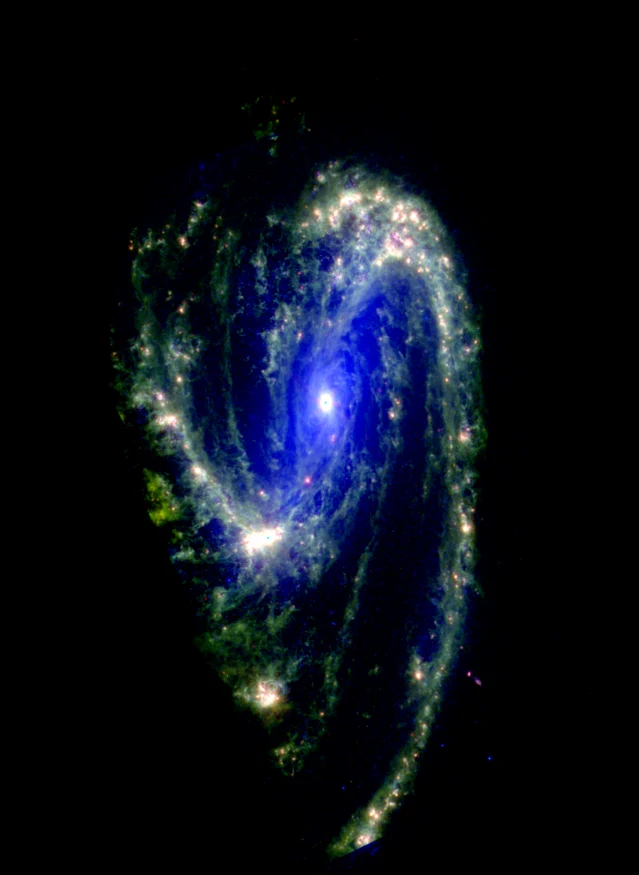
Astronomers have spotted a huge gas trail in galaxy NGC 3627, resembling the wake of a speedboat.
Abstract

Astronomers have spotted a giant gas trail in galaxy NGC 3627 that looks like a contrail from an airplane. It's 40 times longer than it is wide and stretches for thousands of light-years. This long, narrow 'condensation' trail was left behind by a massive object that tore through the galaxy's disk—maybe a black hole or the core of a dwarf galaxy. Now, trails like this could become a way to find hidden giants in space.

Links in the knowledge graph 1

In the galaxy NGC 3627, a trail of cosmic dust and gas has been found, resembling the wake of a speedboat. The role of the speedboat was played by a massive black hole or the core of a dwarf galaxy that tore through the disk at over 300 km/s. The wake stretches for 26,000 light-years but is just 650 light-years wide — like a pencil line drawn across a football field. The gas inside moves chaotically at tens of kilometers per second, hinting at a recent event: only about 20 million years ago.

This is the first such “cosmic wake” outside the Milky Way and the most elongated known: 40 times longer than it is wide.

The object that left this trail likely had a mass millions of times that of the Sun — an invisible giant that gave itself away by rippling the galactic disk. Such wakes can be spotted by telescopes like James Webb and ALMA, opening a new way to hunt for hidden massive bodies.

🎯 It takes light 26,000 years to travel from one end of the wake to the other — that's longer than the distance from Earth to the center of our Galaxy.

Scientists
Stephen HawkingJacob BekensteinAlbert EinsteinFritz ZwickyVera RubinBernhard Riemann
Tags
black hole galaxy JWST cosmic dust
Laws
Hawking radiationgravitational lensingBekenstein-Hawking entropyEinstein field equationsvirial theoremno-hair theorem
Original: arXiv:2509.20832 · CC BY-SA 4.0 · bridge42worlds