Quantum Chip Outperforms Supercomputers: Two Hours vs. Years express
The task resembles a giant maze with a single exit among billions of dead ends. A conventional computer checks each corridor step by step — taking centuries. A quantum processor launches a wave that seeps through all paths at once. The correct route echoes back, amplifying, and the answer is found in hours. That’s exactly how the “peak” circuits worked in the new experiment.
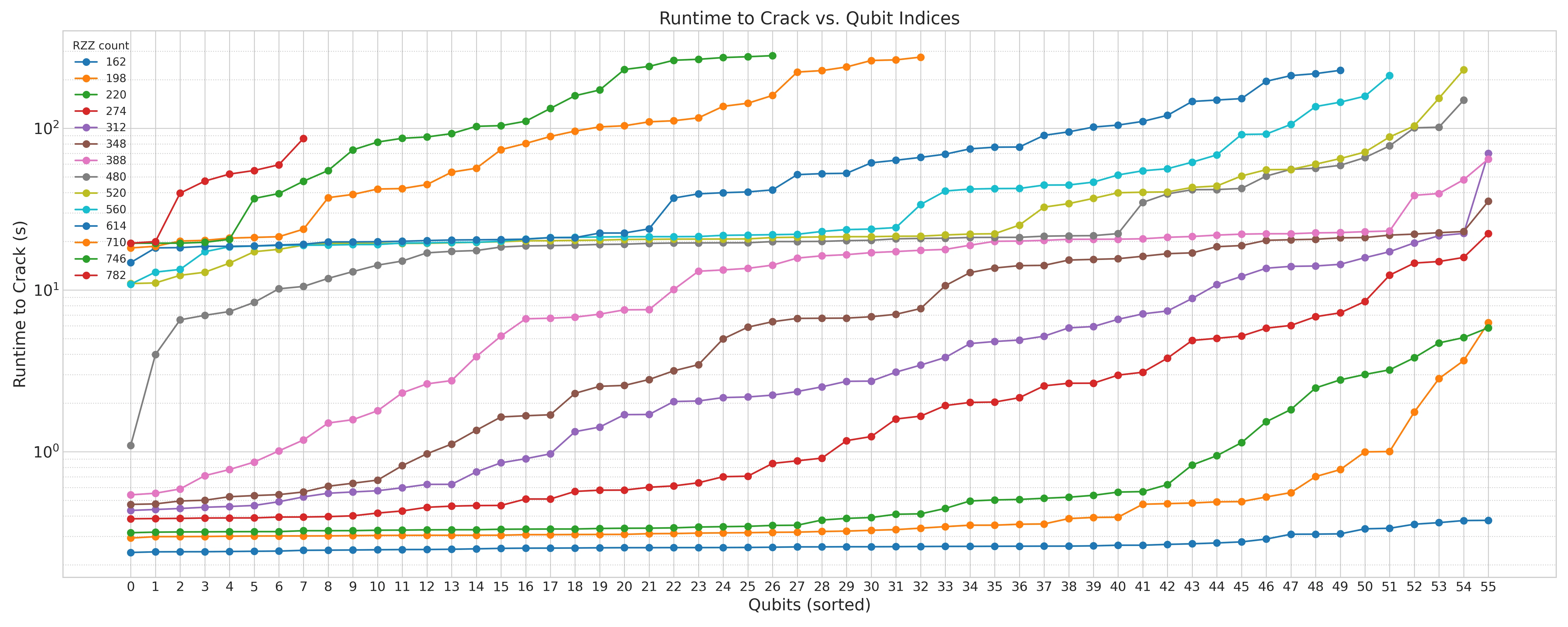
With each additional fork, the quantum chip’s advantage grows not just quickly, but frighteningly so, like the expansion of the Universe accelerates galaxies. Surprisingly, the quantum device’s answer is probabilistic: it guesses the path with high accuracy but doesn’t guarantee it. Yet that accuracy is enough to make classical verification take years. In the experiment, the most complex circuit had 2,000 forks. H2 found the exit in two hours; supercomputers would need years.
Original abstract
as written by the authors arXiv:2510.25838
We design and demonstrate heuristic quantum advantage with peaked circuits (HQAP circuits) on Quantinuum's System Model H2 quantum processor. Through extensive experimentation with state-of-the-art classical simulation strategies, we identify a clear gap between classical and quantum runtimes. Our largest instance involves all-to-all connectivity with 2000 two-qubit gates, which H2 can produce the target peaked bitstring directly in under 2 hours. Our extrapolations from leading classical simulation techniques such as tensor networks with belief propagation and Pauli path simulators indicate the same instance would take years on exascale systems (Frontier, Summit), suggesting a potentially exponential separation. This work marks an important milestone toward verifiable quantum advantage, as well as providing a useful benchmarking protocol for current utility-scale quantum hardware. We sketch our protocol for designing these circuits and provide extensive numerical results leading to our extrapolation estimates. Separate from our constructed HQAP circuits, we prove hardness on a decision problem involving generic peaked circuits. When both the input and output bitstrings of a peaked circuit are unknown, determining whether the circuit is peaked constitutes a QCMA-complete problem, meaning the problem remains hard even for a quantum polynomial-time machine under commonly accepted complexity assumptions. Inspired by this observation, we propose an application of the peaked circuits as a potentially quantum-safe encryption scheme~\cite{chen2016report,kumar2020post,joseph2022transitioning,dam2023survey}. We make our peaked circuits publicly available and invite the community to try additional methods to solve these circuits to see if this gap persists even with novel classical techniques.
The most complex circuit involved 2,000 operations, like an orchestra of 2,000 instruments playing in unison.