Quantum supremacy is the milestone at which a quantum computer performs a calculation that is practically impossible for any classical supercomputer, regardless of how much time or resources are available. It is not about beating a classical machine in every task, but about demonstrating a clear, unambiguous advantage in a specific, well-defined problem. The concept is crucial because it provides the first experimental evidence that quantum mechanics can be harnessed for computation in a way that fundamentally outstrips classical physics.
History
The term was coined by John Preskill in 2012. The first claimed experimental demonstration was by Google's Sycamore processor in 2019, followed by the Chinese Jiuzhang photonic processor in 2020, with subsequent improvements like Jiuzhang 4.0.
How it works
The demonstration typically involves a carefully designed problem that is easy for a quantum processor to solve but exponentially hard for a classical one. For example, sampling the output distribution of a random quantum circuit or boson sampling with photons. The quantum computer runs the experiment and produces results; classical supercomputers are then challenged to reproduce the same results using the best-known algorithms. When the classical simulation time becomes astronomically large (e.g., thousands of years), while the quantum device finishes in minutes or hours, supremacy is claimed.
In practice
Beyond the benchmark itself, the techniques developed for supremacy experiments—such as verifying random quantum circuits—are used to validate quantum hardware and develop error-correction protocols.
Fun fact
The classical simulation of Google's 2019 supremacy experiment was later improved using a clever algorithm, reducing the estimated time from 10,000 years to a few days on a large cluster, showing that 'supremacy' is a moving target.
In mathematics there is a sieve that sifts not dust, but infinity itself. It’s called a Q-space: here any subset turns out to be a Gδ set — a countable intersection of open sets, as if sifted through an unimaginably fine mesh.
In 1953, mathematician Alexander Grothendieck proved a theorem that became a cornerstone in the theory of tensor products. It states that for ordinary function spaces, two natural norms, the projective and the injective, are equivalent up to a universal constant. In other words, two ways of measuring the 'size' of combinations of vectors give similar results.
A classical computer sorts data like a person meticulously sifting through grains of sand of different colors. A quantum processor takes its cue from nature: just as a droplet of water splits sunlight into a rainbow, revealing all hues at once, this new algorithm instantly grasps the essence of vast information arrays.
In a lab, you measure a very weak signal — say, a tiny change in a magnetic field. The instrument trembles from passing cars, from the experimenter's breathing, from wires heating up. This technical noise can't be fully eliminated, and it sets a limit on precision. An ordinary sensor works like a scale that sways with any draft.
IBM's Heron R3 quantum computer handled a task that made a classical method back down. The challenge was finding the ground state, the lowest energy level, of a system of 49 quantum bits.
Ordinary computer memory constantly uses energy to store ones and zeros. Superconductors, on the other hand, carry current with zero loss — if you could build memory from them, it would barely draw any power. The catch is that superconductors can't remember: their state changes too easily.
Uranium ditelluride crystals turned out to be the exception.
Finding the largest group of strangers among a crowd is a challenge that pops up in logistics, chemistry, and scheduling. Ordinary computers hit a black hole here: not from lack of power, but because the problem's structure swallows any classical solution.
The new quantum algorithm sidesteps the trap.
When making popcorn, a microwave uses electricity only to heat the kernels. A gas stove heats the entire burner and the air around it. The same difference applies between a photonic quantum chip and a classical supercomputer when solving a problem devised by Scott Aaronson.
A quantum computer is like an exquisite dish. There are recipes for ordinary kitchens, but special quantum states are secret ingredients that turn the dish into a masterpiece. One of them is 'magic'. The term was coined by John Preskill in 2018.
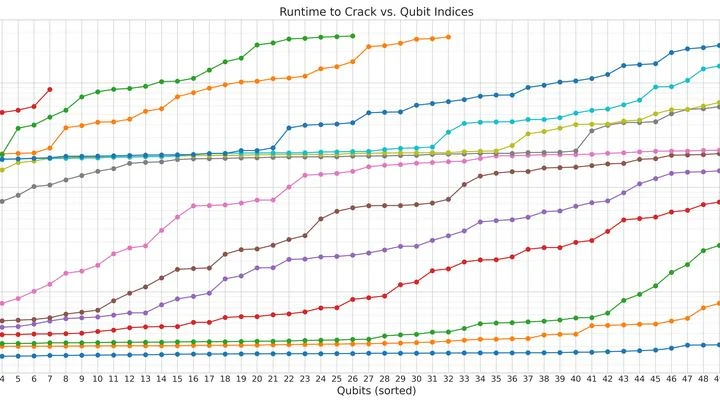
The task resembles a giant maze with a single exit among billions of dead ends. A conventional computer checks each corridor step by step — taking centuries. A quantum processor launches a wave that seeps through all paths at once. The correct route echoes back, amplifying, and the answer is found in hours. That’s exactly how the “peak” circuits worked in the new experiment.
A laser pulse lasting one and a half nanoseconds hits a nonlinear crystal, and a stream of squeezed light is born. That is how an experiment on the Jiuzhang 4.0 quantum processor in China begins.