How Galaxies 'Simmered' Metals in the Cosmic Noon Era express
Galaxies are like giant kitchens where, in stellar cores, light atoms are fused into heavy ones — much like flour and water becoming bread. When a star dies, it spills its accumulated riches into the interstellar gas, seasoning it with 'spices': oxygen, carbon, iron. The James Webb Telescope caught the faint glow of heated oxygen in 34 galaxies shining 3 billion years after the Big Bang. By measuring the brightness of this light, like gauging a flame's temperature, astronomers calculated the oxygen abundance — breaking light into its colors works more precisely than a kitchen thermometer here.
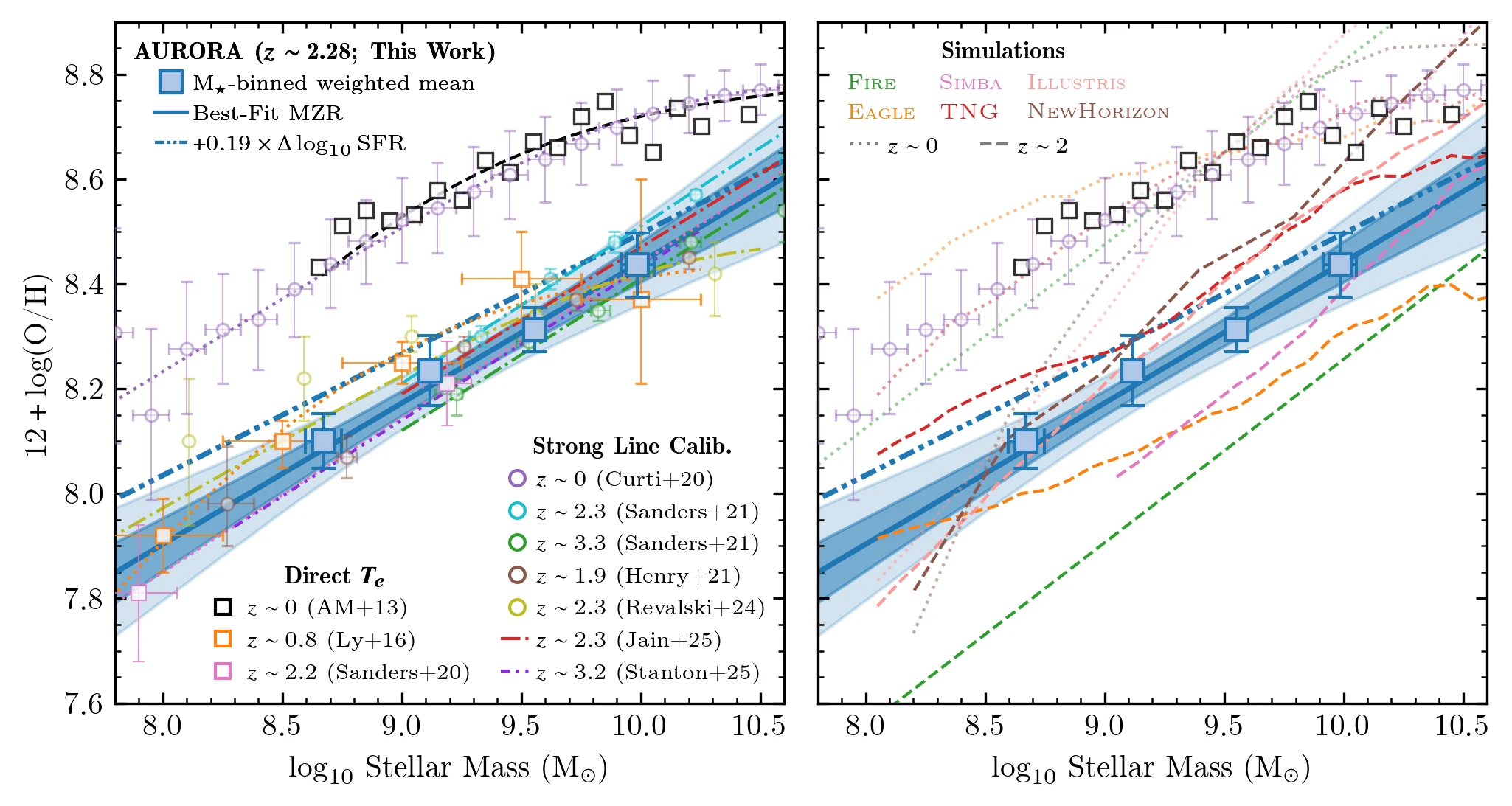
It turned out: the heavier the galaxy, the more oxygen it holds — a relationship nearly identical to that of today's nearby galaxies. But computer simulations of the universe's evolution couldn't reproduce this consistency. Back in the era of cosmic expansion 10 billion years ago, stars were born much faster, yet the recipe for metal enrichment never wavered — as if a chef cooking ten times faster never missed a gram of seasoning.
Original abstract
as written by the authors arXiv:2512.16989
We present new constraints on the Mass -- Metallicity (MZR) and Fundamental Metallicity Relations (FMR) using a sample of 34 galaxies at $$1.38\leq~z\leq~3.5$$ (median $$z=2.28$$). These galaxies have direct $$T_e$$ measurements from [O\sc{iii}]4363\AA~and/or [O\sc{ii}]7320,7331\AA~auroral emission lines detected with \textit{JWST}/NIRSpec as part of the AURORA survey. The detection of both oxygen auroral lines allows for dual-zone direct $$T_e$$ measurements and expands the dynamic range in $$12+\log\mathrm{(O/H)}$$ (7.68 to 8.65 dex), stellar mass ($$10^{8}$$ to $$10^{10.4}$$ M$$_\odot$$), and star-formation rate ($$1$$ to $$100$$ M$$_\odot$$ yr$$^{-1}$$) compared to previous direct $$T_e$$ studies of the high-redshift MZR and FMR. We characterize the $$z\sim2$$ MZR and find a slope of $$0.27\pm0.04$$ and normalization of $$12+\log\mathrm{(O/H)} = 8.44\pm0.04$$ at $$10^{10}$$ M$$_\odot$$ with an intrinsic scatter of 0.10 dex, consistent with past strong-line MZR measurements. Comparisons with $$z\sim2$$ predictions from six simulations reveal that none reproduce our observed MZR normalization evolution between $$z\sim0$$ and $$z\sim2$$. This discrepancy suggests current models do not fully capture the chemical enrichment and feedback processes occurring at cosmic noon. However, all 34 galaxies are on or above the star-forming main sequence such that our sample may be biased towards lower $$12+\log\mathrm{(O/H)}$$ if the FMR persists at $$z\sim2$$. Correcting for this selection effect would increase O/H by $$\approx0.1$$ dex at 10$$^{9.3}$$ M$$_\odot$$ (the median mass of our sample) bringing our MZR into better agreement with that of \texttt{TNG}. Lastly, we find our $$z\sim2.3$$ sample is consistent with the $$z\sim0$$ FMR within 0.1 dex in O/H, indicating that the smooth secular mechanisms regulating chemical enrichment, star formation, stellar mass, and outflows were in place at cosmic noon.
The oxygen in our breath was once hurled out by an exploding massive star — we inhale the ashes of supernovae.