Stellar nucleosynthesis is the process by which stars forge heavier chemical elements from lighter ones through nuclear fusion reactions in their interiors. This is the mechanism that created most of the elements heavier than hydrogen and helium in the universe, from carbon and oxygen in main-sequence stars to iron and beyond in supernovae and neutron star mergers. Without this process, the universe would consist almost entirely of hydrogen and helium, and planets, life, and everything we know would not exist.
History
The concept was developed in the mid-20th century, with key contributions from Arthur Eddington (who first suggested stars are powered by fusion), and later Fred Hoyle, William Fowler, and the B2FH paper (Burbidge, Burbidge, Fowler, Hoyle) in 1957, which laid out the full framework of stellar nucleosynthesis.
How it works
In the core of a star, immense gravitational pressure and temperature (millions of degrees) overcome the electrostatic repulsion between atomic nuclei, allowing them to fuse. The process starts with hydrogen fusing into helium (proton-proton chain or CNO cycle). When hydrogen is exhausted, the core contracts and heats up, enabling helium to fuse into carbon and oxygen. For massive stars, this continues through successive stages, building elements up to iron, which is the most stable nucleus. Elements heavier than iron are produced primarily by neutron capture processes (s-process in asymptotic giant branch stars and r-process in supernovae or neutron star mergers).
In practice
Stellar nucleosynthesis explains the observed abundance of elements in the universe and is used to date stars and galaxies, as well as to understand the chemical evolution of the cosmos.
Fun fact
The calcium in your bones and the iron in your blood were forged in the cores of massive stars billions of years ago, making us literally 'star stuff'.
An interpreter gets distracted by every rustle in the hall, and a one-hour meeting stretches into two. A neutron star compresses a solar mass into a sphere the size of a city, and the matter in its core is denser than an atomic nucleus. Physicists cannot probe its structure in the lab: the required pressures are unattainable.
A neutron star is the remnant of an exploded star, compressed so tightly that a teaspoon of its material would weigh as much as a mountain. Inside such an object, protons and neutrons are packed tightly together, and under enormous pressure, hyperons, particles containing a strange quark, can appear.
In dark interstellar clouds where new stars are born, chemistry starts with a tiny particle — the trihydrogen ion (H₃⁺). It collides with other atoms and sets off a cascade of reactions that build ever more complex molecules. For a long time, it was thought that the main reaction producing it, H₂⁺ colliding with H₂, only happens in the gas phase.
A handful of sand in your fist: the grains press against each other, and your hand can't squeeze any further. Ordinary matter behaves similarly. But in a neutron star, compression is billions of times stronger — atoms are crushed, electrons are squeezed into protons, and nearly all space is filled with neutrons.
In June 2024, the CHIME radio telescope recorded over 700 radio bursts per hour from source FRB 20240114A. Such a hyperactive repeater releases in one hour nearly all the magnetic energy of a typical magnetar (a neutron star with an ultra-strong field).
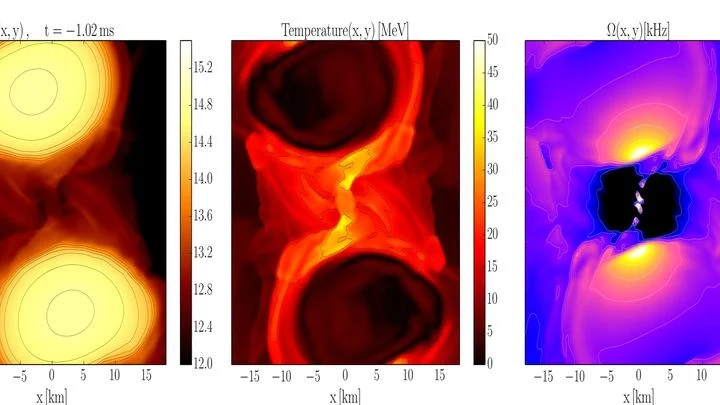
When two neutron stars, the ultra-dense cores of dead stars, collide, a kilonova is born: an explosion a thousand times brighter than a typical nova. This is the universe's true smelting works. In the scorching cloud racing outward at near-light speeds, a furious flux of neutrons transmutes atomic nuclei into gold, platinum, osmium.
Two neutron stars whirl in their final dance. If their spin aligns with their orbital motion, the partners merge neatly, launching a narrow jet of superheated matter. If they spin in opposite directions, the dance breaks apart, scattering a thick shroud of debris.
In 2017, detectors picked up a tremor in space — gravitational waves from the merger of two neutron stars. Telescopes immediately found a flash of light: a cosmic explosion astronomers dubbed a kilonova. In that fiery cauldron, it turned out, the heaviest elements of the periodic table are born — gold, platinum, uranium.
In the first moments after the Big Bang, matter and antimatter should have been created in equal amounts. But today we see only matter — stars, planets, ourselves. Where did the antimatter go? One clue hides in nearly elusive particles: right-handed neutrinos. The usual story is that their decays create a slight bias in favor of matter.
Inside a neutron star, the density doesn't change smoothly but drops abruptly at sharp cliffs — density staircases. At these steps, the void suddenly births pairs: neutrinos and antineutrinos.
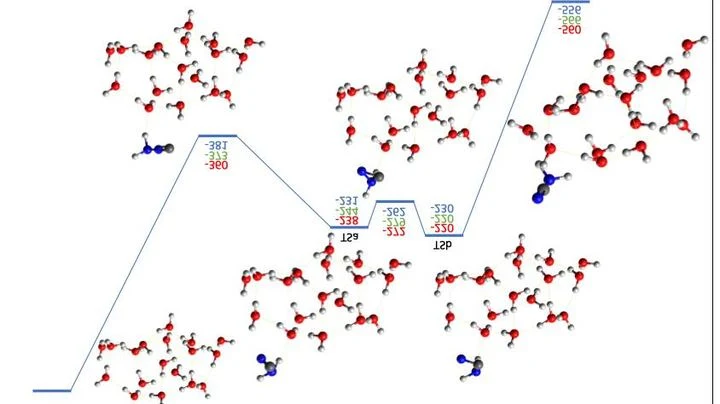
In cold clouds between the stars, dust grains are coated with ice, like windows covered with frost in winter. On this icy crust, chemical reactions take place that do not occur in gas. One such reaction is the encounter between a carbon atom and a nitrogen molecule.
Deep inside a massive star, before it explodes, layers sit on top of each other like the layers of an onion. Sometimes two adjacent layers, the carbon and oxygen layers, mix together. It's like how layers of broth and vegetables in a pot of soup blend when you stir them with a spoon.
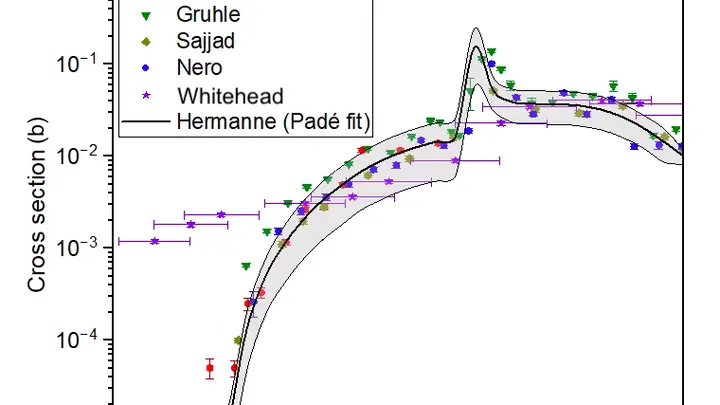
Deep inside a dying star, just before it goes supernova, nuclear reactions determine which chemical elements will be scattered across the cosmos. One such reaction is the collision of an oxygen nucleus with a proton, producing a nitrogen nucleus and an alpha particle (a helium nucleus).
When a star like the Sun runs out of hydrogen, it swells into a red giant, and helium piles up in its core. At some point, the helium ignites — in a few seconds, it releases as much energy as the star had radiated over thousands of years. This is a helium flash.
In the dark, cold clouds where stars are born, dust grains are covered with an icy crust. Across this crust, like on a winter road, individual atoms wander slowly. Calculations show that it is precisely these wandering oxygen and nitrogen atoms that kick off the assembly of the HNSO molecule — a compound of hydrogen, nitrogen, sulfur, and oxygen.
Sub-Neptunes — worlds slightly smaller than Neptune — are common among exoplanets. They are detected using the transit method (by the dimming of a star), pioneered by William Borucki.
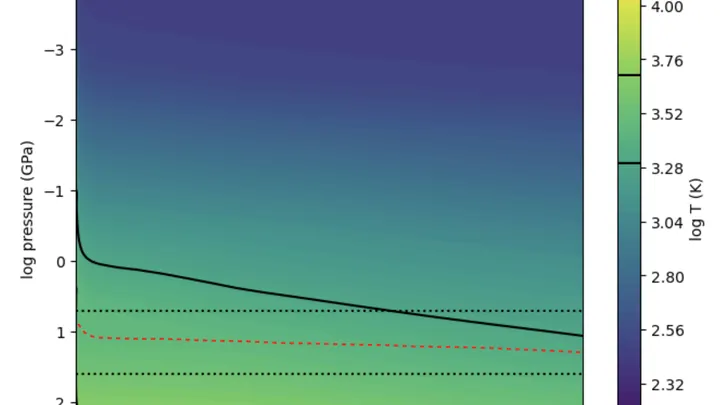
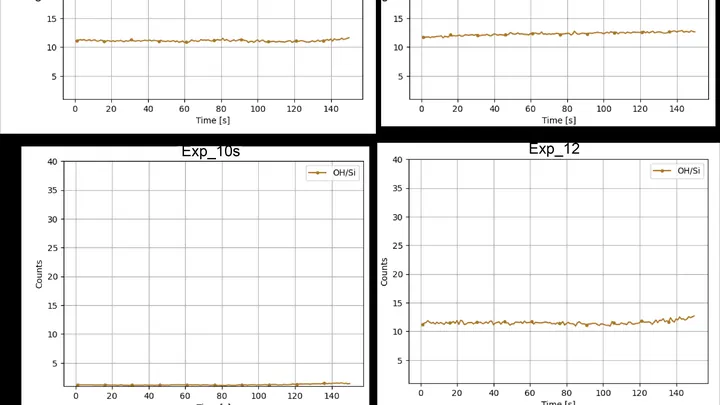
The most common type of planet in our Galaxy — rocky worlds around other stars, or exoplanets, shrouded in the simplest gas hydrogen. Their innards remained a mystery until scientists recreated the conditions of the interior in the lab.
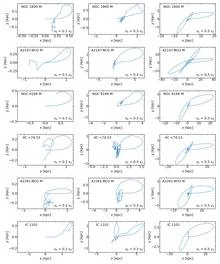
At the center of galaxy NGC 1600, 200 million light-years away, astronomers spotted a dense cluster of stars. It looked like a bright knot against the diffuse glow, and that was unexpected.
In 2017, the LIGO and Virgo detectors caught gravitational waves from the merger of two neutron stars. A kilonova flared: a brilliant cosmic explosion thought to forge the heaviest elements in the periodic table. Gold in jewelry, platinum in catalysts, europium in smartphone screens: all of it, according to a beautiful legend, came to us from such catastrophes.