Light Switched Faster Than Its Own Oscillations express
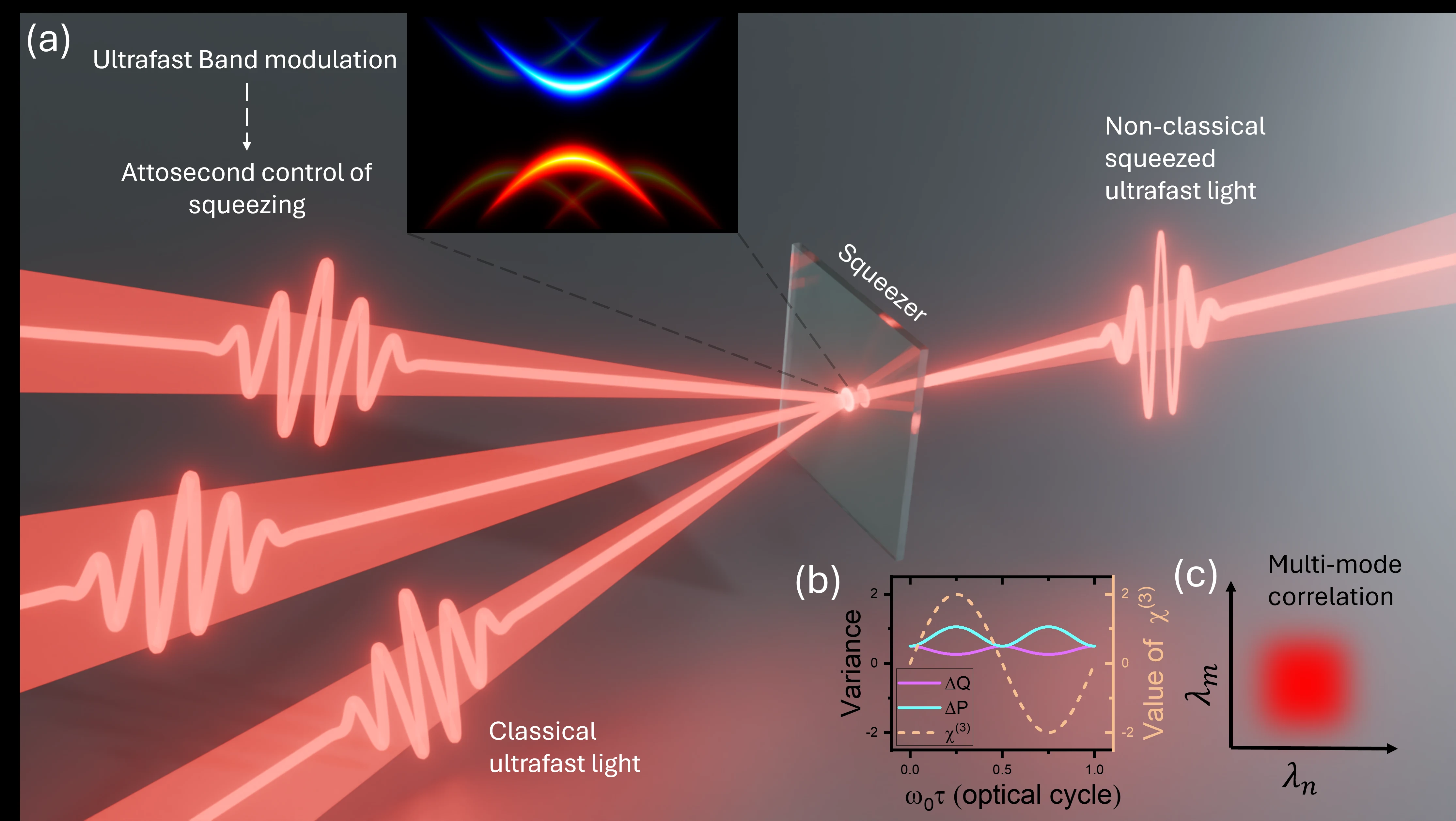
Ordinary light always jitters a bit: its brightness and color fluctuate, like the air in a balloon after a tap. In 'squeezed' light, these fluctuations are redistributed — as if you squeeze the balloon from one side, making it thinner here and thicker there, but the total volume stays the same. This trades accuracy in one place for gains in another. This has already let gravitational wave detectors pick up vibrations thousands of times smaller than an atomic nucleus, and hear black hole collisions from billions of light-years away.
Now physicists have learned to instantly change which part of the 'balloon' gets squeezed. They fire two laser flashes at a material with a delay less than one light oscillation — the light doesn't have time to change, while the material is already rearranged. This switching happens in attoseconds (billionths of a billionth of a second). Analysis using spectroscopy shows how different colors of this light are linked, letting researchers design ideal quantum sources for future computers. Such speed could surpass modern processor speeds by billions of times.
Nobody physically squeezes 'squeezed' light — it's just a clever redistribution of natural noise, where reducing disturbances in one spot makes them grow in another, just like a balloon.