Polarization control techniques are methods for generating, manipulating, and measuring the polarization state of light or other waves. Polarization describes the orientation of the electric field oscillation in a wave, and controlling it is essential for many technologies, from LCD displays to quantum communication. These techniques range from simple polarizers and waveplates to advanced adaptive optics that correct polarization distortions in real time.
History
The first polarizing devices were invented by Étienne-Louis Malus in 1808, who discovered polarization by reflection; the mathematical framework was developed by George Stokes in 1852.
How it works
Polarization is manipulated using birefringent materials (which have different refractive indices for different polarizations), chiral structures, or metamaterials that rotate or convert polarization states. Measurement typically involves splitting the beam into orthogonal components and comparing their intensities. Modern techniques use spatial light modulators or machine learning algorithms to reconstruct the full polarization state from a few intensity measurements, even when the signal is extremely weak — as in the case of detecting a handful of photons.
In practice
Used in optical communication to increase data capacity, in remote sensing to study atmospheric aerosols, in astronomy to map magnetic fields, and in quantum key distribution where polarization encodes secure information.
Fun fact
Some species of mantis shrimp can see circularly polarized light — a capability humans can only achieve with specialized optical instruments — and they use it to communicate with each other.
A light wave is like a rope that has been shaken: it oscillates in a specific plane. This property, polarization, reveals the shape and composition of objects. But capturing it is not easy, especially when you need to cover a wide range of colors. Usually, this requires bulky systems of lenses and filters.
In pursuit of gravitational waves, ripples in spacetime left by black holes and neutron stars, detectors like LIGO pump their arms with light of dazzling intensity.
A thin film of molybdenum disulfide, less than a micron thick, acts as a miniature photon-pair factory built right into a fiber-optic connector.
Ordinary optical fiber is not just a glass thread for the internet.
A pendulum that swings on its own, without any winding — in the quantum world, such 'pendulums' are called time crystals. In them, rhythmic motion arises spontaneously and does not decay. But until now, controlling this rhythm was nearly impossible: any intervention threatened to destroy the fragile order.
X-ray detectors work like honeycombs: particles flash here and there in hexagonal cells. Conventional algorithms stretch these combs onto a square grid, creating ghostly polarization artifacts. Scientists used a neural network that lives by the rules of the hive — it processes the hexagonal structure directly, preserving the natural pattern.
Imagine a carousel with two types of seats: some spin clockwise, others counterclockwise. If you push all of them at once, the carousel jerks but stays in place. That's how a Weyl semimetal crystal works: electrons are born in pairs—'left' and 'right'—and their contributions to current cancel each other, like two identical motors running in opposite directions.
Any measuring device is spoiled by quantum noise — the chaotic jitters of elementary particles. To tame it, physicists used a trick on calcium fluoride molecules, much like squeezing a balloon: press in one spot, and it bulges in another.
Gravitational waves are the trembling of spacetime itself. Usually we only catch their overall hum, but each wave also has a direction of oscillation – polarization. Old maps were built only from signal loudness, which led to errors. It's like trying to see the bottom of a pond through sun glare.
A conventional laser is like an orchestra where musicians must warm up before playing in unison. You first need to pump enough atoms with energy so they 'flip' and are ready to emit light: this is called population inversion. Only then does the beam flash. A polariton laser plays by different rules: its 'musicians'—a mix of light and matter — join in almost without preparation.
Ordinary light scatters in all directions, like water from a shattered glass. But in some crystals, light waves can bunch together into narrow beams and flow in a single direction, like water in a trough. Physicists studied such a material: layered vanadium oxide α-V2O5.
In this crystal, atoms vibrate differently along and across the layers.
Light from distant stars travels for millions of years, but X-rays can't be caught with ordinary glass: they pass right through it like a bullet through paper. That's why X-ray telescopes need special lenses: stacks of tiny prisms that gently deflect the rays and focus them to a single point.
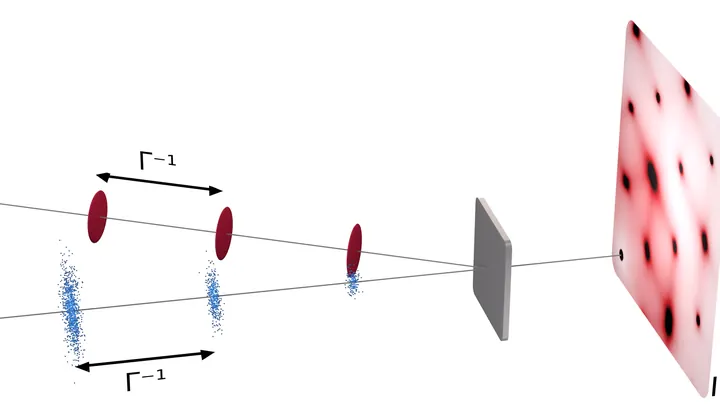
Two tiny dust grains hover at the crossing of laser beams. Each is held by its own 'tweezer'—a focused beam that keeps the particle from falling. Inside a mirrored cavity, light bounces between the walls, and its oscillations are coupled to the trembling of the grains.
When light passes through a turbid medium, like a glass of milk or frosted glass, it scatters in all directions. But sometimes, instead of spreading out, it gets trapped in tiny 'pockets' inside the material. Physicists call these pockets localized modes: light falls into them as if into a trap and cannot escape.
A flashlight beam in fog breaks into thousands of faint specks. Each speck is light that has bounced off countless water droplets before reaching your eye. To make sense of this mess, physicists construct a special table — the scattering matrix. It records how each incoming ray turns into a set of outgoing ones.
Deep inside every hard drive or flash drive lies a material that can 'remember' an electric field. Such a material is called a ferroelectric. When you apply a voltage, tiny regions inside the crystal (domains, like compass needles) flip. Flip the needle one way, you've written a one; flip it back, a zero. But what happens to the atoms at the moment of that flip?
A typical accelerator is like an assembly line where electrons are the workpieces. To get the desired X-ray pulse, the workpiece is fine-tuned after it's already on the line: squeezed, filtered, corrected. In the new work, engineers decided to take a different approach — shaping the workpiece before it even hits the conveyor.
At LCLS-II, electrons are knocked out of a metal by a short laser pulse.
In particle scattering experiments, the target is often polarized: nuclei are aligned so that their spins point predominantly in one direction. The degree of this alignment affects the collision outcomes.
When two different materials are pressed together and then pulled apart, a spark jumps between them. Anyone who has pulled off a wool sweater in the dark or gotten a shock from a doorknob knows the feeling. For a long time, it was thought that charges simply hop from one surface to another due to differences in material properties.
To align particle spins in one direction, physicists usually cool a substance to near absolute zero and place it in a strong magnetic field. That is expensive and bulky.
A new method resembles tuning many spinning tops with a gentle touch: mediator molecules temporarily bind to target atoms and pass on their order.
Light passing through a thin crystal can change color and the direction of its oscillations. In a molybdenum disulfide flake just hundreds of atoms thick, an infrared beam turns green, and its polarization, the way the light wave oscillates, obeys the crystal's geometry.
A fingernail-sized piece of ceramic is squeezed in a vise, and its internal structure rearranges like clay under your fingers. Inside, orderly rows of tiny domains line up where they were once randomly oriented. After this 'massage,' the crystal lets light through almost like glass and, at the same time, generates a strong electric charge when bent or pressed.
A camera that captures not light but a stream of electrons reflected off a crystal is a hybrid pixel detector. It can count every electron that hits it, generating almost no noise of its own. In normal mode, when the electron beam flows continuously, the detector works perfectly.
Terahertz radiation sits between microwaves and infrared light. It passes through clothing, paper, and plastic but is blocked by water and metal. That's why these waves are used in security scanners and for quality control of materials.
Hydrogen is the lightest fuel, and its conversion into electricity on a metal surface resembles a game of ping-pong: hydrogen atoms alternately attach to and detach from the electrode. But the score in this game depends on solution acidity in ways that were unexpected. Classical formulas predict a smooth change, while experiments show jumps and kinks.
The cosmic microwave background is a faint glow left over from the Big Bang, like the cooling embers of a campfire. It encodes gravitational waves that may have arisen in the first fractions of a second, when the universe inflated faster than light.
In the ocean, sometimes a huge solitary wave appears out of nowhere and then vanishes. Such rogue waves are rare but dangerous. Similar rare and intense spikes occur in other systems, from financial markets to lasers. The problem is that they are hard to predict, let alone trigger on demand.
Light from a star is not just a stream but a wave that can oscillate in different directions. Ordinary light is like a crowd where everyone waves their arms randomly. But after reflecting off dust grains or passing through a magnetic field, some waves align in a single line, like soldiers in a row.
Terahertz radiation sits between microwaves and infrared light. It passes through clothing, paper, and plastic, but not through metal or water. That's why it's used in security scanners and medical imaging. To see the polarization of such radiation, you need a detector.
Light traveling through an optical fiber is like a runner in a narrow corridor: it can run straight, or it can weave from side to side. The direction of these "weaves" is polarization. Physicists have learned to keep the runner on a straight path: they constantly check its trajectory and gently correct it, not letting it veer off.
Two light beams run side by side along silicon tracks narrower than a human hair. One oscillates up and down, the other left and right. The task is to separate them into different outputs without losing a drop of power. Engineers built a device just 20 micrometers long — roughly a quarter of the thickness of a sheet of paper.
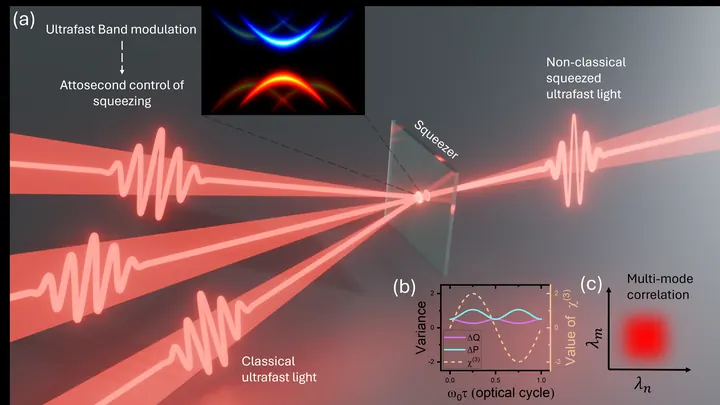
Ordinary light always jitters a bit: its brightness and color fluctuate, like the air in a balloon after a tap. In 'squeezed' light, these fluctuations are redistributed — as if you squeeze the balloon from one side, making it thinner here and thicker there, but the total volume stays the same.
Light passing through a birefringent crystal changes its polarization depending on wavelength. This profile is like a mosaic assembled from rare flashes, where each shard hints at the shape of its neighbors.
Four cesium atoms hang in vacuum, held by laser tweezers like beads on an invisible thread. Around them is a ring resonator, a closed loop of mirrors where light circulates without obstacles. When a probe beam strikes this tiny chain, something strange happens: the atoms scatter light not uniformly in all directions, but predominantly in one direction.