Attosecond spectroscopy is the science of capturing electron motion in real time. Electrons inside atoms and molecules move on timescales of attoseconds — one quintillionth of a second (10⁻¹⁸ s). By using ultrashort laser pulses, researchers can initiate and then probe these ultrafast dynamics, effectively creating a stop-motion movie of electrons as they jump between energy levels, tunnel through barriers, or respond to light. This field has opened a window onto the quantum world that was previously inaccessible, allowing us to observe processes that underpin chemistry, biology, and materials science at their most fundamental level.
History
The field was experimentally established in 2001, when Ferenc Krausz and his team at the Vienna University of Technology generated and measured the first attosecond pulses. For this work, Krausz, along with Anne L'Huillier and Pierre Agostini, was awarded the Nobel Prize in Physics in 2023.
How it works
The technique relies on generating laser pulses that last only a few hundred attoseconds. These pulses are so brief that they can 'freeze' the motion of electrons, much like a strobe light freezes a spinning fan blade. A first pulse (the pump) excites the system, and a second, precisely delayed pulse (the probe) takes a snapshot of the resulting electron distribution. By varying the delay between the two pulses, scientists reconstruct the full temporal evolution of the electron dynamics. This pump-probe scheme is the core of most attosecond experiments, often combined with spectroscopy to measure the energy of emitted electrons or photons.
In practice
Attosecond spectroscopy is used to study electron transfer in photosynthesis, to understand radiation damage in biological molecules, and to develop ultrafast electronics that could operate at petahertz speeds.
Fun fact
An attosecond is to a second what a second is to the age of the universe.
Tuning a string to the right note: the laser pulse is adjusted so that harmonics play in unison at kiloelectronvolt frequencies.
Visible light oscillates at hundreds of trillions of times per second.
You can walk a long road, or you can fold it into a shorter route without losing the key landmarks. In quantum computing, that road is the time evolution of a state: it demands ever longer chains of operations, which quickly drown in noise on a real processor. Physicists have found a way to compress each step of the evolution into a compact, tunable circuit while keeping accuracy above 99%.
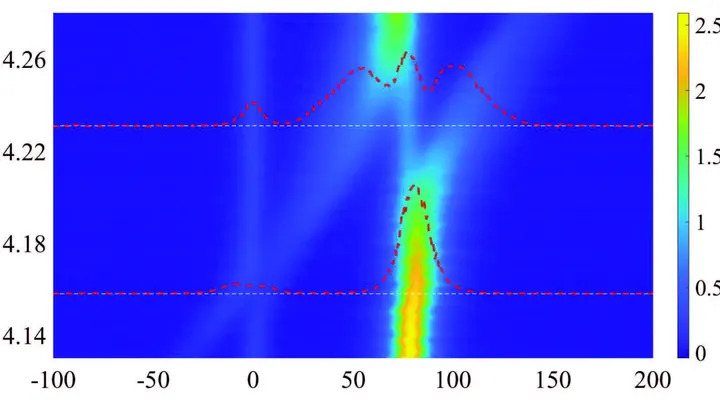
Two electrons that leave a metal needle tip almost simultaneously start to repel each other, like two people trying to squeeze through a narrow door at the same time. The closer they are, the more they get in each other's way.
Toss a handful of sand onto a table — the grains scatter equally in all directions. But if a magnet is hidden under the table and the sand is iron, the trajectories get trickier: an invisible structure overlays the chaos. That's roughly how molecular motion works inside a living cell.
A superconducting qubit is like a finicky musical instrument: until you tune it, you won't get a clean note. But even after tuning, the pitch drifts. The culprits are tiny defects in the material that physicists call two-level systems. They're like invisible cracks that appear and disappear, throwing off the processor's rhythm.
Light waves are never perfectly smooth — they are constantly jittered by quantum ripples. These almost invisible nudges were studied by Nobel laureate Roy Glauber, who laid the foundations of quantum optics. Now physicists have learned to freeze these ripples.
A charged particle streaks through a silicon sensor, leaving behind a trail of free electrons. The time it takes for this charge to be collected at the electrode depends on how deep in the crystal it was born. A particle entering head-on carves identical paths through neighboring pixels: their signals arrive almost simultaneously.
In a benzene molecule, electrons buzz around the nuclei like a swarm of bees around a hive. But this swarm doesn't just hum: it pulses: every 856 attoseconds, the electron cloud completes a full oscillation cycle. The hive itself, the carbon nuclei, rocks more slowly, with a period of 36 femtoseconds.
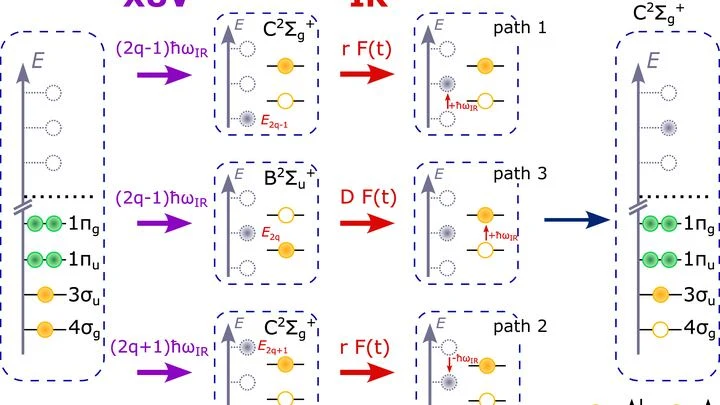
A high-speed camera capable of capturing the motion of electrons is an attosecond interferometer. It sends two laser pulses at a substance with a tiny delay. The first, ultraviolet, acts like a flash, knocking an electron out of the molecule. The second, infrared, like an invisible hand, gently nudges or slows this electron in flight.
An ordinary camera flash lasts thousandths of a second. An attosecond pulse is a trillion times shorter — in the time it takes, light travels a distance smaller than the size of an atom. Such flashes act as an ultra-high-speed shutter: they freeze the motion of electrons, letting us see them jump between orbitals or take part in a chemical reaction.
An ordinary camera flash lingers for hundredths of a second, but for atoms, that's an eternity. Inside molecules, electrons jump in attoseconds: billionths of a billionth of a second. To capture that, you need a light pulse shorter than the event itself.
Physicists take an electron beam in a linear accelerator and compress it so that individual bunches become thinner than a hair — in time.
An electron in an atom is like a tennis player waiting for a serve. The light flash is the ball, moving at a speed the eye can't follow. The new device catches the moment the racket meets the ball with a precision previously unimagined. The setup uses two laser beams: one strikes the atom, the other acts as a stopwatch.
When light knocks an electron out of an atom, it flies off like a ball thrown into a crowd. Scientists have long wanted to know the exact moment each electron leaves the atom, but direct measurement disturbed the very process. Now physicists have proposed a method that uses a second light pulse to 'photograph' the moment of the electron's birth.
Ordinary window glass may seem frozen forever, but inside, atoms never stay still. In amorphous germanium telluride (GeTe)—a material used in rewritable discs and non-volatile memory — physicists have for the first time directly tracked how atomic bonds stretch and bend in trillionths of a second.
Radio waves that oscillate less than once per second pass through the earth and water with almost no loss. Such signals are used to communicate with submarines and to search for minerals. But a conventional antenna for them would need to be hundreds of meters long, and its sensitivity leaves much to be desired.
A standard laser rangefinder works like a stopwatch on a 100-meter dash: it times how long light takes to run to the target and back. But such a stopwatch has a limit: it ticks in steps of tens of picoseconds (trillionths of a second). In that step, light travels about a centimeter, so finer details are invisible.
A regular radio receiver picks up waves with a metal antenna. Here, the antenna is a single atom with an electron boosted to a distant orbit, like a satellite in a high orbit around Earth. Such atoms are called Rydberg atoms.
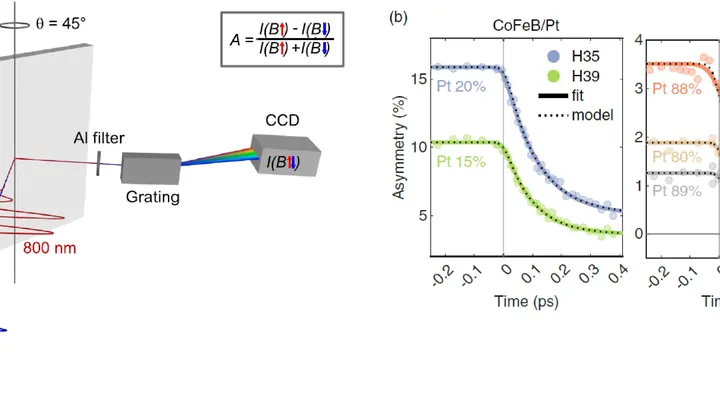
A fridge magnet holds on thanks to tiny internal arrows: each one like a miniature compass. If you hit the metal with an ultrashort flash of light, these arrows start to jitter chaotically, and magnetism melts away in a millionth of a billionth of a second. Previously, such 'melting' was too fast to observe.
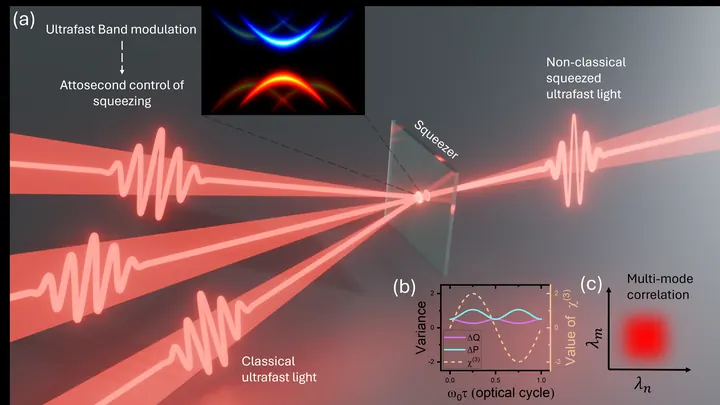
Ordinary light always jitters a bit: its brightness and color fluctuate, like the air in a balloon after a tap. In 'squeezed' light, these fluctuations are redistributed — as if you squeeze the balloon from one side, making it thinner here and thicker there, but the total volume stays the same.