Twin Photons in a Light Cavity express
Inside a tiny mirrored cavity, smaller than the thickness of a hair, light is trapped and bounces off the walls many times. If you place a material that can absorb and emit light inside, the light particles (photons) start to 'dress' in excitations of the material — this is how polariton modes are born. Usually, a bright coherent light, similar to a powerful laser beam, dominates in such a cavity. But physicists from France found a way to extract weak quantum fluctuations — single excitations that appear and disappear spontaneously — from this bright background.
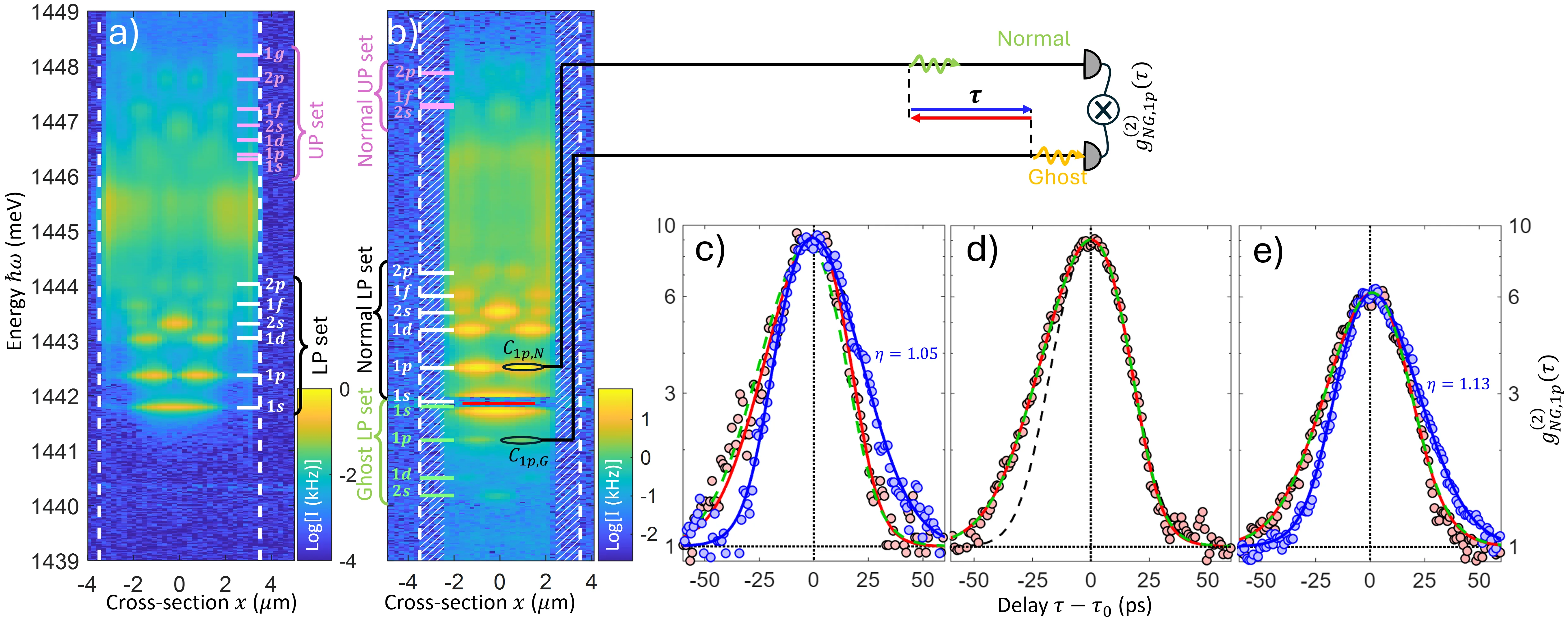
When the average number of such quantum fluctuations is less than one, the researchers measured the arrival times of photons from two sides of the spectrum — red and blue. It turned out that photons arrive in pairs, always in the same order: first red, then blue. This is surprising because in ordinary thermal light, photons are not correlated in time. This ordering arises spontaneously because frequency-resolved detection 'cuts out' certain combinations from the internal quantum structure of elementary fluctuations.
The practical benefit of this discovery lies in the possibility of controlling single quantum states of light inside a solid-state device. Such states are needed for quantum computing and secure communication. Instead of fighting fluctuations as noise, they can be used as a resource: for example, as a source of entangled photon pairs with a predetermined temporal order.
Original abstract
as written by the authors arXiv:2601.06468
Weakly-interacting many-body systems possess remarkable quantum properties that are essential components of quantum technologies, and constitute a topic of fundamental interest. Here we show that in a solid-state nonlinear microcavity embedding discrete modes of exciton-dressed photons, we can isolate a single eigenmode of quantum fluctuations from the much brighter coherent fraction of the field. In this regime, we perform frequency- and time-resolved correlations measurements between photons on the red and blue side of the fluctuations spectrum. When the average number of fluctuation quanta is smaller than one, we observe the formation of large pairwise time-ordered correlations: red photon first and blue photon second. We show that this peculiar time-ordering correlation emerges spontaneously from the interplay between frequency-resolved detection, and the non-trivial internal quantum structure of the elementary fluctuations.
In the experiment, the average number of quantum fluctuations was less than one — meaning that at any given moment, there was usually no 'extra' particle in the cavity, and pairs were born from vacuum fluctuations.