Colored noise is a type of random signal whose properties change over time in a way that is not completely unpredictable. Unlike white noise, which has no memory — each instant is independent of the last — colored noise carries correlations between moments separated by time. This means that if the signal is high now, it tends to stay high (or low) for a while, giving it a smooth, persistent character. The term 'colored' borrows from optics: white light contains all frequencies equally, while colored light emphasizes certain ranges. Similarly, colored noise has a frequency spectrum that is not flat, favoring some fluctuations over others.
History
The concept emerged from studies of electronic and acoustic noise in the mid-20th century, with the '1/f' label popularized by researchers like Benoit Mandelbrot in the 1960s, though the exact origin of the color analogy is diffuse.
How it works
The key is the autocorrelation function, which measures how much a value at one time resembles a value at a later time. For white noise, this function is zero for any nonzero lag — no memory. For colored noise, it decays slowly, often following a power law. A common family is '1/f noise' (pink noise), where the power spectral density falls as 1/frequency, meaning low-frequency (slow) changes are stronger than high-frequency (fast) ones. Other colors, like red noise (Brownian motion), have even steeper spectra, while blue noise has the opposite trend, emphasizing rapid fluctuations.
In practice
Colored noise models are used in climate science to simulate natural variability, in audio engineering to generate realistic ambient sounds, and in finance to describe market fluctuations.
Fun fact
Pink noise, with its 1/f spectrum, is found in everything from heartbeats to river flows, and its ubiquity has led some to call it 'the sound of nature.'
A smartphone camera captures light with tiny sensors, but by themselves, they can't distinguish colors. So color filters are placed in front of them: red, green, blue, like stained glass in a window. Each sensor sees only its own color, and then software assembles the full picture from these pieces.
You're listening to the faint whisper of stars, and nearby someone keeps moving a chair. In gravitational wave telescopes, that role is played by scattered light: it reflects off trembling surfaces and creates false signals.
Inside a supercomputer, fifteen stable wave clumps — solitons — collide to form a halo of dark matter. These waves obey an equation that Erwin Schrödinger derived for electrons at the beginning of the 20th century, but now they paint a portrait of a giant galactic cocoon.
Active noise cancellation creates 'anti-sound' to neutralize noise. But ordinary systems are blind: they don't know where the sound is coming from. In rooms with an echo, it's like boxing with a blindfold on — you're canceling blindly.
Two dead suns circle in an eternal dance. Their orbit is a perfect metronome, keeping time with the accuracy of atomic clocks. But even dead stars can tremble.
Imagine the hum of a crowded square (that's what the gravitational wave background of the Universe sounds like, as detected by a network of pulsars) neutron stars that emit regular radio pulses with the precision of atomic clocks.
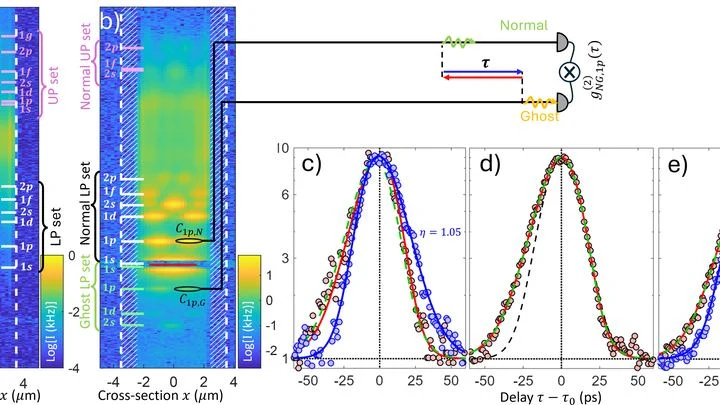
Inside a tiny mirrored cavity, smaller than the thickness of a hair, light is trapped and bounces off the walls many times. If you place a material that can absorb and emit light inside, the light particles (photons) start to 'dress' in excitations of the material — this is how polariton modes are born.
Two beams of light, red and blue, enter a tiny ring made of silicon nitride. The ring is smaller than the thickness of a human hair. At the input, both beams are equally bright. But inside the ring, one of them suddenly starts to outshine the other, like two equally matched people in a debate where one unexpectedly gains the upper hand.
In 2019, the Event Horizon Telescope gave humanity the first image of a black hole's shadow. Since then, astrophysicists have dreamed of more: seeing how matter moves in the very funnel of spacetime. One of the mysteries is chaos.
A translator in a conference room hears not only the words but also the echo of previous phrases still bouncing around the ceiling. If they get distracted by every reverberation, an hour of conversation turns into two. Similarly, a complex system, whether an ocean or a power grid, receives random jolts that do not vanish instantly but drag behind them a tail of memory.