Lava Oceans of Exoplanets express
A planet whose orbit is a little stretched dives closer to its star each pass, then backs away. The varying gravity heats it up, solid rocks melt, becoming an ocean of lava.
On the night side, a frozen crust acts as a shore. Tidal waves crash against it, collide, and spawn wandering hot spots. As a result, the planet’s glow flickers erratically, like a candle flame. Waves can rise several kilometers high — slow-moving stone ridges crawling across the scorching expanse.
Original abstract
as written by the authors arXiv:2601.07080v2
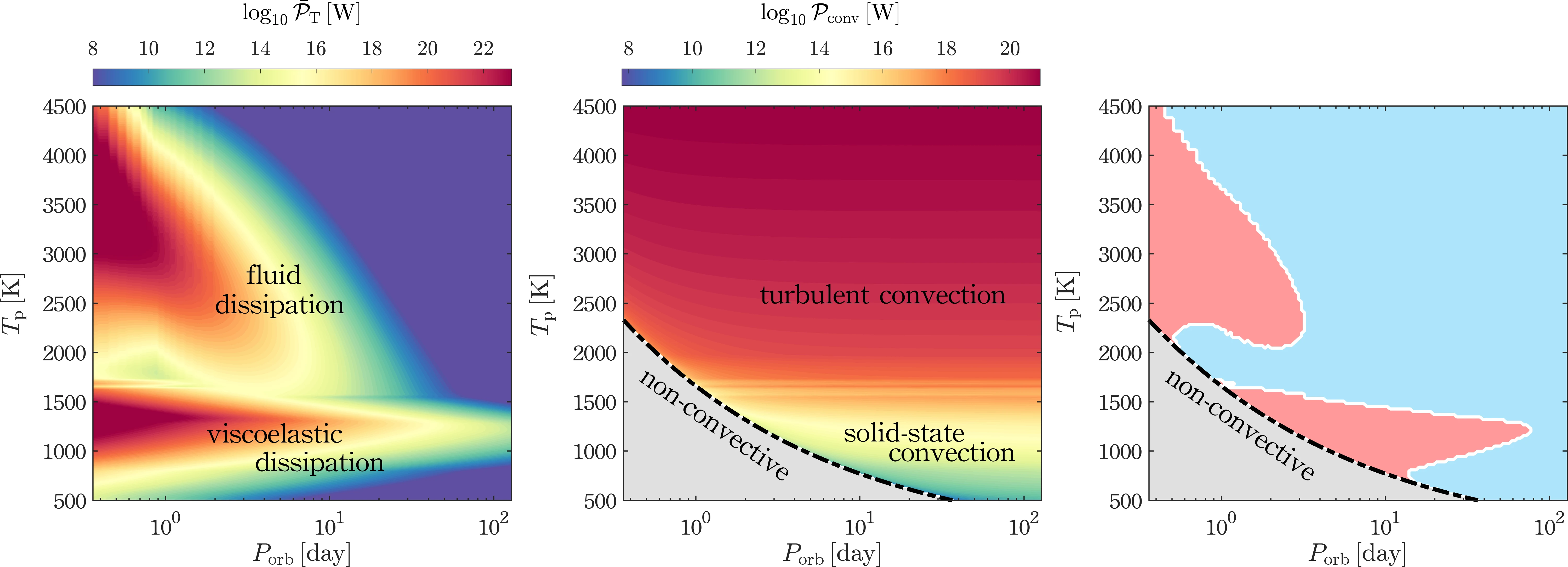
Lava worlds are rocky planets with dayside skins made molten by stellar irradiation. Tidal heating on these shortest-period planets is more than skin deep. We show how orbital eccentricities of just a few percent (within current observed bounds and maintained secularly by exterior companions) can create deep magma oceans. ``Lava tidal waves'' slosh across these oceans; we compute the multi-modal response of the ocean to tidal forcing, subject to a coastline at the day-night terminator and a parameterized viscous drag. Wave interference produces a dayside heat map that is spatially irregular and highly time-variable; hotspots can wander both east and west of the substellar point, and thermal light curves can vary and spike aperiodically, from orbit to orbit and within an orbit. Heat deposited by tides is removed in steady state by a combination of fluid, mushy, and solid-state convection in the mantle. For Earth-sized planets with sub-day periods, the entire mantle may be tidally liquified.
The temperature of these lava oceans is higher than in a smelting furnace: around 3000°C.
Lava worlds like Mustafar from Star Wars turn out even more turbulent than in fiction, thanks to tides.