Primordial Black Holes Build Early Galaxies ✎ express
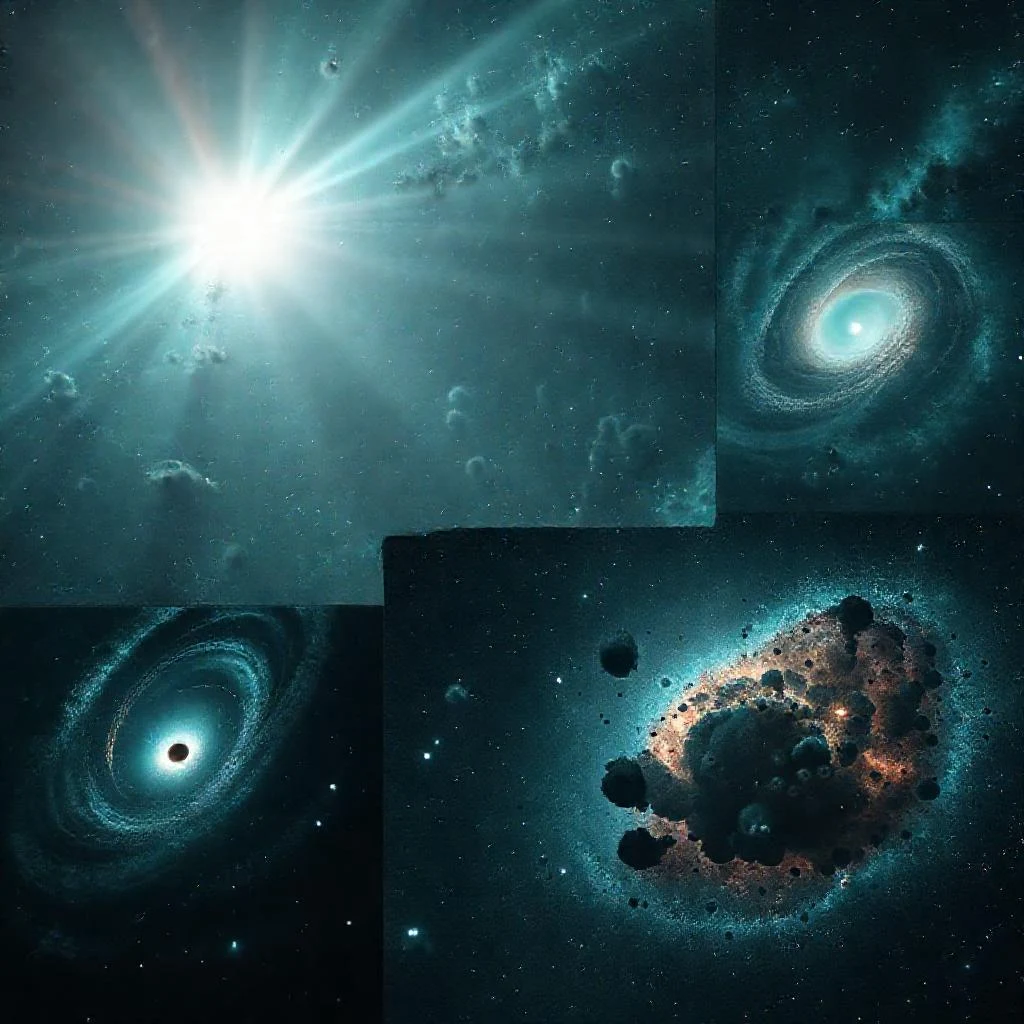
The early Universe was like a construction site where, instead of slowly building floors, they used prefabricated blocks. These blocks were primordial black holes, born in the first fraction of a second after the Big Bang. They likely also serve as dark matter — the invisible substance whose gravity holds galaxies together. Such holes can be astonishingly tiny: with the mass of an asteroid, they're smaller than an atomic nucleus, so they pass right through us unnoticed, but in clusters, they act like balls rolling into a funnel, merging at the center and quickly building a giant black hole. This solves the mystery of why the Webb telescope sees massive black holes in galaxies only 400 million years old.
If a primordial black hole had the mass of an asteroid, its size would be smaller than an atomic nucleus — essentially a point in space, but with enormous gravity.
In the movie *Interstellar*, black holes serve as portals, but in reality, they may have been the 'builders' of the first galaxies.