Dark matter halos are the invisible, massive structures that surround galaxies, extending far beyond their visible stars and gas. They are the scaffolding on which galaxies form and evolve, and their shape and distribution are inferred indirectly from the motions of stars and gas within them. The study of dark matter halos is central to understanding galaxy formation, the large-scale structure of the universe, and the nature of dark matter itself.
History
The concept of dark matter halos emerged in the 1970s from the work of Vera Rubin and Kent Ford, who measured galaxy rotation curves, and earlier theoretical work by Fritz Zwicky in the 1930s on galaxy clusters. The specific term 'halo' became common in the 1980s with the rise of cold dark matter models.
How it works
Dark matter halos are not directly observable, but their gravitational influence is. By measuring the rotation curves of galaxies (how fast stars orbit the center) or the velocities of satellite galaxies, astronomers can map the total mass distribution. The observed flat rotation curves, which do not decline as expected from visible matter alone, reveal the presence of a massive, extended halo. The shape of the halo is often modeled as a flattened, triaxial ellipsoid, and its structure can be probed through gravitational lensing, where the halo's gravity bends light from background objects.
In practice
Understanding dark matter halos is crucial for interpreting galaxy surveys, predicting gravitational lensing signals, and constraining particle physics models of dark matter candidates.
Fun fact
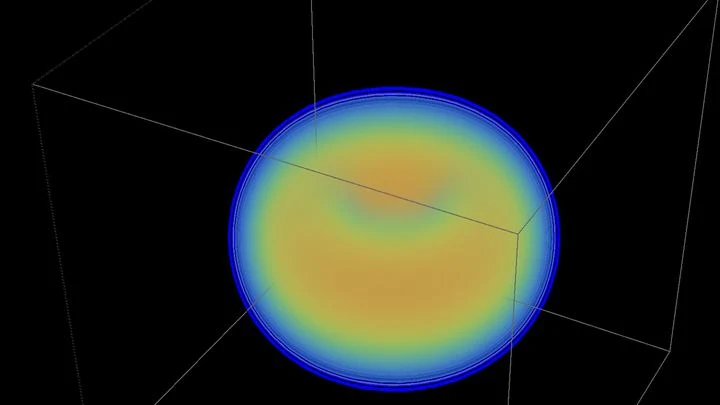
The Milky Way's dark matter halo is not spherical but is flattened and twisted, likely due to interactions with satellite galaxies.
A river drawn on a map is always a single line. But stand on the bank, and you will see that within the channel there are faster currents, eddies, and branches that merge and split. The cosmic web is like that river, but made of dark matter, and until recently astronomers drew it as a single line.
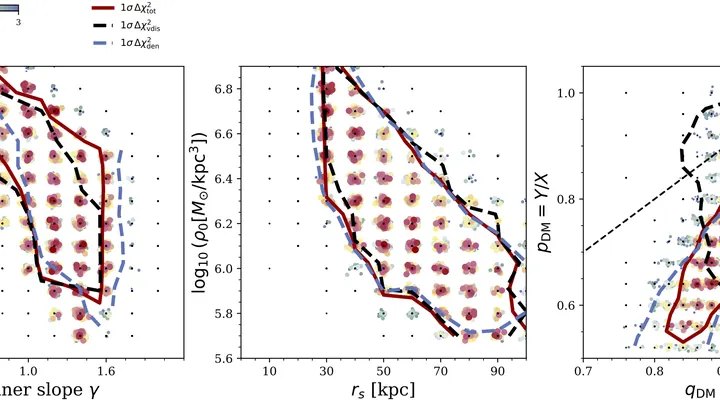
A million orbits: the same score. Nine dark matter halos: nine orchestras without a conductor. All musicians play from the same notes, but in each hall the music sounds different: sometimes in tune, sometimes out of sync. Likewise, satellite galaxies falling into a host halo follow orbits that depend not only on mass but also on the shape of the invisible stage.
A neutron star is the ultra-dense remnant of a supernova: the mass of the Sun packed into a sphere the size of a city. For billions of years, it travels through space, gathering around itself invisible matter, dark matter, which emits no light but pulls with gravity.
The cosmos resembles silk fabric with threads of the dark web showing through. We only glimpse tiny swatches of the real tapestry — through telescopes, in actual galaxy catalogs. To separate the fundamental signal from astrophysical noise in the cosmic pattern, statistical analysis demands thousands of plausible sketches — synthetic sky maps.
At the center of many galaxies lurks a black hole, wrapped in an invisible cloud — the halo of dark matter. This is not just a featureless mass: its density changes from the edge to the center, and the degree of this "compression" is called compactness.
Dark matter — the invisible foundation of cosmic architecture — makes up 85% of all mass, yet eludes direct observation. In the 1920s, Edwin Hubble discovered the expansion of the universe and the realm of galaxies; by the 1930s, Fritz Zwicky suspected hidden mass in their clusters.
At the center of a tiny galaxy lies a dense clump of stars and dark matter. This clump, called a soliton, is not frozen in place: it quivers and oscillates like jelly on a plate.
At the center of attention are tiny stellar cities: ultra-faint dwarf galaxies. They resemble sparse swarms of fireflies circling within a vast invisible cloud. This cloud is a halo of ultralight dark matter. Its particles are so light that they behave not like billiard balls but like waves.
It all began not with emptiness, but with a boiling ocean of plasma. In that primordial broth, sound waves raced through the fiery matter, colliding and compressing it. Sometimes a clump grew so dense that light could no longer escape, and right out of the scorching gas, a primordial black hole was born.
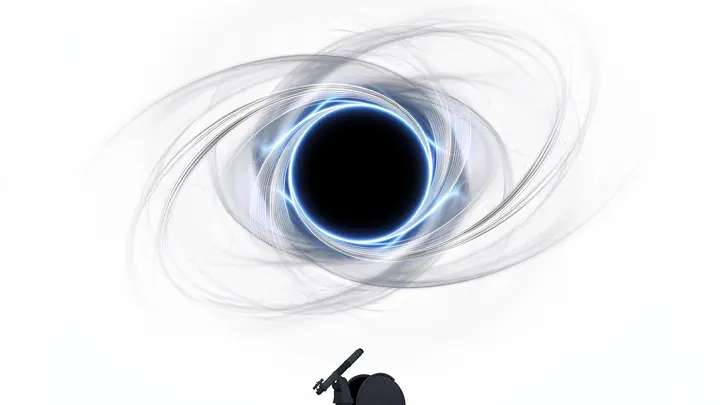
A black hole is not just a dark spot in the sky. Its shadow falls on the glowing backdrop of infalling matter and carries the imprint of spacetime geometry itself. If gravity works even slightly differently than we think, the shadow will give it away.
In a new study, physicists traced light rays around a rotating black hole in so-called Rastall gravity.
Think of a baby mobile: figurines dangling on threads, twitching at even a whisper of breeze. In the same way, planets on very wide orbits barely cling to their star's gravity, and they feel the faintest gravitational drafts. Astronomers have proposed turning such planets into detectors of dark matter.
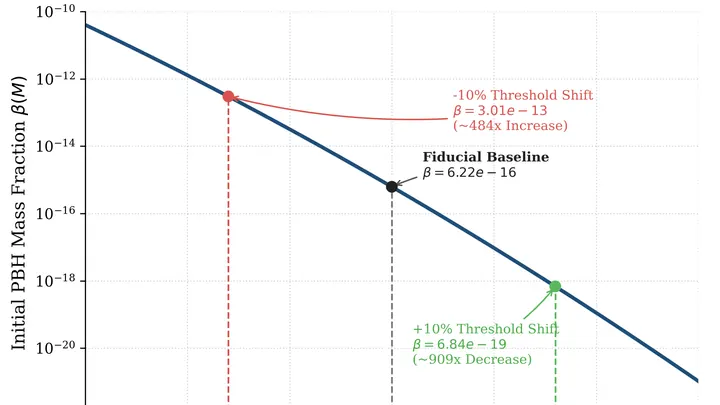
A swarm of tiny ice balls is scattered across a warm room. Some melt faster, others slower, but when only wet spots remain, they all vanish in the same way: the last drop evaporates according to the same law. This is roughly how primordial black holes behave — hypothetical objects born in the first moments after the big bang.
In the 1930s, Fritz Zwicky first noticed that galaxies in clusters were moving too fast — something invisible was holding them. Later, Vera Rubin measured the rotation of spiral galaxies, confirming that space is permeated by dark matter.
A fluffy ball of invisible web envelops a black hole. This web is dark matter, which doesn't shine but, through its weight, governs the motion of stars on the outskirts of galaxies. Astrophysicists have long seen such 'fluffy' clouds around cosmic objects and have mapped their profiles — how density falls from the center to the edge.
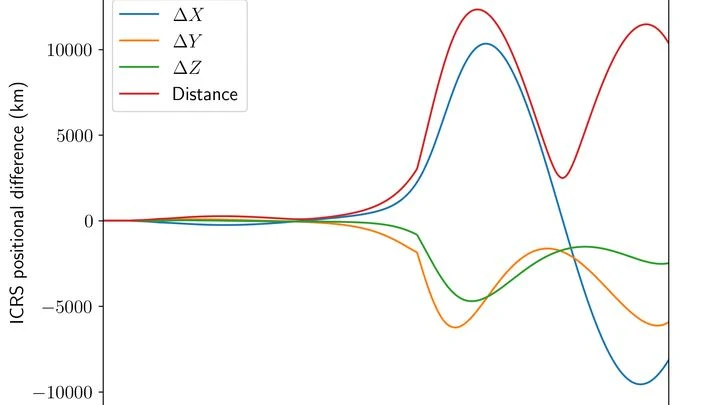
At the heart of our stellar metropolis — the Galaxy — lurks the supermassive black hole Sagittarius A*. Around it, star S2 whirls in a swift dance. But its movements reveal more than just the hole's pull: an invisible partner joins the dance — dark matter.
A magnifying glass focuses sunlight into a bright point. If the glass has a tiny flaw, the spot of light becomes distorted. Gravitational lensing works in a similar way: a massive galaxy bends light rays from a more distant source, creating an enlarged and sometimes distorted image.
A whirlpool in a river sucks everything in. Now imagine adding an invisible jelly to the water that thickens near the vortex and suddenly vanishes at its edge: that's roughly what a black hole looks like in a new mathematical model.
A stellar river winds around the center of a distant galaxy like a glowing ribbon on an invisible frame. That frame is the dark halo: a vast cloud of invisible dark matter whose gravity holds stars and gas in place. If the halo is squashed like a pumpkin or stretched like a melon, the stellar stream will bend differently.
In 2019, the Event Horizon Telescope gave humanity the first image of a black hole shadow — a fiery ring around the abyss at the center of galaxy M87. This gravitational self-portrait, painted by the light of infalling plasma, instantly became an icon of modern astrophysics.
The universe resembles a giant sponge: bright filaments of galaxies weave around enormous dark voids. Inside these filaments and walls hide clumps of invisible dark matter — halos. When dark matter particles collide and decay, they produce ordinary particles that telescopes can catch.
A galaxy is like a glowing pancake studded with stars. If you look at it face-on, you see everything at once — both the bright spiral arms and the dark dust lanes. But tilt the pancake, and the picture changes: layers overlap, light blends together. This very effect, it turns out, creates the illusion of a tight link between radio and gamma-ray emission in distant star systems.
In a vast dark hall, someone invisible plucks the strings. The cosmic gas, the tenuous hydrogen that filled the young universe, resembles stretched strings that can resonate at a radio wavelength of 21 centimeters. This is hydrogen whispering about its temperature.
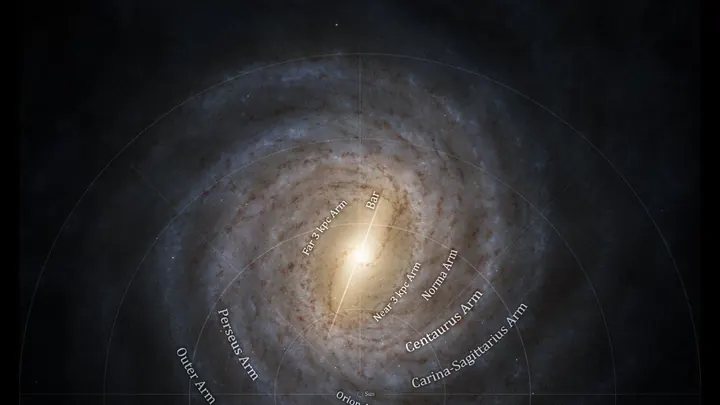
Other galaxies are just ancient snapshots, but we watch the Milky Way live. Comparing data over 30 years, scientists found that the Galaxy’s center is, like, speeding up: the supermassive black hole got heavier, swallowing the mass of a large asteroid each year; the stellar bar (a huge beam of billions of suns, like the…
Dark matter is an invisible substance that keeps galaxies from flying apart. If its particles occasionally decay near the Sun, they shoot out streams of fast particles, like invisible hammers striking light. Each impact turns a particle of sunlight into a gamma ray — a super-powerful flash that telescopes can spot.
In galaxy clusters, invisible dark matter serves as the framework holding star systems together. Its shape is betrayed by a faint glow — stars ripped from galaxies by tidal forces. This stellar 'broth' fills the cluster like a liquid taking the shape of its container: it envelops the clumps of dark matter, creating a precise cast of their outlines.
A galaxy is like a giant merry-go-round: stars and gas whirl around the center, and their speeds reveal how much stuff is on the ride. If we only saw the luminous matter, the outer parts would spin slower than observations show. So there must be invisible mass, dark matter, that holds the galaxy together.
Dough rises faster when it already contains yeast. Similarly, galaxies may have assembled faster if they already had black holes inside. Astrophysicists considered a scenario where the universe contained primordial black holes from the very beginning — objects that could have formed in the first instants after the Big Bang.
At the heart of the Milky Way spins a stellar bar — an elongated cluster, like a rotating paddle. Its gravity creates a rhythmic field around it, like waves from a speedboat.
Black holes heavier than a trillion Suns act like cosmic umbrellas. They cast a shadow on the faint afterglow of the Big Bang — ancient light that fills the entire sky. The shadow turns out not blurred, but with a sharp edge, as if cut out with scissors: around it glows a bright ring of photons trapped by gravity.
In 2015, astronomers were examining the Coma galaxy cluster and noticed something odd: huge, almost invisible "fluff balls." These galaxies are as large as our Milky Way but shine hundreds of times fainter.
Imagine a city map where streets are replaced by car speeds and buildings by the metal content of stars. Such a map can tell you where the center is and where the outskirts are, even without knowing exact distances. This is precisely the approach astronomers took with our Galaxy, using longitude–velocity (ℓ–v) diagrams.
A spinning black hole acts like a cosmic generator: its rotation pumps energy into an invisible scalar cloud — a prime candidate for dark matter. A scalar field is like temperature: at every point in space it's just a single number, with no arrows or vectors. The cloud grows until it overflows.
The early Universe was like a construction site where, instead of slowly building floors, they used prefabricated blocks. These blocks were primordial black holes, born in the first fraction of a second after the Big Bang.
The night sky seems full of stars, but between them lurk clouds of gas where not a single star has ever ignited. Such objects are called dark galaxies: they contain enough gas, but it is too diffuse and cold to collapse into stars.
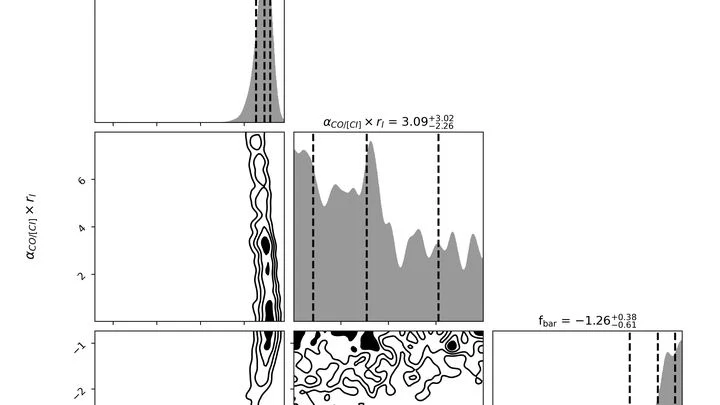
Three distant galaxies spin like giant carousels. Their stars and gas move along spiral arms, and from the speed of this motion you can calculate how much total matter the galaxy contains — visible and invisible.
Astronomers combined two views: radio telescopes revealed cold gas, while the James Webb Space Telescope showed the stars.
By analyzing color indices — the ratio of brightness in different spectral bands in images from the James Webb Space Telescope, astronomers have identified galaxies whose light cuts off sharply in the ultraviolet.
Supermassive bodies warp space, turning into a lens that bends light from distant objects. Such spacetime curvature allows astronomers to see the invisible. Recently, this method helped detect a hidden clump with the mass of a million Suns.
The Milky Way's stellar disk is like a glowing pinwheel, and тёмное вещество is an invisible cloud around it. For the first time, its shape has been precisely measured. Astronomers tracked the motions of millions of stars and built a 3D map of the тёмное гало out to 160,000 light-years.
Using the most powerful space telescope, James Webb, astronomers peeked into the cosmic dressing room and saw how the rings of asteroid Chariklo are changing.