Magnetic Disks Instead of Microchips express
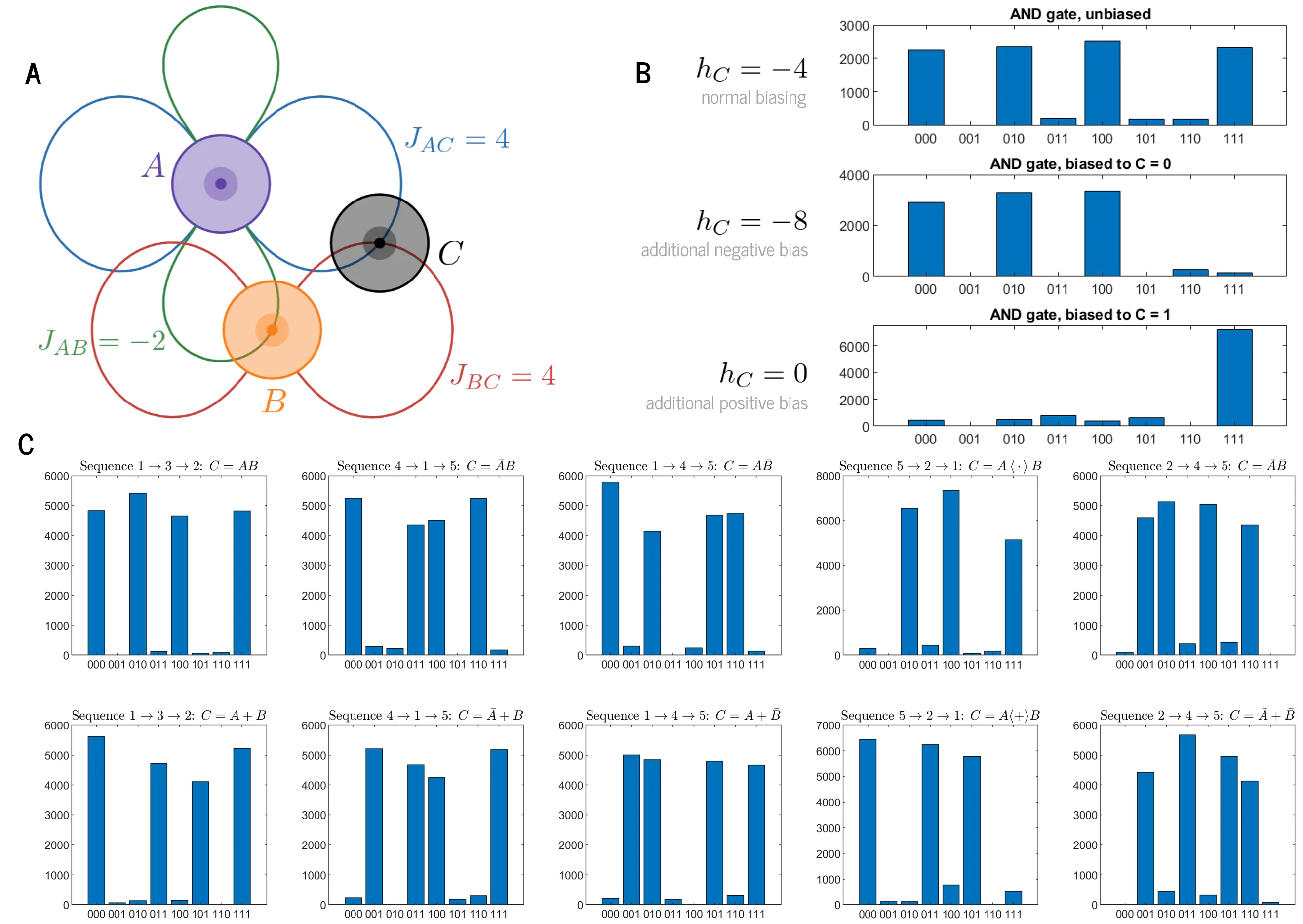
On a table lies a handful of round magnets. As long as no one touches them, they lie in disarray. But send a short current pulse through them, and each disk flips: the north pole swaps with the south. Neighboring disks push each other with their fields, like people in a crowded queue, and the whole handful arranges into a pattern that depends on which way the magnetic wind blew and how warm it is around.
This is exactly how the new computing device works, assembled by physicists from iron disks smaller than a millimeter. The current provides the push, the external field sets the direction, and heat adds randomness: at room temperature, the disks do not always flip identically. By connecting these disks into chains, the authors obtained a circuit that mimics the behavior of the AND logic gate, and from several gates they built a one-bit full adder — a device that adds two bits with a carry, just like in a conventional processor.
The key difference from conventional electronics is reversibility. In a typical chip, the signal goes only one way: knowing the input, you can determine the output, but not vice versa. Here, if you fix the result, the magnetic network itself 'remembers' which inputs could have led to it. This is like a conversation where you can hear not only the answer but also the question.
This ability to move from effect to cause makes probabilistic computers suitable for tasks that require exploring many possibilities — for example, factoring large numbers, which underpins modern encryption. The magnetic implementation outperforms previous attempts in speed, tunability, and energy efficiency: the disks barely heat up, and they can be controlled with weak pulses.
The handful of magnets from the table turned out to be not a toy but a draft of a new type of computation. The first assembled adder is like Edison's first light bulb: dim, short-lived, but showing the way forward.
Original abstract
as written by the authors arXiv:2601.13229
Probabilistic computers replace logic gates with networks of interacting random variables, creating bidirectional systems that can back-derive inputs from outputs. Such architectures enable efficient generation of random samples, implementations of novel algorithms, and natural solutions to classically hard problems such as prime factorization. We present a new physical implementation for these networks: ferromagnetic disks whose magnetization switching process is triggered by current pulses, skewed by external magnetic fields, and randomized by ambient thermal noise. We show that geometry-dependent magnetostatic interactions between these magnetic cells lead to system behavior that emulates deterministic logic gates. Furthermore, by chaining multiple "gates," we achieve a highly accurate bidirectional one-bit full-adder, a proof of concept for complex multi-gate logic functions with reversible information flow. This analog magnetic probabilistic computer methodology improves on other implementations in speed, tunability, and energy efficiency, thereby enabling a powerful new pathway towards practical solution of classically hard problems.
A one-bit full adder made of magnetic disks adds two bits and a carry from the previous digit — exactly what a part of the processor does in any smartphone, except here information flows in both directions.
The idea of a computer that remembers all paths to the answer recalls the machines in Ted Chiang's story 'Story of Your Life', where an alien language allows seeing causes and effects simultaneously.