Light in Layered Crystals: How 2D Materials Transform Optics express
Light passing through a window pane refracts the same in all directions. But in thin layered crystals, it's a different story: light traveling along the layers sees the material differently than light traveling across them. It's as if a sheet of paper were transparent but transmitted light differently along and across its fibers.
This behavior is called optical anisotropy, and it is especially pronounced in two-dimensional materials — crystals just a few atomic layers thick. Within a layer, atoms are held together by strong covalent bonds, like tightly interlocked planks, while between layers, weak van der Waals forces act, like sheets of paper stacked on top of each other. Because of this difference, light 'feels' the structure differently depending on direction.
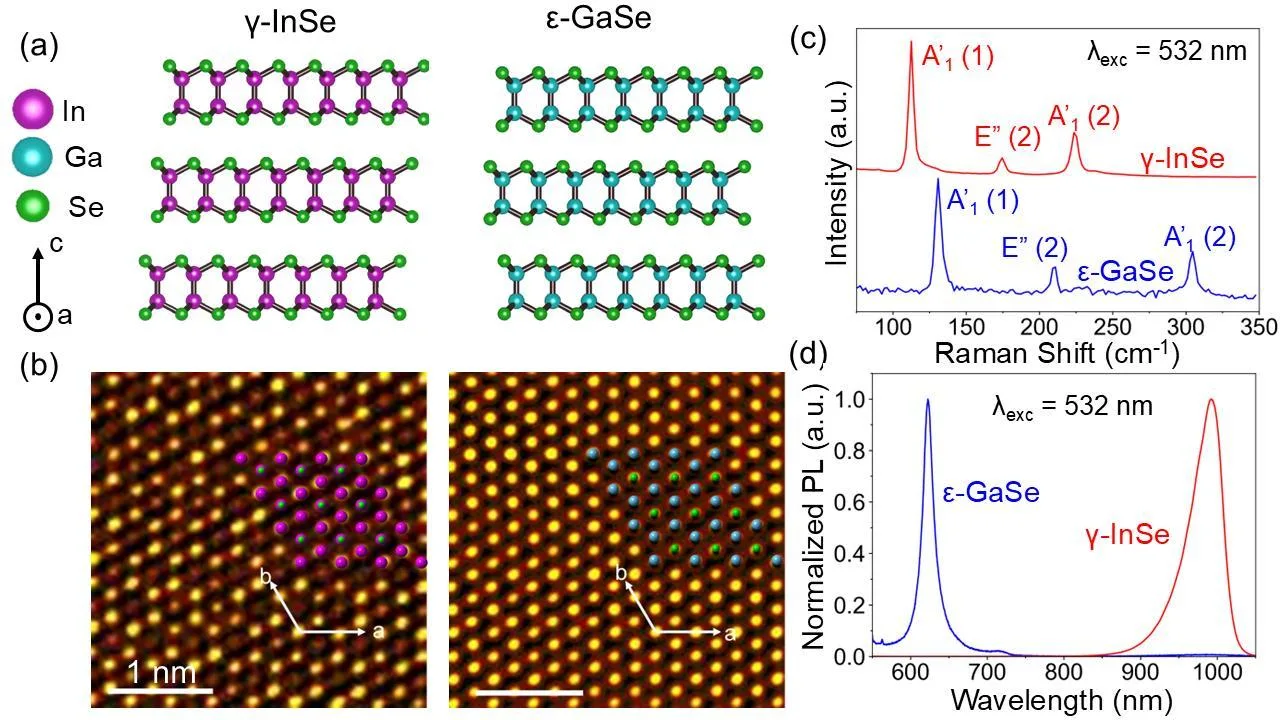
The scientists measured the refractive indices for two such materials: γ-InSe (indium selenide) and ε-GaSe (gallium selenide). They found that both materials exhibit moderate optical anisotropy, and their special excited states, excitons oriented across the layers, noticeably affect light refraction in that direction.
Knowing the precise refractive index values allows accurate modeling of light behavior in such materials. This paves the way for creating ultra-compact optical devices: polarizers, polarization sensors, and sources of polarized light. Such devices could be thinner than a human hair and find applications in telecommunications, displays, and sensors.
Original abstract
as written by the authors arXiv:2601.13961
Low-dimensional media have exhibited optical anisotropy that is unachievable in traditional 3D media due to the asymmetry of their strong, in-plane covalent bonds and weak out-of-plane van der Waals interactions. As a result, 2D media are promising building blocks for ultrathin devices such as polarimeters, polarized light sources, and active polarizers. III-VI semiconductors possess a rare property in the class of multilayered semiconductors, which is that their fundamental excitons are oriented out-of-plane. This allows them to exhibit phenomena such as transparency in the visible range while also being emissive in the visible and near-infrared ranges. Here, we report the first experimental values for the anisotropic refractive indices of {\gamma}-InSe and {\epsilon}-GaSe, and we observe the effects of the out-of-plane excitons on the c-axis refractive index. It is found that both materials exhibit moderate optical anisotropy for multilayered semiconductors. The complex, anisotropic refractive index of {\gamma}-InSe and {\epsilon}-GaSe enables the accurate simulation of these media, allowing for the design of high-performance, ultra-compact optoelectronic devices.
The thickness of a single layer of indium selenide is about 0.8 nanometers, which is 100,000 times thinner than a human hair.