Total internal reflection is the phenomenon where light is completely reflected at a boundary between two media when the angle of incidence exceeds a critical value.
Total internal reflection (TIR) occurs when light tries to go from a denser optical medium (with higher refractive index n₁) to a less dense one (n₂ < n₁) at an angle greater than the critical one. In this case, it is completely reflected back, and only an evanescent field remains beyond the boundary. This effect is indispensable in waveguides.
History
The first description of total internal reflection was given by Kepler in 'Dioptrice' (1611). In 1621, Snellius discovered the law of refraction, from which the critical angle is directly derived. In the 1820s, Fresnel developed the theory, including evanescent waves. In 1854, Tyndall demonstrated a light guide using a water jet - a prototype of optical fiber. In the 1960s, practical application of fiber optics began.
How it works
Condition for TIR: n₁ > n₂ and angle of incidence θ₁ > θ_c. Conservation of the tangential component of the wave vector gives k_x = (n₁ ω/c) sin θ₁. When θ₁ > θ_c, k_x exceeds n₂ ω/c, so the normal component k_z₂ becomes imaginary: k_z₂ = iκ. The field decays exponentially: exp(−κ z), penetration depth δ = 1/κ = λ₀/(2π n₁ √(sin²θ₁ − (n₂/n₁)²)). The evanescent wave carries energy along the boundary but not into the volume. The phase shift upon reflection differs for s- and p-polarizations. Frustrated TIR is analogous to quantum tunneling: when two prisms are brought within a distance of about δ, light partially penetrates into the second.
In practice
Fiber-optic communication (internet), prisms in binoculars, medical endoscopes, touch sensors in screens.
Fun fact
The brilliance of diamonds is a result of total internal reflection: due to the high refractive index (2.42), light repeatedly reflects off facets and exits at various angles, creating a play of highlights.
Imagine an interferometer as a giant ear listening to the radio whisper of a distant galaxy. Three antennas spread across continents capture the signal, and the difference in their phases combines into a quantity that is immune to atmospheric jitter. This quantity is called the closure phase.
When light hits ordinary plastic, some of it reflects, like a glare on a window. To eliminate this glare, a special coating made of tiny structures is applied to the surface, which cancels out the reflection.
Light passing through a glass of murky water dims — some of it is absorbed. That's how many liquid-analysis instruments work: they measure how much light was lost and infer the composition from that. But if the liquid is heterogeneous, like soup with chunks, a single number isn't enough: you need to know where exactly more absorption happened.
In an ordinary room, light vanishes the moment you switch off the lamp. In a tiny silicon nitride cavity, a photon can bounce between the walls 80,000 times before it gets lost. It's like a ball thrown into a room that rebounds off the walls with almost no loss of speed.
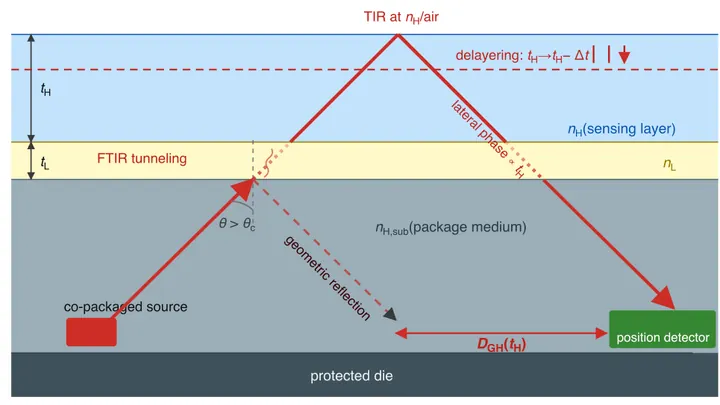
A microchip is like a layered cake: protective layers on top, secrets inside. An attacker can peel off layers one by one to get to the secrets. A new sensor monitors this with a light beam.
The beam hits the chip surface at an angle. Part of the light reflects, but not immediately: it slightly 'dives' into the top layer, like a pebble skipping across water.
In a room with a dead corner, sound doesn’t travel. On the wall there’s a smart mirror: it catches the sound and re-reflects it, making the hidden audible. That’s how a reflective surface works in wireless communication. But if the source is right in front of you, the mirror only creates an echo.
In a thin plate of a layered crystal, light can get stuck, like sound in an empty room. At low temperatures, samples of (PEA)₂PbI₄ with thicknesses ranging from tens to hundreds of nanometers almost stop transmitting light at certain wavelengths.
Two ultra-thin sheets, each just one atom thick, are placed on top of each other and slightly rotated. Like two sheets of colored tracing paper: while they lie flat, the picture is one thing, but give them a twist and a moiré pattern appears. Here, though, the pattern isn't visible to the eye, but it completely changes how the material handles light.
A pebble tossed into a pond sends ripples spreading in all directions. Now imagine the pond itself suddenly turning into jelly — instantly, faster than the wave can complete a single crest. Some ripples would keep spreading but change their spacing, while others would unexpectedly turn around and run back toward the point of impact, as if time were flowing backward for them.
Light usually behaves like a pedestrian on a two-way street: the path from a streetlamp to a camera matches the reverse path. But near a rotating black hole with broken spatial symmetry, this street becomes one-way. Swap the light source and observer, and the hole's shadow changes shape: from an oval resembling a rugby ball, it turns into a teardrop.
An ordinary light sensor answers the question "how much light" but not "where did it come from." To do that, you need lenses, mirrors, or entire arrays. In a new study, researchers propose a sensor that determines the direction of a light beam on its own, without any optics.
A gamma-ray burst is a brief but extremely powerful flash of light, born from the merger of neutron stars or the collapse of a massive star. Inside such a flash, plasma flows race at enormous speeds and collide with each other.
A transparent sheet of acrylic with hundreds of laser-burned holes: that's what the test material looks like. When stretched, it loses stiffness almost linearly: the more holes, the easier it bends. But the rate of this softening is surprising: it's noticeably higher than classical formulas for materials with voids predict.
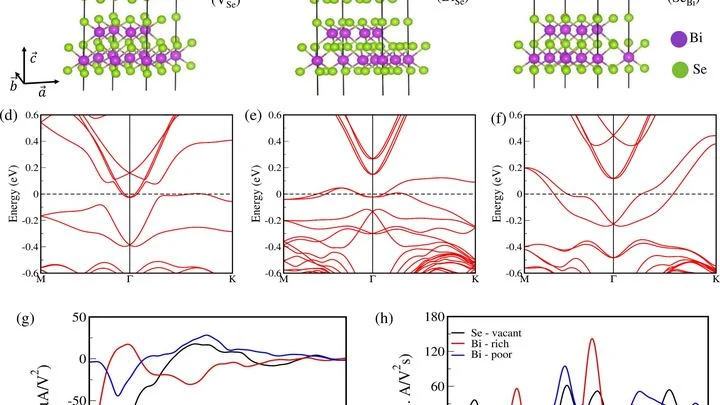
The crystal bismuth selenide (Bi₂Se₃) is symmetric by itself, like a neatly stacked sandwich: flip it over, and nothing changes. But twist one layer slightly relative to the other, and the symmetry breaks. The material begins to 'feel' which side the light comes from and responds with an electric current.
A thin film is like a taut sheet: the thinner it is, the harder it is to push through. Scientists have noticed that films made of very different materials (graphene, graphene oxide, polymers) resist projectile penetration surprisingly well under high-speed impact. And the thinner the film, the more energy it absorbs per unit mass.
An ordinary laser amplifies light into a bright beam. Run the process in reverse, and you get an anti-laser — a device that sucks in light without a trace. But such a machine is finicky: even a slight disorder can ruin the absorption.
Physicists have found a way to make the anti-laser invulnerable.
Light passing through a window pane refracts the same in all directions. But in thin layered crystals, it's a different story: light traveling along the layers sees the material differently than light traveling across them. It's as if a sheet of paper were transparent but transmitted light differently along and across its fibers.
Light traveling through an optical fiber is like a crowd in a narrow corridor: each photon takes its own path, and if the paths get mixed up, you end up with mush at the exit.
Light is a finicky guest. It flies into a cavity but doesn't stay: part of the pulse inevitably reflects and carries away quantum information. Classical single-pass capture schemes hit this limit no matter how much you improve control. Reflection was considered a loss, but the authors of a new study suggest looking at it differently.