How to Cool Light to Quantum Order express
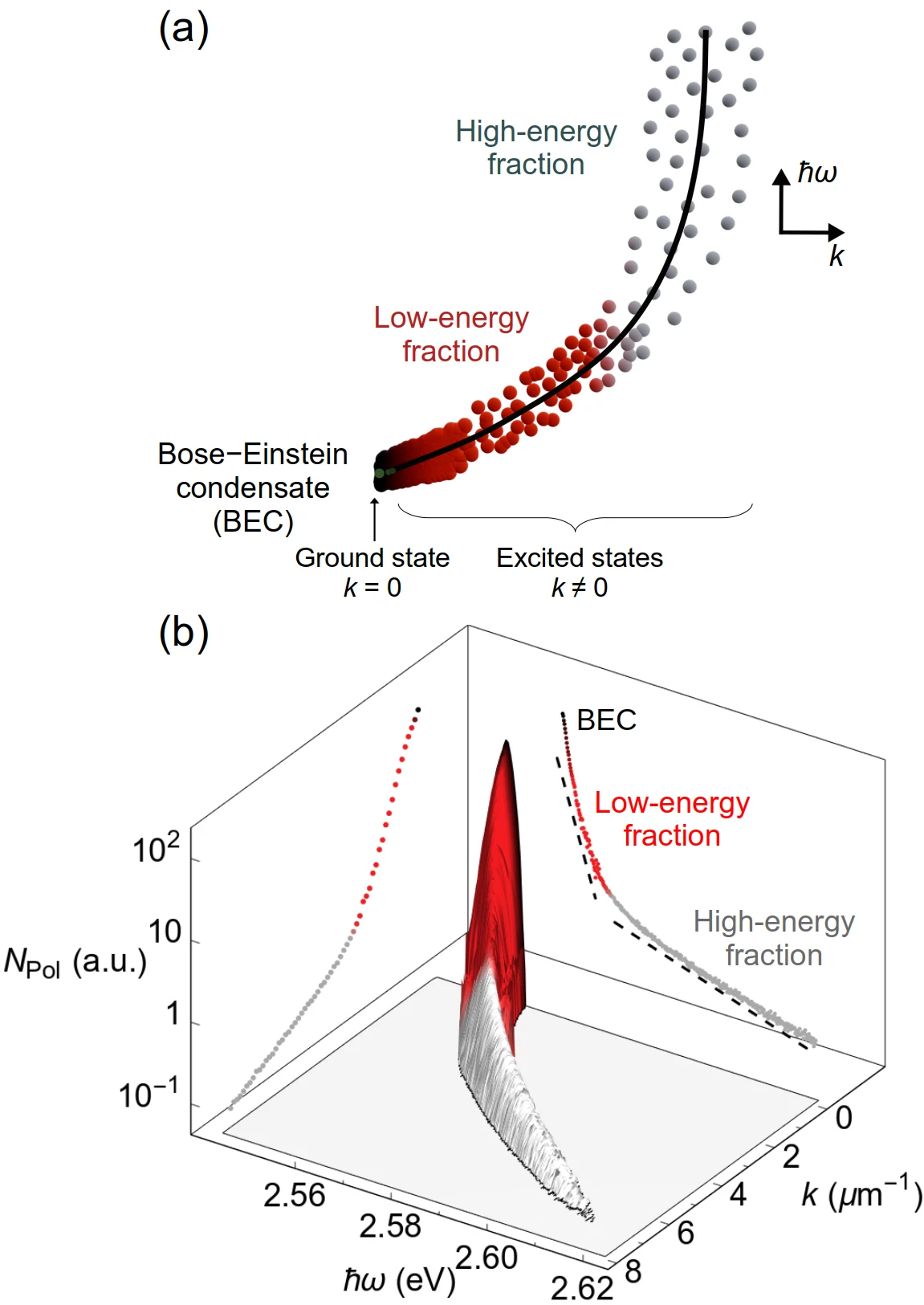
Cooling usually brings order: water freezes into ice. But in the quantum world, order takes unexpected forms. Experimenters cooled polaritons — particles that are both light and matter — to near absolute zero. Instead of simple freezing, the cloud began to 'dance,' synchronizing the oscillations of all particles into a single rhythm. But then the dance split: the cloud broke into two 'dance floors' with different tempos, each obeying the laws discovered by Bose and Einstein. Most strikingly, the temperature of these regions turned out to be not a result of heating, but a direct reflection of the number of particles in each clump. The tighter the crowd, the hotter the dance. This unexpected principle is universal for quantum systems far from equilibrium and may find application in future devices operating at the edge of quantum effects.
Original abstract
as written by the authors arXiv:2601.15080
We report on the experimental observation of stimulated cooling in the non-equilibrium Bose-Einstein condensate (BEC) of weakly interacting exciton-polaritons from approximately room temperature down to 20K. By resolving the condensate in energy-momentum space and performing interferometric measurements, we distinguish the condensate from thermalized particles yet occupying excited states macroscopically. In contrast to the analytical quantum theories of non-equilibrium BEC [Shishkov et al., Phys. Rev. Lett. 128, 065301 (2022)], we observe segmentation of the particle density along the excited states into two fractions both following Bose-Einstein distribution, albeit with different effective temperatures and chemical potentials. Our results indicate that the temperature of the weakly interacting Bose gas is universally set by the density-dependent chemical potential, revealing a defining property of non-equilibrium BECs. Finally, we demonstrate that the stimulated nature of the cooling process directly governs the emergence of quantum coherence of the condensate and shapes the dissipative properties of the excited states.
Polaritons are billions of times lighter than atoms, so cooling them takes just moments even at temperatures relatively 'high' for the quantum world.