The Hidden Order in a Crystal express
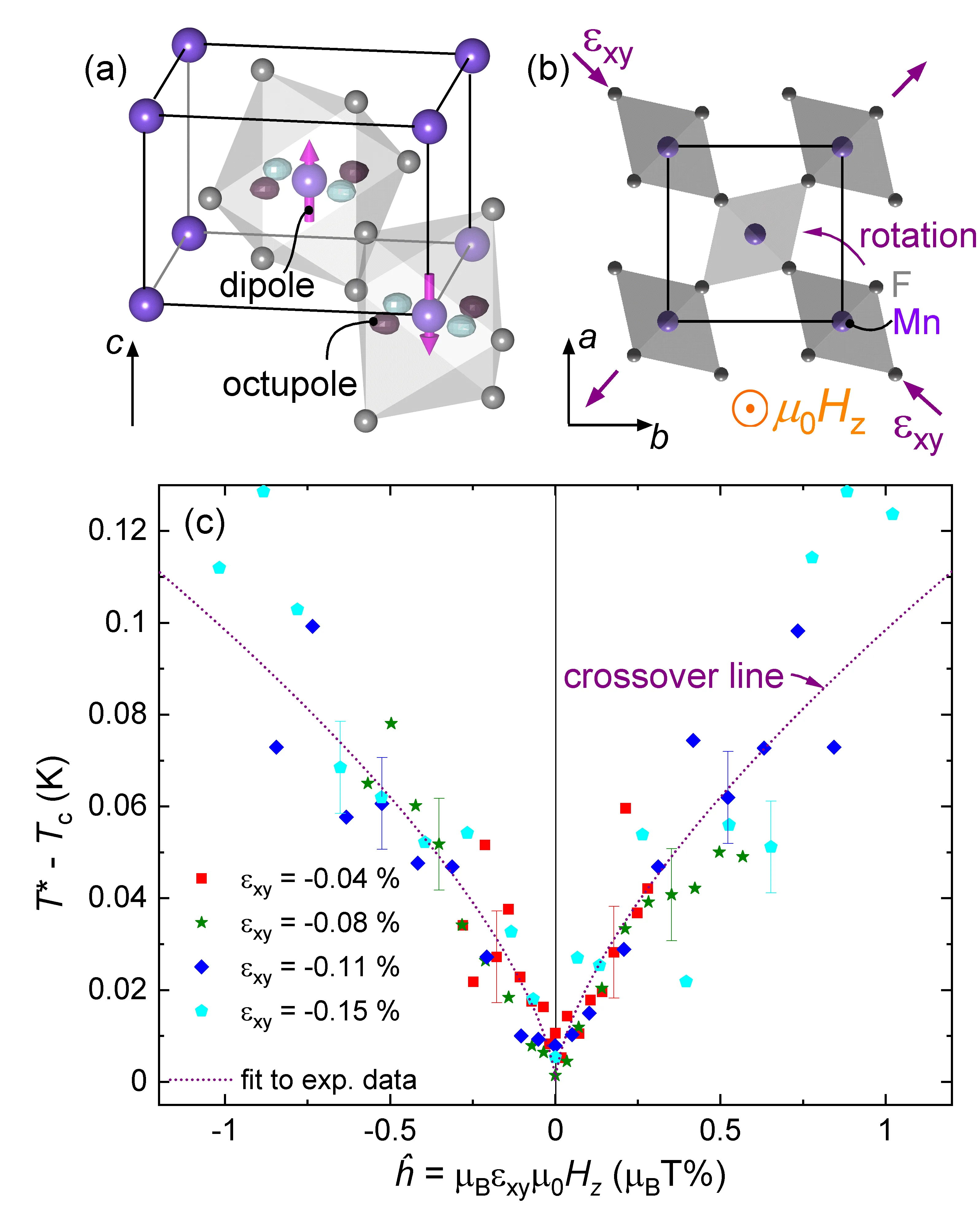
In a manganese fluoride crystal, atoms are lined up like soldiers in formation. But within this formation lies a hidden pattern: the magnetic moments of the atoms point in opposite directions, and the pattern itself changes when the crystal is rotated. This kind of order is called altermagnetic: it does not create net magnetism, but it does affect the material's properties.
Scientists heated and compressed the crystal while tracking how it absorbed heat. They found that at a certain temperature and strain, the crystal abruptly changes its behavior — much like ice melting at zero degrees. Computer calculations confirmed that at this point, the hidden magnetic order disappears.
This method allows similar points to be found in other materials. That means we can study quantum states that were previously beyond measurement.
Original abstract
as written by the authors arXiv:2601.19343
Altermagnets break a combination of time-reversal and rotational symmetries without generating a net magnetization. As such, the order parameter of $$d$$-wave altermagnets has the same symmetry as magnetic multipoles, and couples to the product of a magnetic field and uniaxial strain. We combine elastocaloric experiments, free-energy modeling, and first-principles calculations on MnF$$_2$$ to establish a thermodynamic probe of the predicted finite-temperature altermagnetic critical point. These results pave the way to explore altermagnetic quantum criticality in $$d$$-wave materials and beyond.
Manganese fluoride is a mineral used in optics, but its magnetic properties still surprise physicists.