Heavyweight Stars Change Composition in Pairs express
In stellar nurseries, massive stars are not born alone but in pairs. Two stars orbit a common center, and the more massive one expands first and begins to shed its outer layers. Some of this material doesn't escape into space but flows onto the companion, like water from an overflowing cup into a cup held beneath. As a result, the receiving star becomes enriched with helium that accumulated in the donor's core.
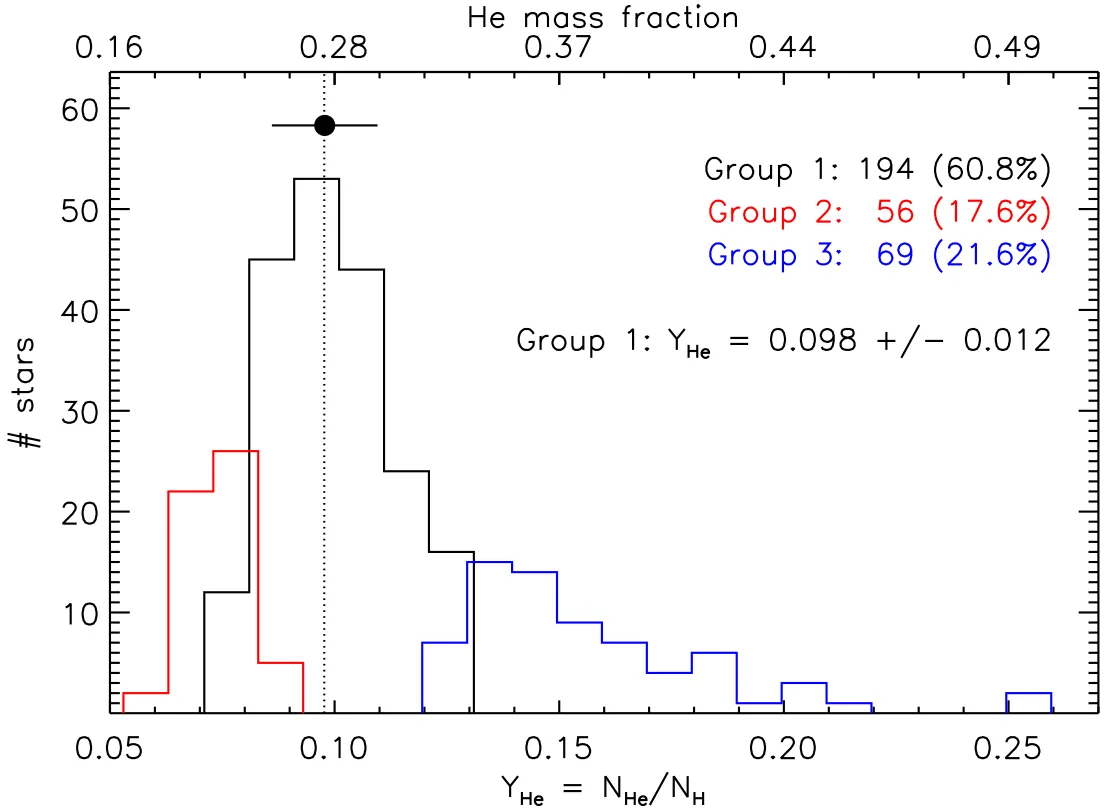
Astronomers from the IACOB project tested this picture on a large sample: 318 massive O-type stars in our Galaxy. In 22% of them, the helium in the atmosphere was significantly higher than the cosmic standard (about 0.098 relative to hydrogen). Moreover, most of these stars show signs of companionship: either a companion is visible nearby, or the star is moving through the Galaxy at an unusually high speed — a trace of past interaction.
This is important for understanding the fate of the hottest and shortest-lived stars. Massive stars explode as supernovae, leaving behind neutron stars or black holes. If a significant fraction of them went through a mass exchange stage, then both the explosions and their remnants will be different. A seemingly single star may be the product of a violent binary history.
Original abstract
as written by the authors arXiv:2601.20698
The presence of massive O-type stars with surfaces enriched by CNO-cycle products has been known since the early 1980s. For many years, internal rotational mixing was assumed to be the dominant mechanism responsible for this chemical contamination. However, accumulating evidence now suggests that binary interaction -- particularly mass-transfer episodes -- may play an equally important, if not dominant, role. We aim to carry out a large-scale investigation of surface helium (He) abundances in Galactic O-type stars, based on the results from the analysis of high-quality spectroscopic data from the IACOB project. We perform a homogeneous spectroscopic analysis of 318 Galactic O-type stars with the IACOB-BROAD and FASTWIND/IACOB-GBAT tools, deriving rotational velocities, atmospheric parameters, and He abundances. We also account for the influence of binarity, runaway status, and parameter degeneracies (e.g., microturbulence, wind properties, diagnostic lines, and companion contamination) on the abundance determinations. We present homogeneously determined surface He abundances (YHe=N(He)/N(H)) for the so far largest, statistically significant sample of Galactic O-type stars. About 78% of the stars show He abundances consistent with the previously proposed cosmic abundance standard of YHe=0.098$$\pm$$0.002. The remaining 22% display clear He enrichment (YHe>0.13). We also provide observational evidence indicating that most of these He-enriched stars are likely the products of binary interaction. Our study highlights how large spectroscopic surveys are gradually opening robust observational avenues to identify the products of massive binary interaction. It also emphasizes the need for caution when interpreting the spectroscopic properties of apparently single O-type stars. A significant fraction may in fact be the outcome of binary evolution rather than isolated stellar birth.
In 22% of massive stars, helium makes up more than 13% of atoms in the atmosphere, like having one and a half spoons of sugar in a glass of water instead of one.