In 1954, while pondering the origin of elements, Fred Hoyle realized that the direct fusion of three alpha particles is too unlikely to explain the abundance of carbon. He proposed a bold idea: the carbon-12 nucleus must have a special excited state with an energy of about 7.65 MeV, acting as a 'resonant bridge.' Thanks to this resonance, the reaction probability sharply increases, and carbon is synthesized in the observed quantities. In 1957, nuclear physicists confirmed the existence of this state with remarkable accuracy.
History
Fred Hoyle in 1954, while developing the theory of stellar nucleosynthesis, concluded that a resonant level in ¹²C was necessary for carbon production. He estimated its energy and persuaded experimentalist William Fowler to conduct measurements. In 1957, at the Kellogg Radiation Laboratory of the California Institute of Technology, such a level was discovered almost exactly at the predicted point, becoming a triumph of theoretical astrophysics and forming the basis of the famous B²FH paper (Burbidge, Burbidge, Fowler, Hoyle) on element synthesis in stars.
How it works
The Hoyle process dominates the helium burning phase of stars with masses greater than 0.5 M☉. It determines the luminosity of red giants and also participates in thermonuclear explosions on accreting white dwarfs. Conditions of applicability: temperatures (1–3)×10⁸ K, densities >10⁵ g/cm³; at lower densities, triple collisions are too rare. At higher temperatures, carbon burning sets in, and at extremely low temperatures, helium degeneracy can lead to explosive burning.
In practice
The Hoyle process is the main source of carbon in the Universe; without it, there would be no carbon-based chemistry of life, nor rocky planets.
Fun fact
The energy of the Hoyle resonance is 'tuned' so finely that if it were shifted by just half a percent, carbon would become extremely rare, and carbon-based life likely would not arise. This fact is often cited as an example of fine-tuning of the Universe.
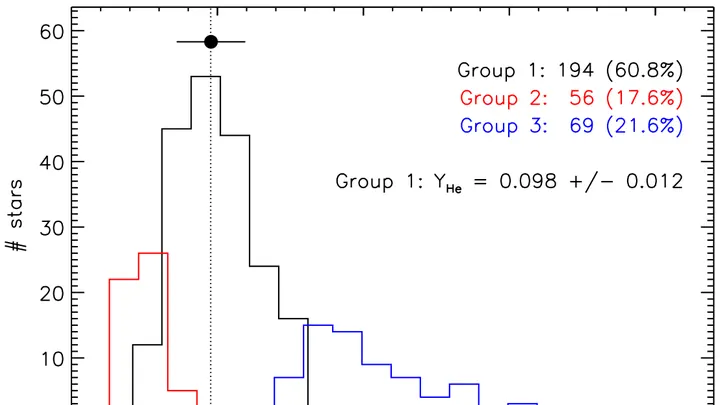
Two spinning tops whirl so close they nearly touch. One is scorching blue, the other dim white. Together they complete a full orbit in twenty hours. This is the pair Feige 64: a blue star with a mass of just a third of the Sun's, and a white dwarf, the cooled core of a former star, one and a half times heavier than our Sun.
The blue star seems too hot for its mass.
In a dense molecular cloud, at the edge of glowing gas, an invisible assembly line is at work. It takes simple scraps — single atoms and light pairs — and glues them together step by step into long carbon chains and rings. The first piece of this assembly line has long eluded our eyes. Now it has been found.
The lifetime of the entangled triplet pair in the protein is about 60 picoseconds, which is eight times longer than in solution.
Sunlight is like a continuous stream of balls flying at a wall.
In dark interstellar clouds where new stars are born, chemistry starts with a tiny particle — the trihydrogen ion (H₃⁺). It collides with other atoms and sets off a cascade of reactions that build ever more complex molecules. For a long time, it was thought that the main reaction producing it, H₂⁺ colliding with H₂, only happens in the gas phase.
Three milliseconds before the merger. A gargantuan black hole spinning at breakneck speed drags in a neutron star — a ball the size of a city but with 1.5 times the Sun's mass. Tidal forces stretch the star into a thread as thin as a needle and fling its matter outward.
Erwin Schrödinger pondered how life maintains order despite the second law of thermodynamics. He could never have imagined that part of the answer lies hidden in the instability of giant stars.
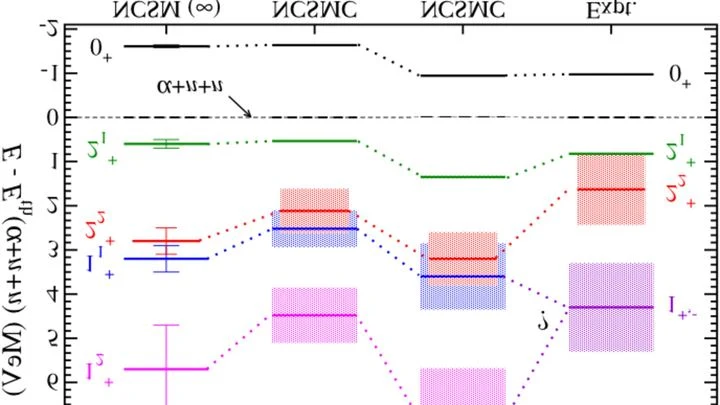
The carbon nucleus was long imagined as a uniform ball of protons and neutrons, evenly mixed like dough. But physicist George Gamow suspected otherwise: particles inside might group into tiny, sturdy blocks — helium nuclei, or alpha particles.
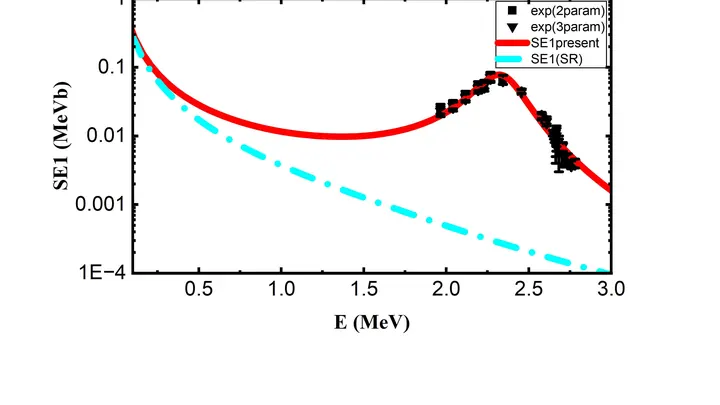
In the scorching core of a star, two helium nuclei approach each other like two dancers on a crowded stage. Their dance is alpha scattering, the basis of stellar helium burning. How smoothly they twirl determines how quickly the star burns its fuel.
Previously, this dance was described in simplified terms.
In the boundless night of space, galaxies come together in a slow gravitational dance, merging into one. Such collisions are not head-on impacts but rather like fingers moving slowly through water, leaving swirls and tails behind.
Two guitar strings are stretched on the same neck. They are almost identical, but one is slightly shorter — and they sound different. That's roughly how the two isomers of ethanimine work: molecules with the same set of atoms but rotated differently in space. Astronomers spotted this molecule in the dense clouds near the center of our Galaxy.
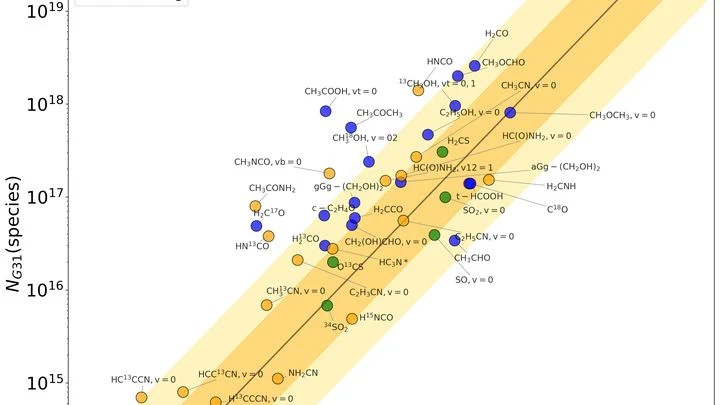
In an oven, a huge loaf of bread is baking. Inside the dough, there is a tiny, hottest spot: that's where the future loaf begins to rise. A hot molecular core (a region the size of the Solar System, where gas is heated to hundreds of degrees and compressed to billions of times the density of ordinary clouds) works in much the same way.
Elliptical galaxies are quiet stellar metropolises in retirement. By all rights, their light should be calm, reddish, like a sunset. But their spectra scream otherwise: in the far ultraviolet, these old-timers blaze like holiday lights. For three decades, astronomers have puzzled over this 'ultraviolet upturn' (UV upturn).
A steel cylinder that has held hydrogen for a long time sometimes breaks not along the usual grain boundaries but right through the crystal grains, leaving a strange pattern, as if the crack chose the wrong road. For a long time, people looked at this and wondered: why?
A match flares from both ends. First the head ignites, and a moment later the flame engulfs the wooden stick. Something similar may happen in some Type Ia supernovae — except the match is a white dwarf (a star the size of Earth), and the flame is a thermonuclear explosion.
Gravitational waves — ripples in spacetime predicted by Einstein — have exposed an abyss: black holes with masses between 60 and 120 solar masses are almost never born.
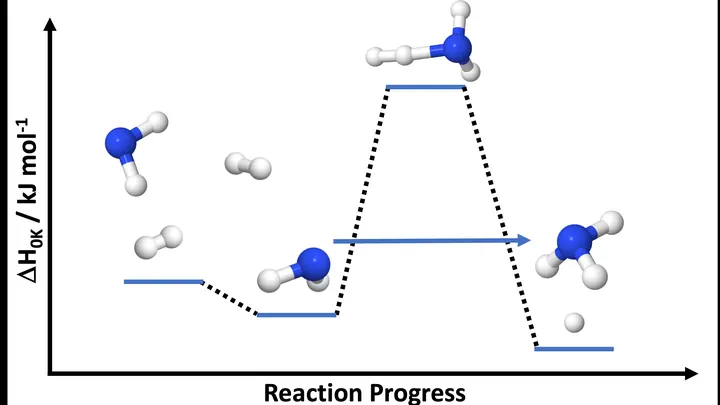
A ball rolls up a hill, but it doesn't have enough energy, so it rolls back down. That's classical mechanics for you. But in the quantum world, a tiny particle can sometimes pass right through the hill, as if the barrier weren't there. This trick, tunneling, is business as usual for a light atom like hydrogen.
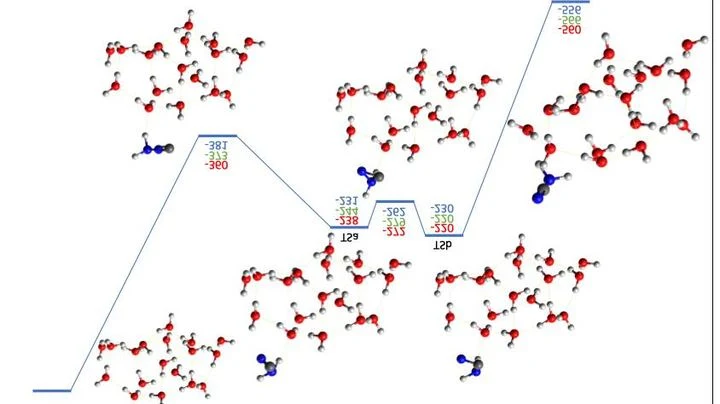
In cold clouds between the stars, dust grains are coated with ice, like windows covered with frost in winter. On this icy crust, chemical reactions take place that do not occur in gas. One such reaction is the encounter between a carbon atom and a nitrogen molecule.
An ordinary atomic nucleus is like a tight ball: protons and neutrons are packed closely together. But some light nuclei, such as helium-6, are different. Two neutrons seem to step aside and form a dilute cloud around the nucleus — called a halo.
Inside the Sun, invisible nuclear transformations occur every second. One of them is the birth of boron-8: a beryllium-7 nucleus captures a passing proton and momentarily becomes a new element. This step kicks off a chain that ends with the emission of a neutrino — a particle capable of passing straight through Earth.
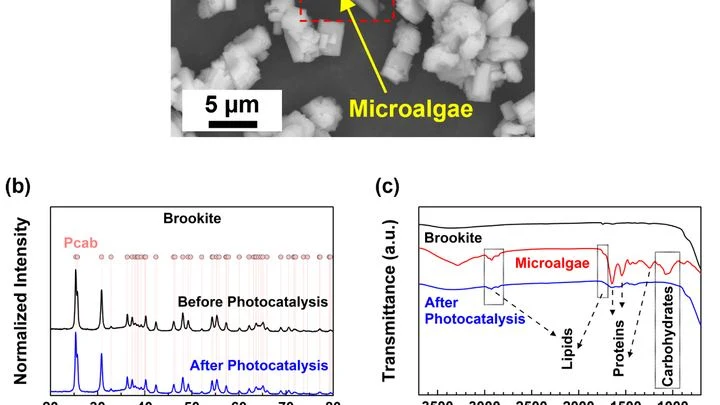
Conventional solar panels convert light into electricity, but here light splits water into hydrogen and oxygen. Hydrogen is a clean fuel, but the process is slow. To speed it up, helper substances that donate electrons are added. Often this is alcohol, but it's a shame to waste it.
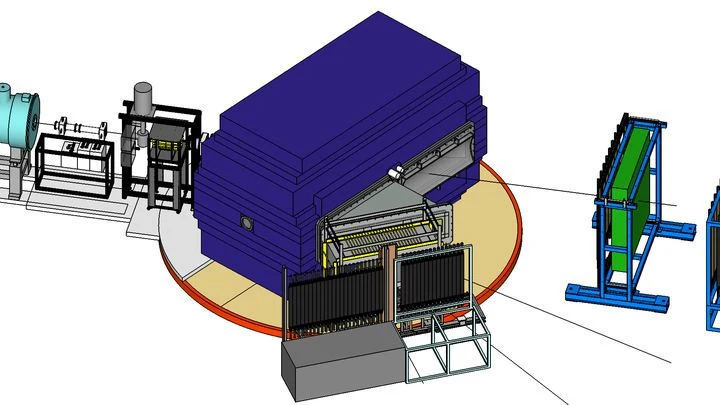
A high-speed collision knocked a neutron out of a helium-8 nucleus, and for an instant a helium-7 nucleus appeared, like an overloaded shelf shedding three books at once. This fleeting 'sound' of decay was captured for the first time: three neutrons flew apart, leaving behind an ordinary helium-4 nucleus.
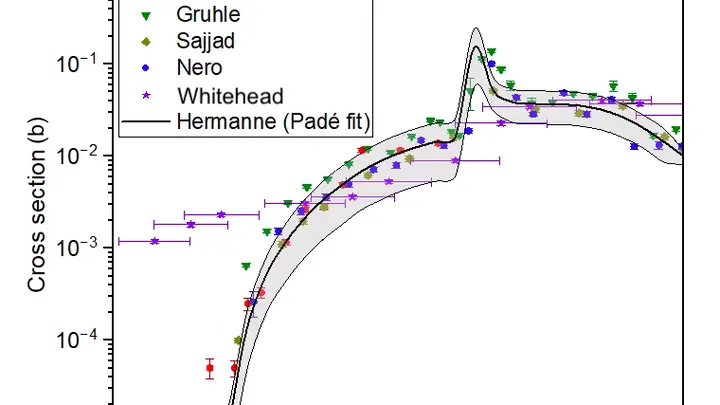
Deep inside a dying star, just before it goes supernova, nuclear reactions determine which chemical elements will be scattered across the cosmos. One such reaction is the collision of an oxygen nucleus with a proton, producing a nitrogen nucleus and an alpha particle (a helium nucleus).
Deep inside a massive star, two carbon nuclei collide and merge into a single magnesium nucleus. This process determines how quickly the star burns its fuel and which chemical elements it manages to create. But calculating such a fusion on paper has proven incredibly difficult: nuclei are not billiard balls but quantum systems that can rearrange themselves in many ways.
When a star like the Sun runs out of hydrogen, it swells into a red giant, and helium piles up in its core. At some point, the helium ignites — in a few seconds, it releases as much energy as the star had radiated over thousands of years. This is a helium flash.
In 1994, astronomers watched as the star V4332 in the constellation Sagittarius suddenly flared up, becoming thousands of times brighter. It hasn't settled down since: its brightness has changed several more times. These outbursts sit between ordinary novae and supernova explosions, and their cause has long been a puzzle.
In a cloud where massive stars are being born, there is a hot, dense core. Like a crowded kitchen where the heat of the stove makes smells evaporate, here the warmth from young stars evaporates molecules from the surface of cosmic dust grains.
In stellar nurseries, massive stars are not born alone but in pairs. Two stars orbit a common center, and the more massive one expands first and begins to shed its outer layers. Some of this material doesn't escape into space but flows onto the companion, like water from an overflowing cup into a cup held beneath.
In the stellar nursery HOPS-288, where three suns are forming, the ALMA telescope revealed two scorching regions around a pair of them. At –170°C, ice on cosmic dust melts, and reactions bubble up in the gas: organic molecules are born — methanol and methyl formate.
A cosmic dust grain is covered in ice, and on this ice, like in a tiny kitchen, molecules are cooked. One of them is methanol, an alcohol that serves as a building block for more complex compounds in space. Previously, it was thought that methanol only forms when hydrogen atoms stick one by one to a carbon monoxide molecule.
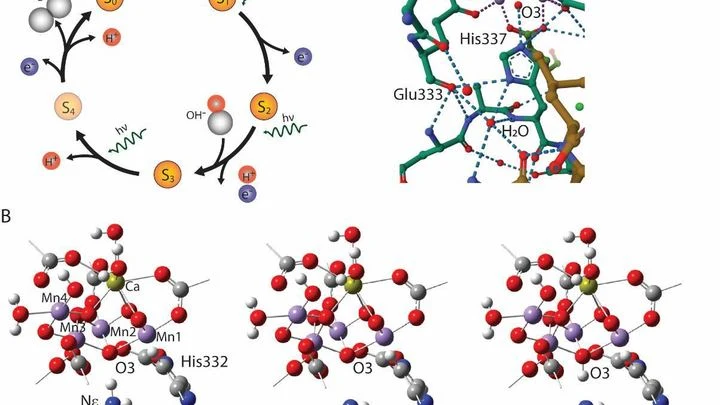
In every leaf, in the light, a factory works that splits water into oxygen and hydrogen. The oxygen goes into the air we breathe, and the plant uses the hydrogen for food. The heart of this factory is a protein complex with four manganese atoms and one calcium atom.