Magnetic Texture Controls Superconductivity in a Nanowire express
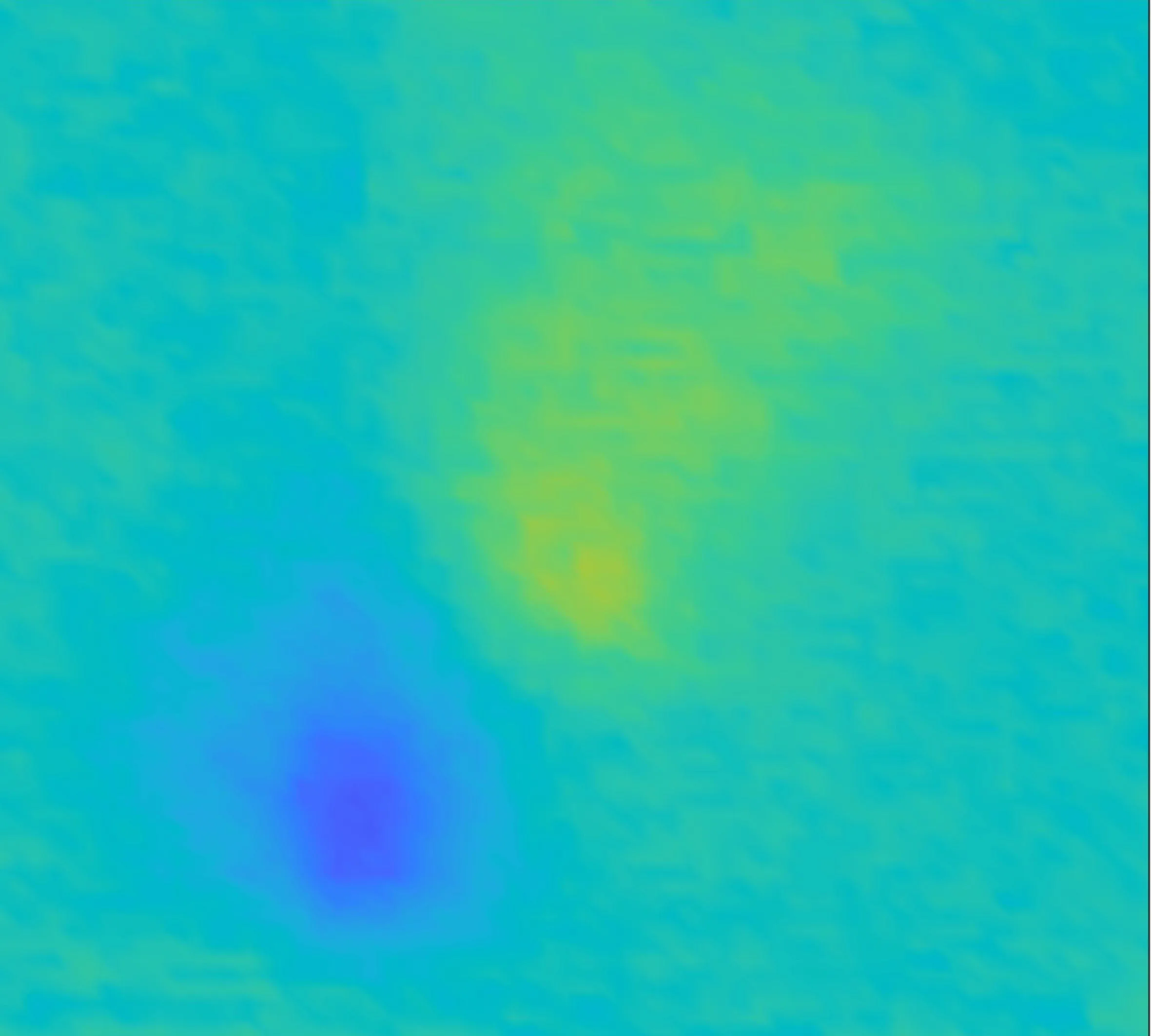
A nanowire is like a tiny cable: inside is a magnetic core, outside is an aluminum shell that can conduct current without resistance. But they don't get along easily: a strong magnetic field destroys superconductivity, like noise drowns out a quiet melody. In this work, a nanowire of indium arsenide was coated with a layer of a magnetic compound of europium and sulfur, and on top with aluminum. Superconductivity in the aluminum survived only where the magnetic field inside the wire nearly vanished — for example, at boundaries between magnetic domains, where the magnetization changes direction and its effects cancel out.
Experiments showed that superconductivity appeared only when the magnetic core was in a multi-domain state — split into many regions with different magnetization orientations. On average along the wire's length, the field was nearly zero, and superconductivity survived. As soon as the core was magnetized into a uniform state, superconductivity disappeared completely.
The maps showed that the magnetic texture was not frozen: a weak external field, less than one thousandth of a tesla, shifted the boundary between domains along the wire at a speed of about 5.5 micrometers per millitesla. The region where the field cancels out and superconductivity could exist would move along with this boundary. It's like a slider: you turn the knob of the external field, and the superconducting zone travels along the wire like a light spot along a string of lights.
Such control of superconductivity by magnetic texture could become the basis for qubits, elements of quantum computers, as well as for superconducting logic and memory. The nanowire becomes a reconfigurable circuit where desired regions are switched on and off with a weak magnetic field.
Original abstract
as written by the authors arXiv:2601.22051
In a one-dimensional ferromagnet-superconductor nanowire, magnetism can suppress superconductivity except where the Zeeman field is suppressed, for example domain wall superconductivity (DWS) near magnetic domain walls or multi-domain-averaged superconductivity (MDAS) in multi-domain states where the net magnetization over the coherence length averages to nearly zero. Here we study full-shell InAs/EuS/Al nanowires using scanning SQUID magnetometry and transport, and find superconductivity in the Al shell only when the EuS is in a multi-domain state, consistent with both DWS and MDAS, and absent in the saturated single-domain state. Scanning SQUID magnetometry further shows that the EuS magnetic texture is position dependent and reconfigurable by small changes in external magnetic field, including moving a well-defined domain wall at $$\approx$$5.5 $$\mu$$m/mT with sub-mT fields, implying that any associated localized superconducting region would likewise be movable. Such magnetic texture controlled superconductivity along a nanowire may be useful for topological qubits, Andreev spin qubits, superconducting logic, and memory devices.
The magnetic domains in the nanowire's core can be moved by a field that is tens of times weaker than the field of an ordinary fridge magnet, and the superconducting region moves along with them.
The idea of superconducting regions reconfigurable by magnetic fields resembles controllable force fields from science fiction, but on the scale of a nanowire.