Light on Demand: How to Tune an On-Chip Photon Source express
If light could be bottled, scientists would have the perfect assembly line: one bottle — exactly one photon, no stray drops. Such single particles of light are needed for quantum computers and secure communication: they carry information that cannot be eavesdropped on unnoticed. But emitting photons one by one, right on schedule, is trickier than it sounds.
Inside a photonic chip, a tiny ring acts like a circular racetrack for light. Two laser beams enter it, collide, and occasionally, very rarely, give birth to a pair of new photons: one is the herald, the other is the worker. The herald immediately flies out and announces, “Ready, take it.” The worker goes off to do its job. The trouble is that usually either there are too few pairs, or the signals often lie.
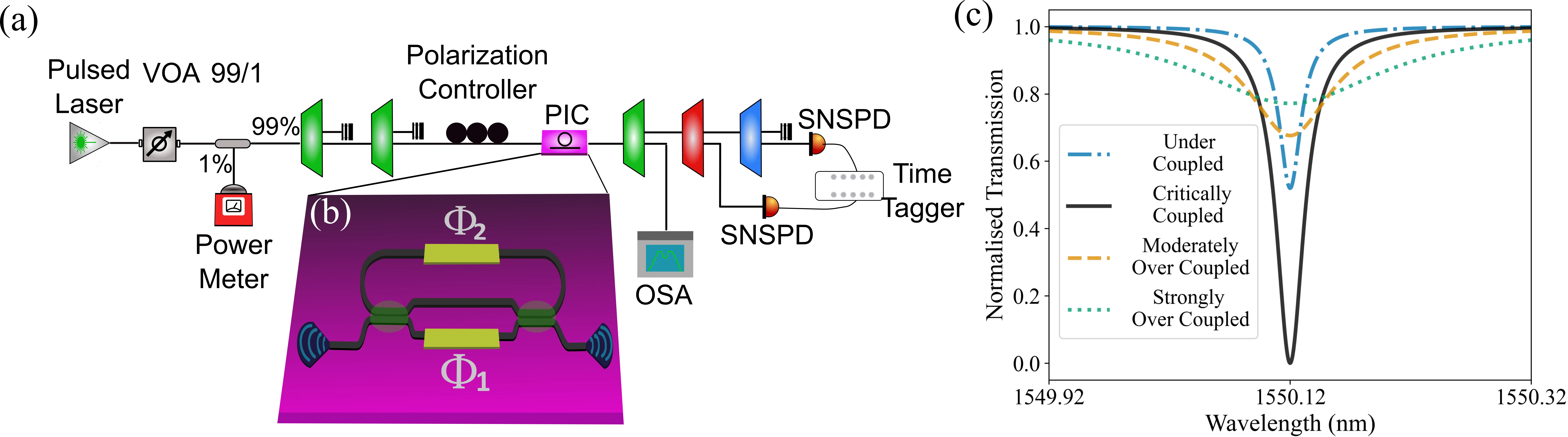
The authors found a sweet spot. They smoothly varied the “turnstile width”—the coupling strength between the ring and the feeding waveguides, and watched how many pairs were born and how accurate the signal was. It turned out that if you let light in a bit more freely than needed for maximum pairs, the pair rate soars above 93,000 per second. And if you open it almost fully, the signal becomes honest in 97.87% of cases. It's like adjusting a faucet so that water flows in a powerful stream but without splashes.
Such a light source is like a well-tuned factory machine: it turns out part after part, almost no defects. In the future, entire quantum computers could be built on such chips, where each photon is like a reliable courier with a secret letter.
Original abstract
as written by the authors arXiv:2602.06790
Efficient and bright single photon sources on photonic chips are key to scaling quantum technologies. Spontaneous four wave mixing in micro-ring resonators creates excellent narrowband and tunable photon sources. We experimentally demonstrate the optimization of heralding efficiency and brightness by tuning the coupling of the pump, signal and idler modes into the resonator whilst operating in a pulsed pump regime. We observe a maximum detected pair rate of over 93,000~coincidences per second in a moderately over-coupled regime, alongside a high intrinsic idler heralding efficiency of 97.87$$\pm$$8.97\% when operating close to maximal over-coupling. The measured dependence on coupling strength is in strong agreement with theoretical predictions, experimentally validating the predicted trade-off between brightness and heralding efficiency.
The coincidence counter in the experiment caught more than 93,000 photon pairs per second: that's like 93,000 light bulbs flashing on and off every second, each flash being strictly single.