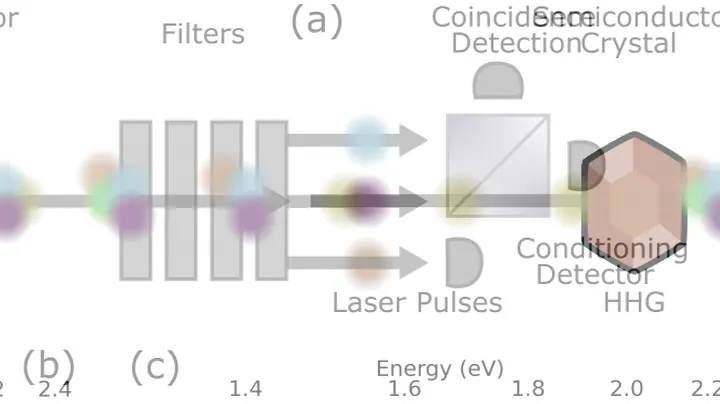
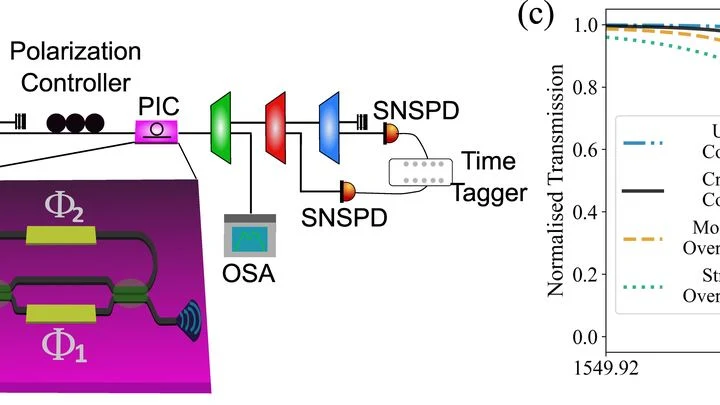
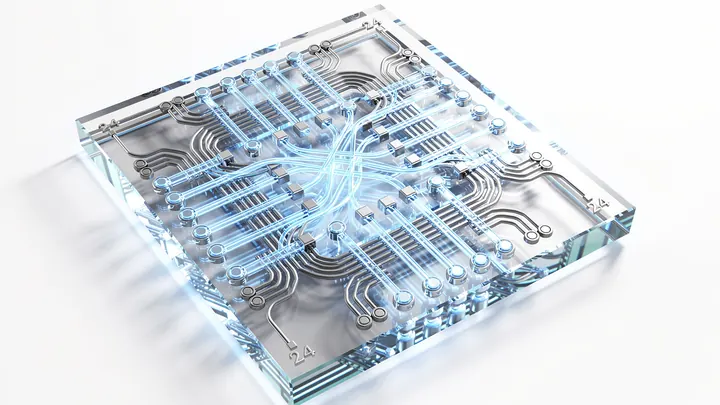
Heralded single-photon generation is a technique to produce individual photons on demand, which is essential for quantum optics, quantum communication, and quantum computing. The 'heralding' means that the generation of a photon is announced by a separate 'trigger' signal, so the user knows exactly when a photon is available. This is typically achieved using spontaneous parametric down-conversion (SPDC) in a nonlinear crystal, where a high-energy photon splits into two lower-energy photons, or four-wave mixing in an optical fiber.
History
The concept of using SPDC for heralded photon generation was demonstrated in the 1980s, following the theoretical prediction of the process in the 1970s. The technique has been refined with the development of efficient single-photon detectors and integrated photonic circuits.
How it works
In SPDC, a pump photon is converted into a pair of photons, usually called signal and idler. The signal photon is sent to the user, while the idler photon is detected by a single-photon detector. The detection of the idler 'heralds' the existence of the signal photon. Because the pair is created simultaneously, the detection of one implies the other is present. The signal photon is then used in an experiment, but only when the herald is detected, ensuring that the photon is present. The process is probabilistic, but the heralding makes it deterministic in practice.
In practice
It is used in quantum key distribution (QKD) for secure communication, in linear optical quantum computing, and in fundamental tests of quantum mechanics, such as Bell inequality violations.
Fun fact
The photons produced in SPDC are entangled in their polarization, which is a key resource for many quantum information protocols, and the process is so efficient that it is used in commercial quantum random number generators.
A courtroom interpreter must relay every word without being distracted by noise in the room. In the quantum world, a superconducting resonator plays that role, losing photons on schedule without straying into spurious effects.
Under an electron microscope, a protein looks like a series of blurry shadows — hundreds of thousands of images of the same molecule, but from different angles and with heavy noise. Previously, from these shadows, one first assembled a volumetric 'haze'—a map of how electric charge is distributed inside the protein.
Catching light one particle at a time is like hearing a whisper in a roaring factory. An electron-multiplying camera (EMCCD) can do exactly that: it turns a single photon hitting a pixel into an avalanche of electrons that can be measured. These cameras are mounted on telescopes to spot a barely visible planet next to a dazzling star.
In a tight row of atoms, spaced closer than the wavelength of light, a remarkable state hides. The excitation is distributed among all particles so that their radiation cancels itself out. This quantum 'silence' is an ideal vault for a photon: it can be stored there hundreds of times longer than usual.
A thin film of molybdenum disulfide, less than a micron thick, acts as a miniature photon-pair factory built right into a fiber-optic connector.
Ordinary optical fiber is not just a glass thread for the internet.
In the Standard Model, our most complete description of the subatomic world, electric charge is always a multiple of the electron's charge: nature works in whole units, like a builder using bricks of a strictly defined size. Yet the equations allow for particles with double charge — bileptons.
A laser hits a target of thin wires, and within tens of femtoseconds (billionths of a billionth of a second) knocks out a stream of protons. These protons fly into a converter made of lithium and deuterium, where neutrons are born.
Diamond is the hardest natural material and usually does not conduct electricity. But if you add a few foreign atoms to its crystal lattice, it can become a semiconductor, like silicon in computer chips.
Light from a bulb or even a regular laser resembles a crowd at a subway exit: people move haphazardly, sometimes dense, sometimes sparse. Physicists call this behavior shot noise — random fluctuations in the number of particles arriving per second.
A light bulb that shines not in a steady stream but in individual drops — photons. Such 'droplet' sources are called single-photon emitters. They are needed for quantum communication, where each photon carries a bit of information, and for ultra-precise measurements.
In a giant particle accelerator, particles smash into each other, and sometimes after the collision only two photons, particles of light, remain. Physicists can predict how often this happens, but their calculations have long disagreed with what detectors see. Each refinement of the theory changed the answer, and there was no consensus.
Light from distant stars travels for millions of years, but X-rays can't be caught with ordinary glass: they pass right through it like a bullet through paper. That's why X-ray telescopes need special lenses: stacks of tiny prisms that gently deflect the rays and focus them to a single point.
In the binary system Cygnus X-3, right here in our Galaxy, a black hole and a giant star whirl so tightly together that the star loses matter: it's swept away by a powerful wind. Jets blast out from near the black hole; recently, a telescope caught photons from them, each carrying the energy of a flying mosquito.
Light in an optical fiber is a stream of photons, and quantum communication requires single photons that can be sent one at a time. But making them emerge quickly while remaining indistinguishable from one another is a tough challenge.
Ordinary light is like a crowd in a square: each photon moves on its own, bumping into others and scattering. But in some media, photons start running together like a pack of dogs: they bunch up. Scientists have built a random fiber laser where light particles gather into especially dense clusters.
An ordinary lamp scatters light in all directions, and it is impossible to predict when the next photon will fly out. Quantum technologies, however, need a completely different kind of light — single photons that appear strictly one at a time, like letters slipping through a mail slot.
Light hits a thin film, and an electric current instantly appears in it. This is how a pair of two materials works: molybdenum disulfide and cobalt. The first is a semiconductor, the second is a magnet. Between them, as it turns out, an invisible intermediary layer is born.
A powerful laser strikes a semiconductor, and it responds with light at many frequencies, like a string sounding a chorus of overtones. Previously, this was used in spectroscopy to observe ultrafast processes. But now physicists have noticed: the overtones are not independent; they behave as if connected by invisible threads.
A quantum dot the size of a few thousand atoms blinks like a faulty light bulb. It flashes brightly, then almost goes dark. Previously, it was thought that in dark moments it emits not only single photons but also extra pairs — a defect for quantum communication.
If light could be bottled, scientists would have the perfect assembly line: one bottle — exactly one photon, no stray drops. Such single particles of light are needed for quantum computers and secure communication: they carry information that cannot be eavesdropped on unnoticed.
A light beam passing through a piece of glass usually just bends slightly. But if you engrave ultra-fine patterns inside the glass with a laser, you can make the light split into separate beams, much like white light fans out into a rainbow after rain.
A laser pulse enters a tiny cavity made of a transparent crystal. Inside, light bounces between mirrors, and occasionally one photon splits into a pair: one goes one way, the other goes another. One becomes the signal, and the other acts as a 'bell' announcing that a single photon is ready.
An ultrathin sheet of semiconductor is like the film of a soap bubble, but made of tungsten and selenium atoms. If you poke it with a sharp diamond needle, tiny defects appear at that spot. At low temperatures, these defects start to glow, but not in a continuous stream, rather strictly one photon at a time.
A typical 3D printer squeezes out plastic like a pastry chef piping cream from a bag. Here, instead of plastic, it's light. A laser beam draws in liquid resin, making it solidify at precise points. This creates parts too small to see without a microscope.
Until now, such printers were slow: the beam crawled across the surface like a pen on paper.
Quantum communication via satellite is like a roll call between two distant lighthouses: the beam must hit the detector exactly, or the message can't be read. But in space, everything shakes — sunlight heats the hull, thrusters cause vibrations, and delicate optics drift off-axis.
A flashlight beam in fog draws a cone, but it can't carve a figure out of a cloud. A hologram, though, is like a stencil for light: it knows in advance where to gather into bright points and where to remain shadow. Now such a stencil makes liquid resin solidify throughout the entire volume at once, without layer-by-layer printing.
A tiny speck of silver is born in a laser beam and immediately starts to grow — faster than you can blink. An ordinary microscope can't keep up with that speed, so until now no one had seen exactly how a nanoparticle appears and gains size. Now scientists have a tool that captures this 'movie' frame by frame.
Light from an ordinary lamp is chaos: photons scatter in all directions with no order. But if you make many atoms emit light simultaneously and in sync, you get a short, powerful flash, like applause that turns individual claps into a single burst. Such coordinated emission is called superradiance.
As light passes through a patterned plate, it folds inside a transparent liquid into a three-dimensional pattern. Where the light is brighter, the resin hardens. After 7.5 seconds, a finished part is lifted out of the liquid — complete with cavities, channels, and tiny protrusions.
A regular 3D printer prints point by point or layer by layer.
A drop of ink falls into a glass of water, and instead of a flat stain, a ring is born that immediately starts to spin. That's roughly what the birth of a skyrmion looks like: light emitted by a tiny source twists into a stable vortex. Until now, such vortices could only be produced by large lasers.
An ordinary laser emits photons one by one, like a faucet dripping water. But what if you need several particles of light born at the same instant? Physicists have made a cloud of cold rubidium atoms emit quadruples of photons — as if the faucet suddenly released four drops at once, each falling into its own test tube.
Creating light with an exact number of photons is like stamping exactly 100,000 flawless coins. Until now, physicists could only control dozens of particles. The 'optical lathe' technology breaks this barrier: virtual lenses, like milling cutters, eliminate 'blurriness' and ensure each bunch contains exactly the specified number of photons. Counting becomes perfect.
The idea of quantum teleportation was proposed by Charles Bennett and realized by Anton Zeilinger. It uses entanglement — when two particles are in sync, like two sheets of paper that instantly copy the same drawing. But earlier, the "ink" would blur, ruining the blueprint.
Regular quantum communication is like a postal service that sends letters strictly one at a time. If the route is long, you have to wait an indecently long time for a reply. Physicists sped up the process by dispatching ten 'postal trucks' — light pulses — into a single optical fiber, but in different time windows.
The laser clicks ten million times per second, and each click kicks exactly one photon out of a polystyrene film. Not a beam, not a burst, just a single particle of light, neatly packaged in space and time. The source is a molecule you can order from a chemical supply catalog: C60 fullerene, sixty carbon atoms folded into a soccer ball.